






























AMD Unveils Helios AI Rack System to Challenge Nvidia
AMD has introduced its Helios AI rack-scale system, targeting Nvidia’s dominance in AI infrastructure with support from major customers including Microsoft, OpenAI and Anthropic.
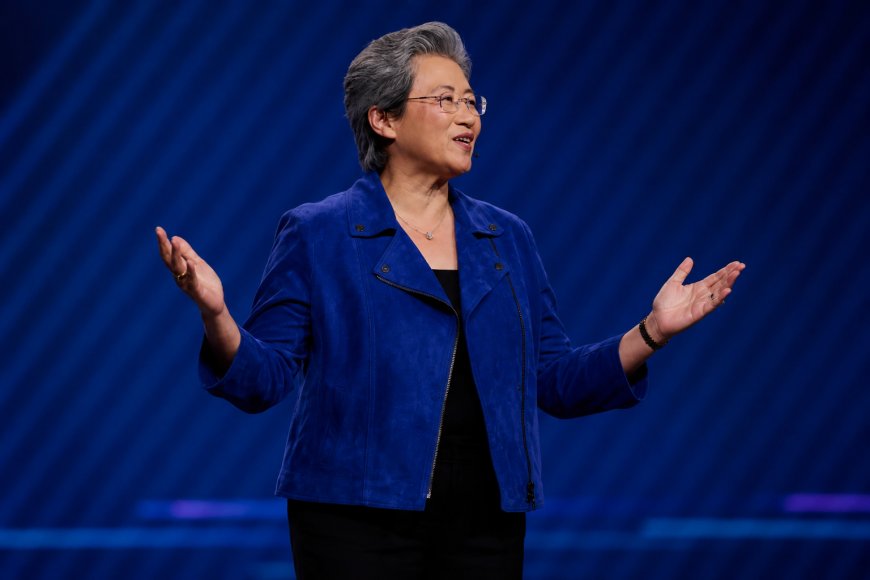
AMD has introduced a new rack-scale AI system designed to challenge Nvidia’s dominance in the market for large-scale artificial intelligence infrastructure. At its sold-out Advancing AI conference in San Francisco on Thursday, AMD Chair and CEO Dr Lisa Su unveiled the Helios AI rack system. The company highlighted a growing list of customers, including Microsoft, as it prepares to begin shipments later this year.
Alongside Helios, AMD also introduced new chips intended to support the rapidly increasing computing demands of AI developers, positioning the company as a stronger competitor in the race to supply hardware for the world’s largest AI laboratories.
Rack-scale systems combine multiple processors into a single high-performance unit that powers AI training, inference and other compute-intensive workloads inside data centres.
Su described Helios as the technology industry’s “highest-performance AI rack,” saying it was designed to train and run the world’s most demanding frontier AI models at massive scale. According to AMD, the system is intended for deployment by leading AI companies operating gigawatt-scale infrastructure.
Nvidia has long dominated this segment with its Vera Rubin and Grace Blackwell rack-scale platforms. Still, AMD is aiming to capture a larger share of the expanding AI infrastructure market. According to The Register, Helios outperforms Nvidia’s Vera Rubin system across several performance benchmarks, giving AMD a stronger competitive position.
Although Helios was first revealed in 2025 and demonstrated at CES 2026 earlier this year, AMD said several major technology companies are already planning deployments. Customers include OpenAI, Microsoft, Meta, Oracle and Anthropic.
Earlier this week, Microsoft CEO Satya Nadella announced that Azure will expand its AI infrastructure using Helios systems. AMD also revealed a strategic partnership with Anthropic to deploy up to two gigawatts of GPUs through the new platform.
In addition to Helios, AMD unveiled the Venice-X CPU, a processor designed for high-performance data centre workloads. The company expects the chip to launch in 2027.
AI demand expected to reshape the chip industry.
During her keynote, Su said artificial intelligence is driving an unprecedented increase in computing demand, particularly as AI agents become more capable of reasoning through complex tasks. She explained that modern AI agents often perform dozens of steps, call multiple tools, access different data sources and repeatedly process information before completing a request, significantly increasing the need for GPU computing power.
AMD expects that trend to continue accelerating over the remainder of the decade. Su projected that the global AI accelerator market will reach approximately $1.4 trillion by 2030, making it nearly as large astoday’ss entire semiconductor industry.
She added that GPUs are expected to account for the majority of that market because AI algorithms continue to evolve rapidly, requiring highly programmable silicon capable of adapting to changing workloads.
What's Your Reaction?
 Like
0
Like
0
 Dislike
0
Dislike
0
 Love
0
Love
0
 Funny
0
Funny
0
 Angry
0
Angry
0
 Sad
0
Sad
0
 Wow
0
Wow
0