





























LG Shows Off CLOid Home Robot at CES, but Questions Remain
LG’s CLOid AI-powered home robot aims to automate chores, but its CES debut highlights how far the technology still has to go.
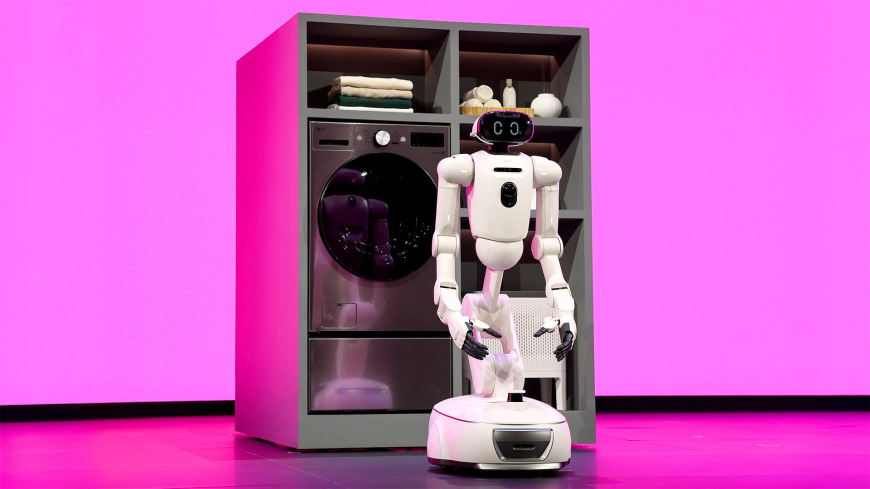
CES is never short on robots, and this year, LG introduced a new one that it says could transform life at home. The robot, called CLOid, is being pitched as an AI-powered household assistant designed to handle everyday chores — potentially so humans don’t have to.
According to LG, CLOid is intended to assist with a wide range of domestic tasks, including folding laundry, preparing meals, and monitoring a home for potential issues. Over time, the company envisions the robot evolving into an “ambient-care agent” that seamlessly supports daily life.
LG officially unveiled CLOid during its CES keynote, but the robot was also showcased on the convention floor through rotating live demonstrations. During one such presentation, CLOid appeared alongside a human host and performed a series of chore-related tasks for an attentive crowd.
The robot can move autonomously and is equipped with multiple cameras and sensors. LG says CLOid works with its ThinQ smart home ecosystem, using environmental and situational data to offer proactive suggestions that improve the user’s day-to-day experience.
CLOid can also communicate verbally through built-in speakers. LG says the robot relies on a vision-language model that translates images and video into structured, language-based understanding, paired with a vision-language-action system that converts spoken instructions into physical actions.
Domestic robots are not new. Products such as Amazon Astro and Enabot EBO X have already entered the market. CLOid appears to aim higher than those earlier efforts. Unlike many existing home robots, which are essentially wheeled platforms, CLOid has a large upper body and two arms — a design clearly meant to allow it to lift objects and interact more directly with its surroundings.
In practice, however, the demonstration was underwhelming. During the presentation, CLOid carefully removed a shirt from a basket and placed it into a dryer. In the next moment, it gently picked up a croissant and put it in the oven. Between these live actions, LG played polished videos showing CLOid operating in idealised, hypothetical household scenarios.
The robot is undeniably charming, but its movements are notably slow. At one point, when asked to prepare breakfast, CLOid rolled over to a refrigerator, waited for the door to open, and then paused for an extended period before selecting a carton of milk. Even a particularly unhurried human would likely complete the same task much faster.
Speed, though, may not be the core issue. LG’s broader concept is the “Zero Labour Home,” an environment where automation handles mundane but necessary chores. At the same time, people focus on other tasks—brushing their teeth, taking a phone call, or getting ready for work—as the robot quietly operates in the background.
What remains unclear is when, or if, this vision will become reality. LG did not provide a timeline for CLOid’s commercial availability. A disclaimer shown during the presentation noted that the products and solutions featured are still under development and not yet released for commercial use, and that specifications may change.
An LG communications representative on-site said CLOid is expected to be available in the future, but could not provide additional details. Follow-up inquiries were sent to LG’s Home Solutions team for clarification.
As with many robots showcased at CES, CLOid currently feels more like a glimpse into LG’s long-term ambitions than a product ready for consumers today. The robot also appears to serve as a flagship concept for LG’s broader AI-powered home ecosystem, which includes a growing lineup of smart appliances that may be easier for consumers to adopt in the near term.
That ecosystem was on display throughout LG’s booth. The company highlighted the return of its ultra-thin LG Wallpaper TV, along with several new appliances, including an AI-enabled oven that recognises ingredients and suggests a recipe, and a conversational AI refrigerator. All of these devices are designed to integrate with CLOid and be controlled through the ThinQ app.
For now, CLOid stands as an intriguing — if still very much in progress — vision of what LG hopes the future of home automation will look like.
What's Your Reaction?
 Like
0
Like
0
 Dislike
0
Dislike
0
 Love
0
Love
0
 Funny
0
Funny
0
 Angry
0
Angry
0
 Sad
0
Sad
0
 Wow
0
Wow
0