
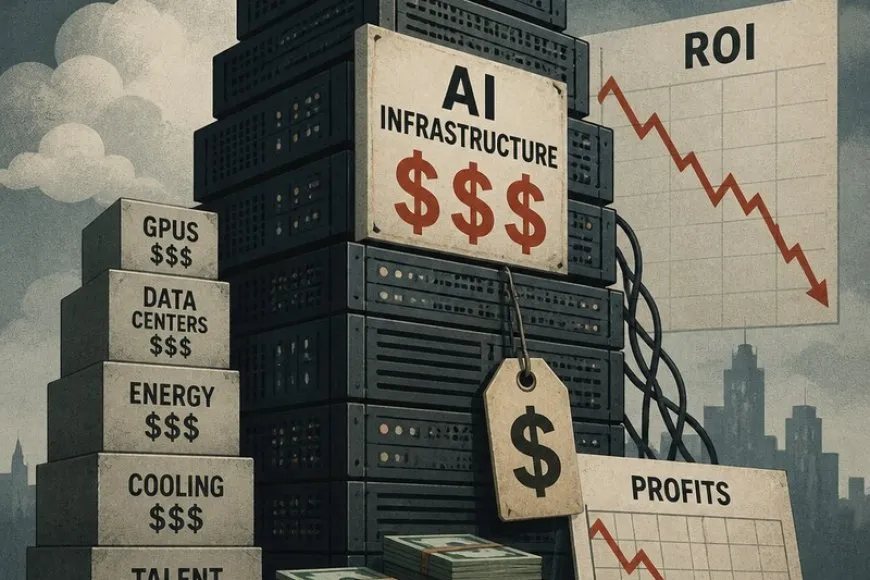
Across the technology sector, businesses are beginning to question the rising cost of artificial intelligence. Uber reportedly exhausted its entire AI coding budget for 2026 by April. Microsoft scaled back developers’ access to Claude Code only months after rolling it out, and a Priceline employee said a routine Cursor contract renewal came back at four to five times the previous cost.
Although the cost per token has declined, growing AI adoption and the rise of increasingly autonomous agents have sharply increased overall consumption. Many organisations that embraced unlimited AI subscriptions in early 2025 are now trying to understand where their spending is going, reduce costs, and determine whether their investments are delivering meaningful returns.
At the same time, a growing ecosystem of startups, established vendors, and industry groups is emerging to help companies track and manage AI expenses.
“Six months ago, customer conversations focused on what AI could do and whether the technology was good enough,” OpenAI Head of Enterprise Alexander Embiricos said during an event in New York this week. “Now the discussion is centred on pending visibility, auditability, token controls, and model efficiency.”
Against this backdrop, the Linux Foundation recently announced plans for the Tokenomics Foundation, a standards initiative aimed at bringing the same financial discipline to AI token spending that FinOps introduced for cloud computing costs.
J.R. Storment, executive director of the FinOps Foundation, said companies began raising alarms earlier this year after discovering they were already several times over their projected annual token budgets.
“We started hearing concerns from organisations that had exceeded their entire 2026 token budgets by April,” Storment said. “The conversation shifted from moving fast and maximising token usage to putting controls and governance in place.”
The pressure has been fueled by demand from executives encouraging teams to adopt the latest AI models. New releases such as Anthropic’s Claude Opus 4.5, OpenAI’s GPT-5.1, and Google’s Gemini 3 Pro have significantly increased the use of agentic tools, driving consumption higher. One company reportedly accumulated a $500 million Claude bill after failing to establish usage limits.
Chris Reed, senior director of IT finance at Priceline, compared the situation to a rapidly escalating dependency, noting that the company has started imposing token limits for certain teams.
Vitaly Gordon, CEO of Faros AI, recalled speaking with a CTO who said one engineer spent $40,000 on AI tokens in a single month, leaving leadership unsure whether to restrict usage or encourage others to follow suit.
Research is also producing mixed conclusions. A two-year Faros study involving 20,000 developers found productivity gains but also increases in software bugs and code rewrites. Engineering management platform Jellyfish similarly found that heavy AI users were roughly twice as productive as lower-usage peers, but consumed about ten times as many tokens.
Nicholas Arcolano, head of research at Jellyfish, said agentic AI features have been a major factor behind rising costs, with per-developer token consumption increasing nearly nineteen-fold in just nine months.
“Whether that level of spending is worthwhile depends on the business value generated by the resulting work, something many companies still struggle to measure,” Arcolano said.
Part of the challenge lies in scale. Storment noted that while cloud cost management already processes hundreds of millions of records each month, token accounting can process trillions of records, requiring entirely new systems for tracking and analysis.
Companies are already finding discrepancies. Reed said Priceline has observed differences between vendor-reported usage and internal measurements, highlighting concerns similar to those seen in earlier telecom and cloud billing environments.
A growing market is attempting to address the issue. Companies such as Pay-i focus on tracking and optimising AI spending, while Paid helps developers measure usage and charge customers based on value rather than fixed subscriptions. Other platforms, including Jellyfish, Waydev, and Faros AI, provide monitoring tools designed to evaluate the return on investment from AI-assisted development.
Larger technology vendors are also expanding their offerings. Ramp has entered the AI spend management space, while Datadog and New Relic have introduced features focused on cloud cost management, token-level observability, and GPU monitoring. AWS is expected to unveil additional financial management capabilities for enterprise AI workloads at the upcoming FinOps X conference.
Industry observers believe efficiency tools will increasingly be integrated directly into AI applications and platforms. Some companies are already deploying model-routing systems that automatically select the most cost-effective AI model for each task.
Still, many of these solutions are being built without common standards for measuring token costs, outputs, or cross-vendor comparisons. The Tokenomics Foundation aims to address that by creating shared definitions, specifications, billing frameworks, and new metrics for evaluating AI economics and efficiency.
“Token economics is more abstract and less transparent than previous technology spending categories,” Salesforce Chief Availability Officer Nishant Gupta said in a statement. “Managing it requires a completely different operational approach.”
The urgency is growing. Goldman Sachs estimates global token usage could increase 24-fold by 2030. While industry groups work on standards and frameworks, many organisations already seek immediate answers to rapidly expanding AI bills.
As Gordon put it, the industry may have built the engine, but it is still figuring out how to operate it efficiently.
For now, Arcolano argues that the strongest returns are likely to come from expanding moderate AI adoption across teams rather than encouraging already heavy users to consume even more.