


































Applied Computing unveils AI platform designed for entire oil and gas operations
Applied Computing has introduced an AI-powered plant-wide model that helps oil and gas operators monitor assets, improve efficiency, optimise production, and support faster operational decisions across industrial facilities.

Applied Computing, a London-based startup developing a foundation AI model for the oil, gas, and petrochemical sectors, has secured $20 million in a Series A funding round led by engineering company KBR, with participation from Databricks Ventures.
Founded in 2023, the company focuses on large-scale industrial operations across oil production, refining, and petrochemical facilities, where thousands of sensors continuously monitor variables such as temperature, pressure, flow velocity, and viscosity. Although energy companies gather enormous amounts of operational data, making practical use of that information remains a major challenge due to the fragmented nature of industrial systems.
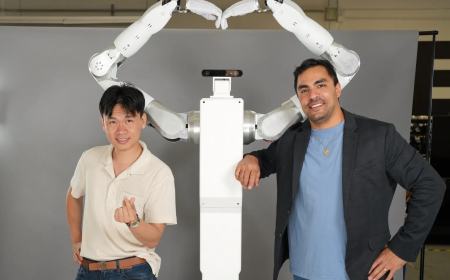
According to Applied Computing co-founder and CEO Callum Adamson (pictured above, right), facilities typically make operating decisions using less than 8% of the data they already collect. While sensor readings, engineering documents, and scientific process data are available, organisations often struggle to integrate these sources quickly enough to generate meaningful analysis and predictive insights.
“The real challenge is getting those three data sources to communicate with each other in real time,” Adamson said.
Unlike traditional large language models that focus on predicting the next word in a sequence, Applied Computing says its AI foundation model, called Orbital, combines a time-series model, a physics-based model, and a language model to predict the operational state of an industrial facility. The platform analyses live sensor information while accounting for physical laws, chemical processes, equipment limitations, and operator activity. It also enables engineers to simulate how adjustments made in one area of a facility could influence performance across the rest of the operation.
Applied Computing’s primary value proposition is speed. The company says Orbital can identify anomalies, determine their likely causes, and evaluate whether a proposed solution could create issues elsewhere in the facility within minutes. Adamson claims the system can reduce investigations that previously required days or even weeks down to just seconds, helping operators improve efficiency, reduce energy consumption, and maintain production levels.
That promise appears to be gaining traction in the market. The startup says it has grown from operating in stealth mode to generating double-digit millions in annual recurring revenue in less than 18 months. Adamson noted that Orbital is currently deployed at several large publicly listed companies across upstream oil and gas, downstream refining, and petrochemical industries. However, he declined to reveal the exact number of customers.
Among its strategic partners are Indian technology company Wipro and KBR, which has integrated Orbital into its INSITE 3.0 digital platform for energy projects and is already using the technology in ammonia production. Adamson also said the company is working with a major upstream oil and gas operator in the United States and expects to announce a partnership with a leading European oil company in the coming weeks.
Applied Computing is entering a competitive industrial software market populated by established providers and AI-focused startups alike. Companies such as AspenTech offer simulation and AI-driven modelling tools for upstream, refining, and chemical operations, while AVEVA provides physics-based process simulation, optimisation, and scenario modelling for industrial facilities. Meanwhile, firms like Cognite and Seeq specialise in industrial data analysis and AI-powered workflow management.
Adamson believes the company’s competitive advantage lies not in simply having access to industrial data or engineering expertise, but in assembling top AI researchers capable of building sophisticated foundation models like Orbital.
“This is fundamentally an AI challenge. It’s not a data problem, and it’s not an energy problem,” he said. “If you’re a world-class AI researcher, where do you choose to work? I don’t think Shell is on that list.”
He also highlighted the value of operational data gathered through Orbital’s deployments. Unlike publicly available datasets, information collected directly from refineries and industrial facilities reflects real-world operating conditions that cannot be fully recreated through simulations.
The partnership with KBR is expected to further strengthen Applied Computing’s position by providing access to additional operational data, engineering expertise, and relationships with potential enterprise customers across the energy sector.
The startup plans to use the newly raised $20 million to support international expansion, recruit additional research and engineering talent, and accelerate deployments with energy companies worldwide.
Alongside the funding announcement, Applied Computing revealed it has opened a new office in Houston, complementing its headquarters in London and its operational hub in Bengaluru. Adamson said the Houston office places the company closer to its North American customers, while expansion into the Middle East is also part of its future growth plans.
What's Your Reaction?
 Like
0
Like
0
 Dislike
0
Dislike
0
 Love
0
Love
0
 Funny
0
Funny
0
 Angry
0
Angry
0
 Sad
0
Sad
0
 Wow
0
Wow
0