






































EU-Backed QuantumDiamonds Looks to Accelerate Semiconductor Manufacturing
QuantumDiamonds has secured EU backing to advance diamond-based quantum sensing technology that could speed up semiconductor manufacturing, improve chip inspection accuracy, and support Europe’s growing semiconductor industry.
As global demand for semiconductors continues to rise, Europe is stepping up efforts to strengthen its position in the industry. While Dutch chip equipment giant ASML has long stood as one of Europe’s biggest semiconductor success stories, it may soon have company.
Through the European Chips Act, the European Union is investing heavily in expanding semiconductor capabilities, partly by providing state-backed funding to promising technology companies. One of the latest beneficiaries is the German startup QuantumDiamonds, which has developed a new approach to semiconductor inspection to improve manufacturing efficiency.
Following approval from the European Commission, QuantumDiamonds has secured €76 million in non-dilutive funding from Germany’s Federal Ministry for Economic Affairs and the State of Bavaria. The funding will support construction of a new semiconductor testing equipment production facility in Munich, forming part of the company's previously announced $178 million investment programme.
A spinout from the Technical University of Munich (TUM), QuantumDiamonds has also completed a €15 million equity funding round led by venture capital firm World Fund. Although the company did not disclose its valuation, it confirmed that Bayern Kapital participated in the financing alongside existing investors, including Creator Fund, Earlybird, First Momentum, IQ Capital, Onsight Ventures, and UnternehmerTUM.
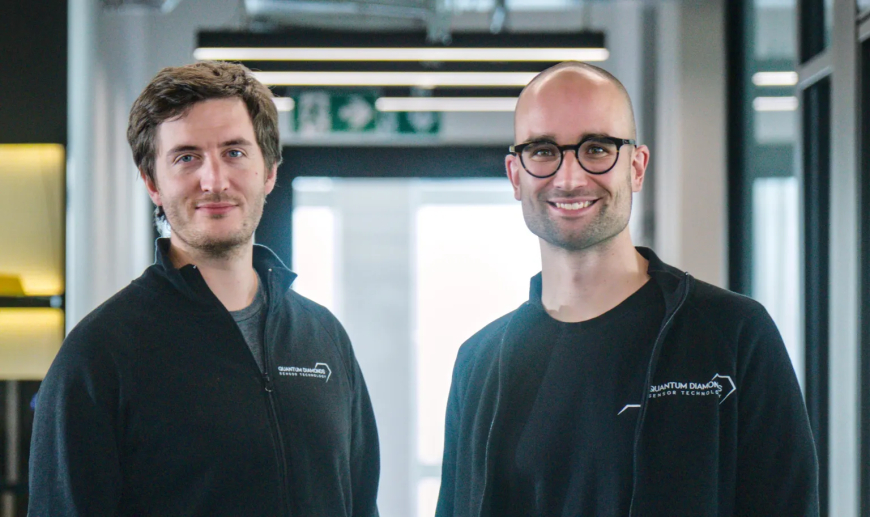
Chief Executive Officer Kevin Berghoff said the fundraising process moved relatively quickly because the company had already demonstrated strong customer demand for its technology.
“We work with almost everyone in the chip ecosystem,” Berghoff said. With global demand for semiconductors continuing to rise, he noted that manufacturers are equally interested in technologies that improve production efficiency and increase manufacturing yields.
QuantumDiamonds says its inspection system reduces a defect-detection process that traditionally takes several weeks to just two minutes, without interrupting production lines. According to the company, the technology could save semiconductor manufacturers—including Taiwanese foundries and South Korean memory chip producers—hundreds of millions of dollars by enabling them to identify manufacturing defects significantly faster.
Berghoff said customers typically recover the cost of purchasing the company’s hardware within only a few months. In addition to selling the inspection equipment, QuantumDiamonds generates recurring revenue through subscription services that provide on-site support and software capable of analysing inspection data and identifying likely causes of manufacturing issues.
Behind the scenes, the technology represents one of the earliest commercially practical applications of quantum sensing. Unlike many quantum computing projects that remain under development, quantum sensing can already generate highly precise magnetic field measurements to detect semiconductor defects. Berghoff said customers are primarily interested in thetechnology’ss performance rather than the fact that it relies on quantum principles.
The company’s name also reflects another key component of its technology. The diamonds used in its inspection systems are synthetic rather than natural gemstones. QuantumDiamonds leverages the microscopic properties of these engineered diamonds to observe how electricity flows through semiconductor chips. Unlike conventional inspection techniques that examine only the upper layer of a chip with microscope-based systems, the company’s approach can detect defects across multiple layers without damaging the chip.
That capability is becoming increasingly valuable as semiconductor manufacturers move toward more complex multi-layer chip designs. Berghoff noted that startups such as Semron are already developing three-dimensional chips, while much of the industry sees stacked architectures as the future for AI data centres. As transistors approach the limits of miniaturisation, manufacturers are instead adding more layers to deliver greater computing performance.
Although major competitors—including large U.S.-based semiconductor inspection companies valued at well over $100 billion—could eventually introduce similar technology, Berghoff believes QuantumDiamonds currently benefits from being first to market.
“There is no U.S. or Asian company that has shipped those tools,” he said, noting that the startup has already moved beyond laboratory research and is now transitioning from customer research facilities to semiconductor fabrication plants.
Berghoff explained that the company’s existing systems are designed primarily for laboratory environments, where manufacturers perform sample-based testing on perhaps one chip out of every million produced. The next objective is to introduce high-throughput inspection systems capable of examining every chip directly inside production facilities, enabling full-scale quality control throughout the manufacturing process.
The inspection equipment represents a significant investment, although Berghoff said pricing remains modest compared with other semiconductor manufacturing systems. Laboratory inspection tools currently sell for several million dollars, while the future high-throughput systems are expected to cost between $10 million and $15 million. Even at that price, they remain far less expensive than ASML’s advanced lithography machines, which can cost around $400 million each.
The comparison with ASML extends beyond pricing. In a statement, World Fund managing partner Daria Saharova suggested QuantumDiamonds has the potential to become Europe’s next ASML. Berghoff acknowledged that possibility while also noting that ASML itself has shown growing interest in semiconductor inspection technologies, making it a company that could potentially consider acquiring QuantumDiamonds in the future. However, ASML has recently indicated it is not actively pursuing acquisitions.
For now, QuantumDiamonds may have more in common with another World Fund portfolio company, the Finnish quantum computing firm IQM, which recently went public. Both businesses have emerged from Europe’s deep-tech ecosystem and are seeking to use European funding and research expertise as a foundation for global expansion.
QuantumDiamonds is still in the early stages of its commercial journey, but 2026 has already marked significant international progress for the company. It recently opened a regional hub in Taiwan. It completed its first commercial deployments in Taiwan and the United States, including the installation of a system at Eurofins EAG Laboratories in Sunnyvale, California.
The latest funding will also support job creation in Munich, where most of QuantumDiamonds’ workforce of around 70 employees is currently based. Berghoff and co-founder and Chief Technology Officer Fleming Bruckmaier plan to double the company’s engineering team over the next 12 months by leveraging the region’s strong pool of semiconductor and quantum technology talent.
According to Berghoff, Munich already provides the expertise the company needs to continue developing advanced semiconductor inspection systems and to expand into international markets.
What's Your Reaction?
 Like
0
Like
0
 Dislike
0
Dislike
0
 Love
0
Love
0
 Funny
0
Funny
0
 Angry
0
Angry
0
 Sad
0
Sad
0
 Wow
0
Wow
0