Each wave of new technology reshapes how people interact with tools, but the role AI will ultimately play in redefining work remains uncertain. One emerging idea is that traditional interfaces could disappear entirely.
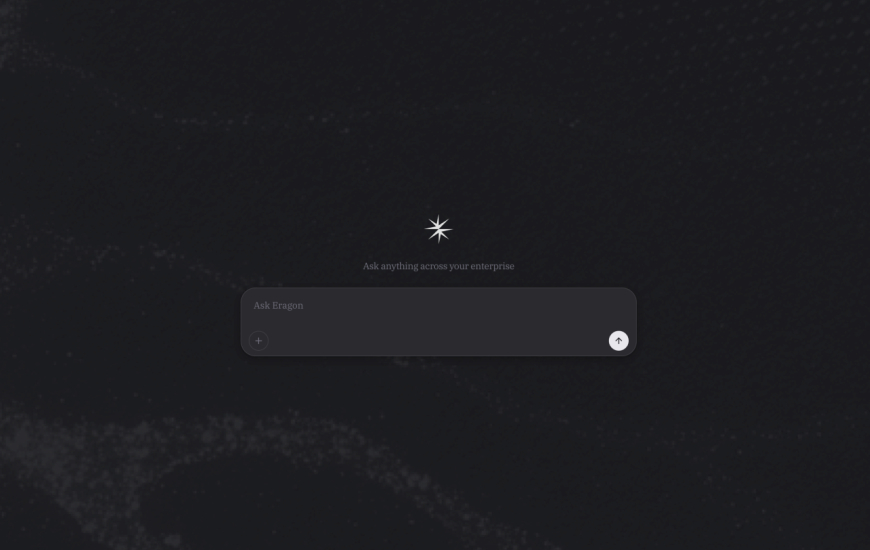
That concept is at the core of Josh Sirota’s vision. He founded the startup Eragon in August and has now raised $12 million at a $100 million post-money valuation to develop what he describes as an agentic AI operating system tailored for enterprise customers.
Sirota’s central argument is straightforward: “Software is dead.” In his view, traditional elements such as buttons, menus, and dialogue boxes are becoming obsolete, with future business workflows instead driven by natural language prompts. Eragon’s goal is to replace the conventional stack of enterprise tools — including platforms like Salesforce, Snowflake, Tableau, and Jira — with a single large language model-based interface.
Before launching the company, Sirota worked on go-to-market teams at Oracle and Salesforce. He described experiencing a period of reflection before moving to San Francisco and starting Eragon with a small team operating out of a live-work loft near the San Francisco Giants’ stadium. The workspace features a mix of startup culture and symbolism, including Mac minis, a bottle of Moët, and a copy of the fantasy novel “Eragon” by Christopher Paolini, which inspired the company’s name — following a tradition similar to companies like Palantir and Anduril, which also draw from fictional sources.
Investors were drawn to Sirota’s experience in implementing enterprise software, seeing it as strong alignment between founder expertise and market opportunity. Backers include Arielle Zuckerberg of Long Journey Ventures, along with Soma Capital, Axiom Partners, and angel investors Mike Knoop and Elias Torres.
“We see enormous potential for Eragon to become the connective tissue for how modern teams operate and make decisions,” said Sandhya Venkatachalam of Axiom. The company’s technical team includes Rishabh Tiwari, a PhD student in computer science at Berkeley, and Vin Agarwal, a PhD from MIT, both contributing to the development of the platform’s technology.
At Eragon’s workspace, Sirota demonstrated how the company uses its internal system. The platform fine-tunes open-source models such as Qwen and Kimi using customer data and integrates with company resources, such as email systems. During a demonstration, Sirota onboarded a new client, Dedalus Labs, using a natural-language prompt. The system automatically created user credentials, deployed a dedicated cloud instance, and initiated onboarding processes.
Sirota envisions Eragon as a tool executives can use to analyse business operations — from identifying deals at risk to improving supply chain performance — and then assign AI agents to carry out tasks. Even dashboards can be generated on demand simply by requesting them.
While the demonstration highlighted the platform’s potential, it also raised questions about limitations. Complex or unexpected queries could challenge the system, and certain automated processes may be difficult to audit. For example, Eragon was shown automatically approving invoices from Sirota’s inbox, prompting concerns about how such automation might handle edge cases.
Security is another major consideration when deploying AI agents in enterprise environments. For now, the company is focusing on refining the system through real-world use. Several large enterprises and dozens of startups are currently using Eragon.
Nico Laqua, CEO of insurance startup Corgi — which raised $180 million after emerging from Y Combinator — described Eragon as “the best applied AI for enterprise in the market.”
“Most of the data we have needs to remain secure and behind our own cloud,” Laqua said. “Eragon trains state-of-the-art models for us on our data and deploys them in our own environment.”
Data ownership is a key part of Eragon’s offering. The company emphasises that customer data remains within the client’s infrastructure, and that businesses retain control over their model weights — the parameters that determine how an AI system operates. Sirota believes that models trained on years of internal company data will become valuable assets in their own right.
Although leading AI labs offer powerful models, Sirota argues that relying on external APIs without owning configurations puts companies at a disadvantage. He compares the current stage of AI to the transition from centralised mainframes to personal computers, suggesting that widespread adoption will depend on localised, customisable solutions.
This perspective aligns with broader industry trends. At Nvidia’s GTC conference, CEO Jensen Huang described agentic AI as a transformative force for enterprise workflows, stating that it could replace traditional approaches to white-collar work. He likened the shift to how Windows enabled personal computing, suggesting that “every single SaaS company will become Agentic-as-a-Service.”
Huang’s comments relate to Nvidia’s new initiative, NemoClaw, which aims to support AI agents operating within secure enterprise environments. This signals both validation of Eragon’s approach and the likelihood of intense competition from established players and emerging startups alike.
Despite the competitive landscape, Sirota remains confident, predicting that Eragon could reach a billion-dollar valuation by the end of the year. He acknowledged the widely cited MIT statistic that 95% of enterprise AI initiatives fail to gain traction. Still, he attributed this to a lack of understanding among executives of day-to-day employee workflows. Eragon, he says, is designed to provide a more practical and usable solution for modern businesses.


































 Like
0
Like
0
 Dislike
0
Dislike
0
 Love
0
Love
0
 Funny
0
Funny
0
 Angry
0
Angry
0
 Sad
0
Sad
0
 Wow
0
Wow
0