





























All the EVs That Were Discontinued or Killed Off in the U.S. This Year
Several electric vehicles have been discontinued or cancelled in the U.S. this year as automakers respond to lower demand, tariffs, changing regulations and shifting business priorities.
The U.S. electric vehicle market is undergoing another major shift as several automakers discontinue, cancel or pause EV models despite continued consumer interest in battery-powered transportation. While EV sales remain substantial, the industry has been affected by the end of the $7,500 federal tax credit, higher production costs, tariffs, changing customer demand and evolving corporate priorities.
According to Kelley Blue Book and Cox Automotive, more than 247,000 electric vehicles were sold in the United States during the second quarter of 2026, representing around 5.8% of the total vehicle market. Although sales improved compared with the previous quarter, they remained below the same period in 2025. Even as new models such as the Rivian R2 prepare to enter the market, several manufacturers have decided to scale back or abandon certain EV programmes altogether.
Afeela
Sony and Honda’s Afeela project generated significant attention after evolving from Sony’s Vision S concept, first unveiled at CES 2020. The partnership formally introduced the Afeela brand in 2023 and continued promoting the vehicle through numerous public demonstrations and technology events.
Despite years of marketing and prototype showcases, the vehicle never reached commercial production. In March 2026, the Sony Honda Mobility joint venture cancelled development of both planned Afeela-branded electric vehicles following Honda’s broader decision to reduce its U.S. EV ambitions.
Honda and Acura
Honda’s retreat represents one of the biggest changes among traditional automakers. The company cancelled development of the Honda 0 SUV, Honda 0 Saloon and the Acura RDX electric model in March 2026, citing pressure from U.S. tariffs and increasing competition from Chinese manufacturers.
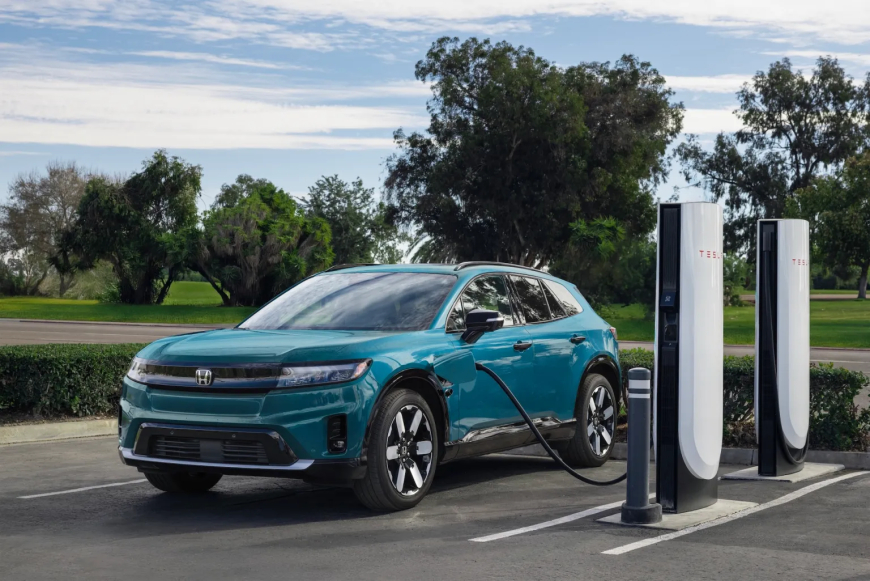
Honda also confirmed the end of the Prologue, the company’s only fully electric vehicle available in the United States. Built through a partnership with General Motors at GM’s Ramos Assembly Plant in Mexico, the Prologue recorded respectable sales in 2024 and 2025 before demand weakened after federal EV incentives ended.
Hyundai
Hyundai continues to perform well in the American EV market but has adjusted its product strategy. Earlier this year, the company announced it would stop selling the imported Ioniq 6 in the United States, a move widely linked to tariffs affecting South Korean-built vehicles.
The manufacturer will continue to offer the performance-focused Ioniq 6 N while concentrating U.S. production on models such as the Ioniq 5 and Ioniq 9, which are assembled at its Georgia manufacturing facility.
Nissan
Nissan has also stepped back from one of its key electric vehicles. The company previously confirmed it would not produce a 2026 model-year Ariya SUV for the U.S. market, and there has been no indication that the model will return.
The Ariya was introduced as Nissan’s first major all-electric vehicle since the pioneering Leaf and was expected to play a central role in the company’s modern EV lineup.
Polestar
Polestar’s exit from the United States has been driven primarily by regulation rather than market demand. The Swedish EV manufacturer, owned by China’s Geely, has been unable to continue importing vehicles after U.S. restrictions on Chinese-connected vehicle technology.
Although the company will continue to support existing customers and sell the remaining inventory of the Polestar 3 and Polestar 4, it no longer has approval to continue broader U.S. sales. The sister company, Volvo Cars, received the necessary authorisation to continue operating.
Tesla Model S and Model X
Tesla has decided to discontinue production of its long-running Model S sedan and Model X SUV as it shifts resources towards artificial intelligence, autonomous technology and humanoid robotics.
Sales of both premium models have declined for years as buyers increasingly favoured the more affordable Model 3 and Model Y. Production ended this spring, and Tesla has reportedly removed the assembly lines from its Fremont factory to make room for Optimus robot manufacturing.
Volkswagen
Volkswagen has scaled back its U.S. electric vehicle portfolio by ending domestic production of the ID.4 at its Chattanooga, Tennessee, plant. Existing inventory will continue to be sold while supplies last, with stock expected to remain available into 2027.
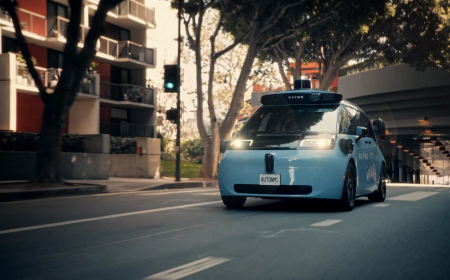
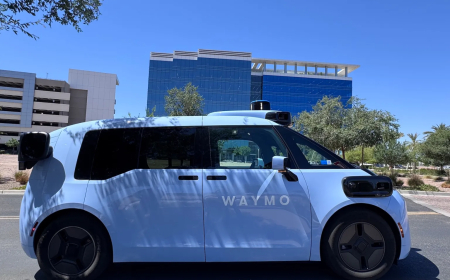
The company has also paused the ID Buzz for the 2026 model year, although Volkswagen says the electric microbus will return in 2027. Meanwhile, autonomous versions of the ID Buzz are already being tested in Los Angeles by Volkswagen subsidiary MOIA America and Uber ahead of a planned robotaxi service.
Volvo
Volvo announced in March that it would withdraw the compact EX30 and EX30 Cross Country from the U.S. market after the summer production run. The EX30 attracted strong early interest asVolvo’ss more affordable electric vehicle, but changing market conditions prompted the company to end U.S. production.
The Swedish automaker will continue offering larger electric SUVs, including the EX60 and EX90, allowing it to maintain a presence in the American EV market despite reducing its entry-level offerings.
Industry Outlook
The growing list of discontinued electric vehicles highlights how rapidly the U.S. EV market is changing. While overall sales have begun to stabilise after the loss of federal tax incentives, manufacturers are reassessing which models can remain profitable under new economic and regulatory conditions. Companies continue to invest in electrification, but increasingly with a sharper focus on costs, localisation, AI technologies, and long-term profitability rather than on expanding every segment of their EV portfolios.
What's Your Reaction?
 Like
0
Like
0
 Dislike
0
Dislike
0
 Love
0
Love
0
 Funny
0
Funny
0
 Angry
0
Angry
0
 Sad
0
Sad
0
 Wow
0
Wow
0