
































Behind the Scenes of Drone Food Delivery in Finland
Go inside Finland’s drone-powered food delivery system, where Manna, Wolt, and Huuva collaborate to bring meals faster despite harsh weather.
Finland is known for its harsh and unpredictable weather — yet even in these conditions, your next meal might arrive by drone.
After Helsinki’s annual Slush conference, on a rainy afternoon, Finnish entrepreneur Ville Leppälä gave TechCrunch an inside look at a three-way collaboration between Irish drone delivery company Manna, DoorDash-owned platform Wolt, and his own startup, Huuva.
Huuva — named after the Finnish word for “kitchen hood” — raised a seed round led by General Catalyst in 2022, promising to bring high-quality cuisine to suburban areas. While the company expanded beyond its original cloud kitchen concept, delivery technology remains central to its business. Now, drones have joined that ecosystem.
Customers ordering from Huuva’s Niittari site in Espoo have been receiving a special notification on Wolt’s app: “If available, we’ll send your order with a drone.” Espoo, located within the wider Helsinki metropolitan region, is considered by Leppälä an ideal testing ground.
European suburbs are more compact than those in the U.S., but many people who live, study, or work in places like Espoo still lack the diverse food options found in central Helsinki. Huuva enables them to order their favourite dishes from partner restaurant brands — and with drone logistics, those meals can arrive more quickly, Leppälä explained.
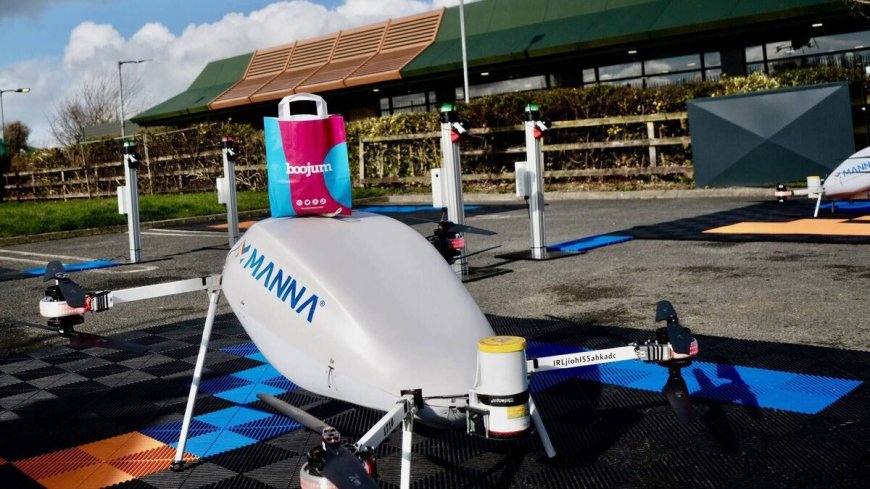
Leveraging Manna’s experience from over 50,000 deliveries in Dublin, the Finnish rollout moved fast once regulatory permissions were granted. After a pilot phase beginning in February, drones have been in full operation in Espoo for the past two months, flying out of a launchpad shared with Wolt Market, the delivery-only grocery service from Wolt.
For customers, this means they can combine meals from Huuva’s partner restaurants with groceries — each drone can transport about 4.4 pounds, and Manna can dispatch two drones simultaneously.
The result is faster service and greater convenience. Unlike couriers, drones won’t get stuck in lunchtime traffic. According to Leppälä, this is crucial for ensuring food arrives warm and fresh. It also has the potential to improve Huuva’s unit economics.
Huuva estimates that standard deliveries cost around €5–6 ($6–8), while drone deliveries could eventually fall to roughly €1 ($1.16). This does not include any additional expenses Manna faces from launching in Finland, though the weather has been less problematic than expected for a newcomer.
Coming from Ireland, Manna’s drones were already stress-tested for heavy wind and rain conditions severe enough that snow is considered manageable. Ice, however, presents a unique challenge. Local operations lead Makar Nalimov said drones won’t fly in icing conditions, as de-icing chemicals cannot be used when carrying food. In such cases, deliveries revert to alternative methods.
These backup procedures highlight that Manna’s drones are part of a growing ecosystem of last-mile delivery solutions. Wolt is already using sidewalk delivery robots from Coco and Starship in Finland. At the same time, its parent company, DoorDash, has developed its own robot, Dot, which began operating in Arizona earlier this year.
With ongoing rumours that DoorDash may be developing its own drone delivery platform — in addition to its work with Alphabet’s Wing — these direct partnerships with Huuva and Manna could prove valuable. Huuva is even eyeing expansion into another Espoo site where Wolt Market wouldn’t be involved, meaning the drone launchpad could be positioned close enough for meals to be passed through a window straight from the kitchen.
Currently, Manna’s launchpad is a short distance away. Delivery workers on e-scooters collect meals from Huuva’s kitchen in insulated bags and hand them off to Manna’s team. Under Nalimov’s supervision, staff weigh the orders, adjust the balance if needed, and place them into regulator-approved protective bags.
These reinforced bags are just one part of the extensive safety protocols. Drones always take off with freshly switched batteries. Redundancy and contingency plans are in place at every stage of the process — and, as a final safeguard, each drone carries a parachute.
Although Manna maintains local ground teams, the company’s Mission Control is located in Ireland. Remote operators there analyse LiDAR maps, approve flight paths, and pinpoint a safe drop location near the customer’s home. If conditions do not meet safety standards, the order defaults to a human courier. If approved, the drone takes a photo of the landing area for human confirmation before lowering the package using a biodegradable rope.
This workflow has become routine for the Finnish operations team, which is now completing double-digit deliveries daily and preparing confidently for its first winter season in Finland. As for Huuva, the company is ready to expand its drone delivery program in Espoo, with one small request: permission to place its branding on those regulator-approved delivery bags.
What's Your Reaction?
 Like
0
Like
0
 Dislike
0
Dislike
0
 Love
0
Love
0
 Funny
0
Funny
0
 Angry
0
Angry
0
 Sad
0
Sad
0
 Wow
0
Wow
0