































Caterpillar Partners With Nvidia to Bring AI Capabilities to Construction Equipment
Caterpillar is partnering with Nvidia to bring AI-powered assistance and automation to its construction equipment, starting with a pilot on its mini excavators.
Caterpillar is expanding its use of artificial intelligence and automation across its construction machinery through a new partnership with Nvidia.
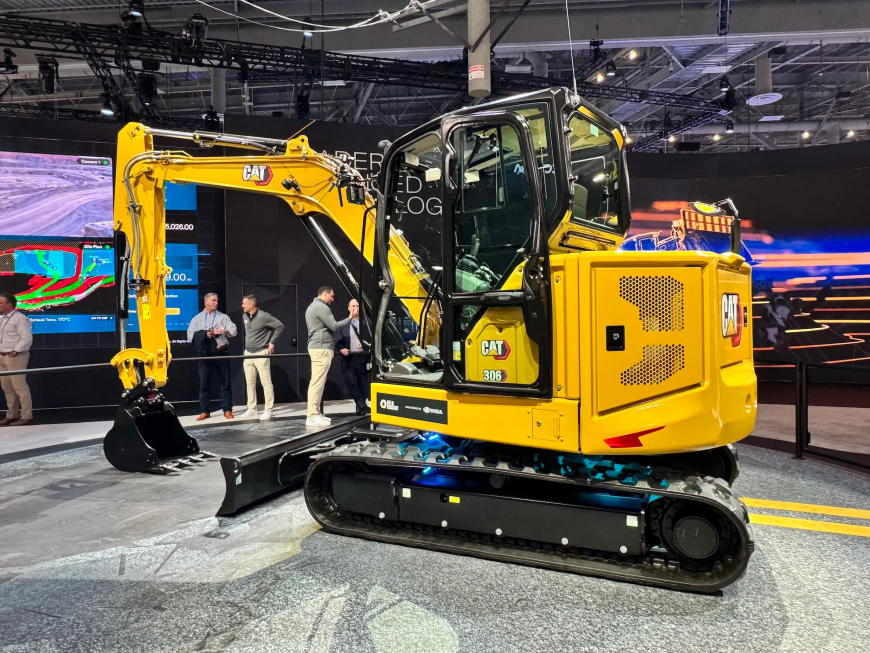
The heavy equipment manufacturer is currently piloting an AI-powered assistive system in its Cat 306 CR Mini Excavator, a mid-size machine commonly used on construction sites. The system, known as Cat AI, is built on Nvidia’s Jetson Thor platform and is being demonstrated at CES on Wednesday.
According to Brandon Hootman, Caterpillar’s vice president of data and AI, Cat AI is powered by a collection of AI agents designed to support equipment operators in real time. The system can respond to operator questions, surface technical resources, provide safety guidance, and help schedule maintenance and service tasks.
Beyond on-machine assistance, a significant advantage of integrating AI into Caterpillar’s equipment is the volume of operational data these systems can generate and transmit.
“Our customers don’t sit in front of laptops all day — they’re out in the dirt,” Hootman said. “Being able to deliver insights and enable action while they’re actively working is extremely important.”
Caterpillar is also testing digital twins of construction sites using Nvidia Omniverse, the company’s simulation platform. These virtual replicas enable the company to experiment with scheduling scenarios and more accurately estimate project material requirements. Hootman said Caterpillar’s machines collectively send about 2,000 data messages per second back to the company, providing the foundation for these simulations.
The company already operates fully autonomous vehicles in the mining sector, and Hootman described the current construction pilots as a natural progression as Caterpillar works to introduce more automation across its broader product lineup.
“We started here because it addressed a real customer challenge and because we already had momentum that allowed us to move quickly,” Hootman said. “At the same time, it creates a technology foundation we can continue building on.”
For Nvidia, collaborating with an industrial manufacturer like Caterpillar aligns closely with its broader physical AI strategy. In 2025, Bill Dally, Nvidia’s chief scientist, told TechCrunch that the company views physical AI — systems that interact with and operate in the real world — as its next major growth frontier.
During its CES keynote earlier this week, Nvidia outlined its full-stack approach to physical AI, which includes open AI models such as the Cosmos, simulation environments, and developer toolkits.
While physical AI is often associated with robotics companies, Deepu Talla, Nvidia’s vice president of robotics and edge AI, said the concept applies far more broadly.
“Physical AI is the next wave of AI,” Talla said. “Nvidia is building the computers that train the models, simulate them, and deploy them into machines — whether that’s an autonomous vehicle or a Caterpillar excavator.”
What's Your Reaction?
 Like
0
Like
0
 Dislike
0
Dislike
0
 Love
0
Love
0
 Funny
0
Funny
0
 Angry
0
Angry
0
 Sad
0
Sad
0
 Wow
0
Wow
0