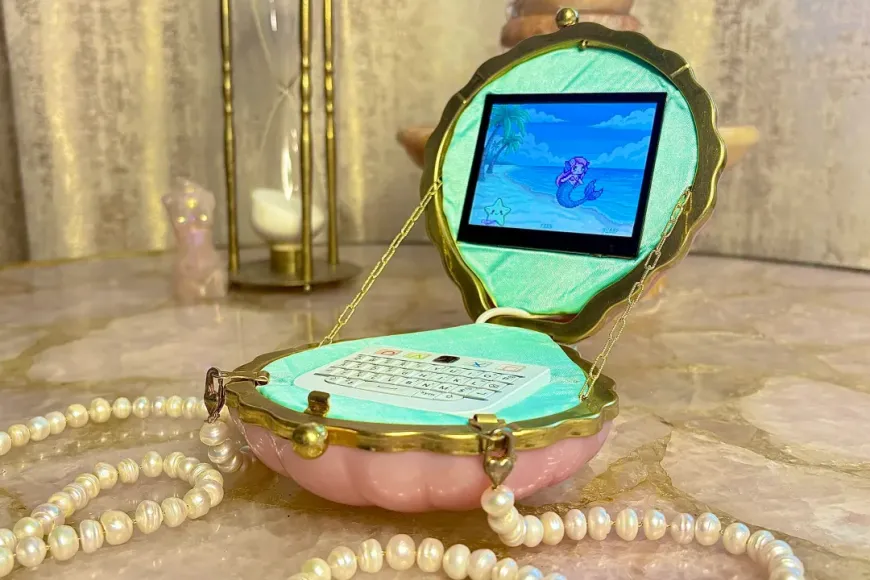
When reaching out to the self-described “open source baddie” known as CC for an interview, there’s a good chance she’s responding from one of her most unusual creations — a pink mermaid purse transformed into a functional computer.
“I’m just having so much fun,” she said while describing her seashell-inspired cyberdeck. “It’s a Tamagotchi. It’s also an e-reader. It’s connected to my vault and servers so it can access all my server data, including PDFs, books, notes, and everything else. It’s also linked to my local AI setup at home.”
Although CC does not come from a software engineering or computer science background, she has become skilled at building highly unconventional cyberdecks — compact, custom-built computers often assembled from off-the-shelf hardware. Through her blog, Bimbo Tech, she documents the entire process to help other women build their own devices, even if they are only beginning to learn basic technical concepts.
The concept of the cyberdeck traces its roots to William Gibson’s 1984 science fiction novel Neuromancer. Decades later, the arrival of affordable, credit card-sized computers such as the Raspberry Pi inspired hardware enthusiasts to create their own versions and share them within niche online communities. In recent months, however, cyberdeck culture surged in popularity as women across social media platforms have begun teaching one another how to create highly personalised, artistic, and often hyper-feminine computing devices.
“I have a running joke that there’s this underlying misogyny in tech — because whenever they release a pro model or an elite model, I’m always like, let me guess, it’s black or silver,” CC said. “It’s never going to come in pink.”
For many builders, designing and customising a cyberdeck has become as important as the technology itself. Social media platforms such as Instagram and TikTok now feature a wide variety of imaginative creations. Examples include a wooden, moss-covered cyberdeck capable of running Game Boy Colour games, a desert-themed MP3 player built into a 3D-printed fossil, a Barbie dollhouse that unfolds into a working miniature computer, and even a duck figurine modified to record voice notes.
“I don’t want Meta AI glasses. I want to pirate books in a tiny embellished shell,” creator Sarahbelle Kim said in a TikTok video. “No one can surveil you there. You can get some basic parts at the thrift store or eBay and customise it.”
While aesthetics clearly play a role in the trend’s popularity, participants say the movement is about more than colourful accessories and decorative electronics. The rise of cyberdecks is occurring at a moment when many people feel increasingly disconnected from the technology they use every day and frustrated by the influence of large technology companies.
“I think that’s such a refreshing thing for people who were sold these devices that are like Apple’s,” CC explained. “If you try to jailbreak it, if you try to do anything to this phone that you paid $1,000 for, that you own, it’s out of warranty. So I love seeing people taking the power back into their hands, taking the control back into their hands, which obviously always means creativity when people are given the means to go outside of the black box.”
For blockchain developer Maro Vardanyan, cyberdecks offered a new way to combine long-standing interests in technology, sustainability, and art.
“A few months ago, I just started as a hobby making art and jewellery pieces and purses with recycled or upcycled old computers I had,” Vardanyan said. “When I saw everyone doing cyberdecks, I was like, wait, why am I just doing recycled and upcycled ones when I can actually preserve the pieces on something wearable that’s movable?”
Vardanyan’s work approaches cyberdeck culture from a different angle. Rather than focusing solely on computers as gadgets, she explores the historical relationship between technology and textile arts. She often refers to her creations as “crocheting with computers” or “macrame motherboards,” intentionally highlighting the overlooked role that weaving and textile work have played in the development of computing.
Before modern silicon processors became standard, some early computers relied on magnetic-core memory systems made from precisely threaded copper wiring that encoded binary data. During the development of the Apollo Guidance Computer, for example, highly skilled women textile workers manually wove complex wiring patterns that helped power the spacecraft that carried astronauts to the moon.
“The original processor was handwoven by seamstresses, not by engineers or anybody else,” Vardanyan said. “I feel like the hand weaving, and even the fashion-meets-technology aspect of it, is so full circle.”
She began weaving bright pink Raspberry Pi boards into wearable items such as purses and corsets, later sharing images of her work online.
“Of course, when the macrame went viral, all of the men were like, ‘This is such a waste of the Raspberry Pi,’ or, ‘What about the rain?’” she said. “And then I have to be like, ‘Actually, it’s preserved in an acrylic shell.’ And then they’re like, ‘This is so performative, and the GPIO is gonna lose energy!’ And I’m like, ‘Actually, I’m using a conductive thread, so it actually will move and be fully functioning.’”
CC has encountered similar reactions online. Some critics questioned whether using Raspberry Pi hardware for decorative projects was appropriate during periods of hardware shortages.
“This guy on Reddit was like, ‘You built your first computer a month ago, calm the f— down,’” CC recalled. “Mind you, I’ve been building PCs for years. So, long story short, he ends up apologising and buying me the circuit board for my next cyberdeck.”
From CC’s seashell purse computer to Vardanyan’s Raspberry Pi corsets, these projects represent more than creative hardware experiments. They also serve as a rejection of the highly standardised culture often associated with Silicon Valley and mainstream consumer electronics.
Their intentionally unconventional designs prioritise individuality and creativity over efficiency and optimisation. In an era where technology is increasingly polished, locked down, and controlled by major corporations, cyberdeck enthusiasts are embracing imperfect, highly personal devices that foster a deeper connection between users and technology.
“Ten years ago, I would walk into a conference, there would be three girls, and people would literally just be like, ‘Were you hired for the marketing team?’” Vardanyan said. “I can’t even tell you how amazing it is seeing so many girls all over my social media and Instagram being into hardware, being into software, and then educating each other, and that’s definitely the energy that we’re missing on every level in society.”
As cyberdeck communities continue to grow, their appeal extends far beyond nostalgia or aesthetics. For many participants, these handmade devices represent creativity, technical curiosity, ownership, and a desire to reclaim a more personal relationship with technology in an increasingly standardised digital world.