



































Microsoft’s Nadella Wants Us to Stop Thinking of AI as ‘Slop’
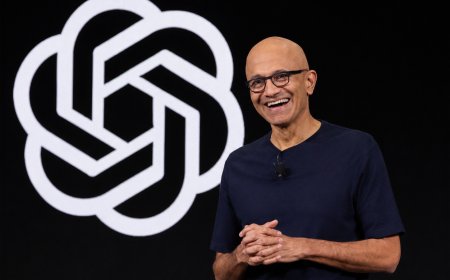
Microsoft CEO Satya Nadella urges the tech industry to stop viewing AI as “slop” and instead see it as a tool that amplifies human potential.
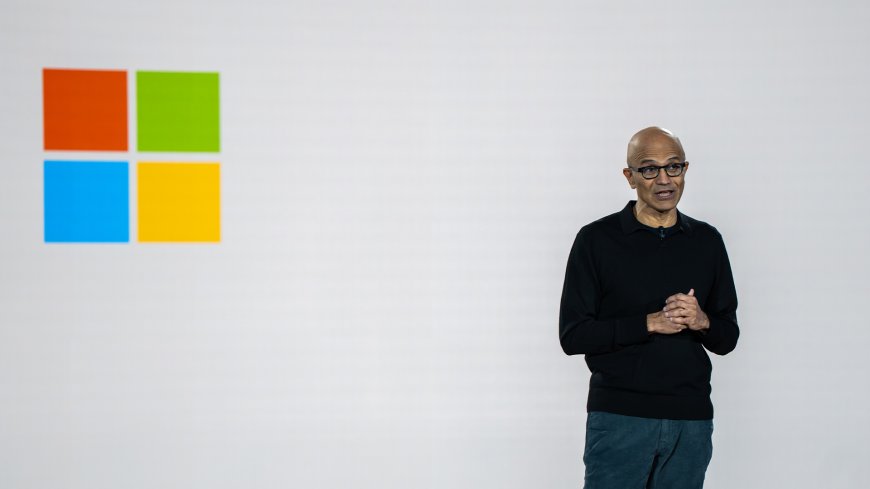
A few weeks after Merriam-Webster named "slop" its word of the year, Satya Nadella offered his perspective on artificial intelligence and what it should represent as 2026 approaches.
In a post published on his personal blog, the Microsoft CEO argued that people should move away from viewing AI as "slop" and instead see it as "bicycles for the mind." The phrase echoes a long-standing metaphor for technology as a tool that amplifies human capability rather than replacing it.
"A new concept that evolves 'bicycles for the mind' such that we always think of AI as a scaffolding for human potential vs a substitute," Nadella wrote.
He continued: "We need to get beyond the arguments of slop vs sophistication and develop a new equilibrium in terms of our 'theory of the mind' that accounts for humans being equipped with these new cognitive amplifier tools as we relate to each other."
Stripped of its philosophical framing, Nadella's message is clear: he wants the tech industry and the public to stop describing AI-generated output as disposable content and to stop positioning AI as a replacement for human workers. Instead, he argues that AI should be understood primarily as a productivity-enhancing assistant.
That framing, however, is at odds with how AI is often marketed. Many AI agents and automation tools are priced and sold on the basis of their ability to displace human labour, a narrative frequently used to justify enterprise spending.
At the same time, some of the most prominent voices in AI have warned of widespread job losses. In May, Dario Amodei, CEO of Anthropic, said AI could eliminate up to half of entry-level white-collar jobs, potentially driving unemployment to between 10% and 20% over the next five years. He reiterated that warning in a later interview on 60 Minutes.
How accurate those projections will prove to be remains uncertain. As Nadella suggests, most AI tools today are not replacing workers outright but are instead being used by them—often with humans still responsible for reviewing and correcting AI output.
One frequently cited study examining this question is MIT's Project Iceberg, which tracks the economic impact of AI on employment. The project estimates that AI is currently capable of performing about 11.7% of paid human labour. While that figure has often been interpreted as indicating that AI can replace nearly 12% of jobs, the researchers emphasise that the estimate reflects how much of a job can be offloaded to AI, not how many jobs disappear entirely. Examples include automated paperwork for nurses and AI-assisted software development.
That distinction doesn't mean AI has left all occupations untouched. Fields such as corporate graphic design and marketing blogging have experienced significant disruption, according to reporting by Substack's Blood in the Machine. Newly graduated software engineers have also experienced higher unemployment rates. At the same time, skilled artists, writers, and programmers often produce stronger work when using AI tools than when working without them. For now, AI still depends heavily on human creativity and judgment.
As 2026 approaches, some economic data suggests a more nuanced picture. Vanguard's 2026 economic forecast report found that approximately 100 occupations most exposed to AI automation are outperforming the broader labour market, with stronger job growth and real wage increases. The report concluded that workers who use AI effectively are becoming more valuable, not more replaceable.
There is irony in Nadella's message given Microsoft's own actions. The company laid off more than 15,000 employees in 2025, even as it reported record revenue and profits for its fiscal year ending in June. Nadella addressed the layoffs in a public memo, pointing to the need to "reimagine our mission for a new era" and identifying "AI transformation" as one of Microsoft's core strategic priorities, alongside security and quality.
He did not say the layoffs were driven by internal AI efficiency. As Vanguard's analysis suggests, much of the job loss attributed to AI in 2025 was instead linked to conventional business decisions—shifting investment from slower-growth areas to faster-growing ones.
Microsoft was not alone. According to research by Challenger, Grey & Christmas, cited by CNBC, AI-related restructuring contributed to nearly 55,000 U.S. layoffs in 2025, with significant cuts reported at Amazon, Salesforce, Microsoft, and other technology companies that are investing heavily in AI.
And while Nadella may want the world to move past the idea of AI as "slop," some might argue that low-stakes, AI-generated memes and short-form videos remain among the technology's most entertaining—and widely consumed—applications.
What's Your Reaction?
 Like
0
Like
0
 Dislike
0
Dislike
0
 Love
0
Love
0
 Funny
0
Funny
0
 Angry
0
Angry
0
 Sad
0
Sad
0
 Wow
0
Wow
0