


































Why Rivian is delaying its $45,000 R2 base model until late 2027
Rivian plans to delay its $45,000 R2 base model until late 2027 as it focuses on higher-margin variants, production scaling, and cost efficiency.
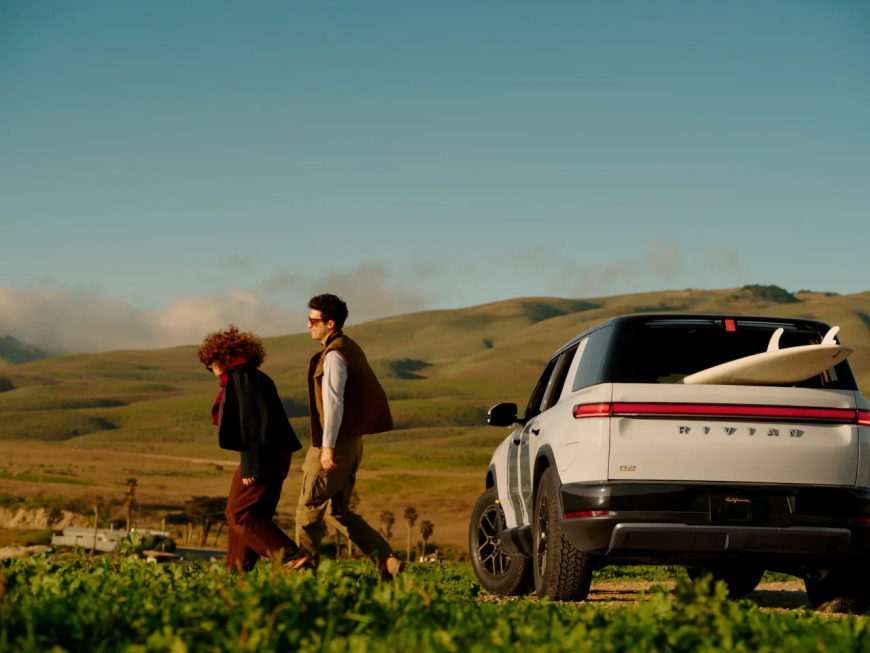
Rivian shared the full specs and pricing details for its crucial R2 SUV on Thursday. In the process, it also answered a question that had long hung over the vehicle: When will buyers actually be able to purchase the promised $45,000 base version?
According to the company's press materials, the answer is "late 2027." But there is an important wrinkle. Rivian's wording has changed. The company now says the base model R2 will be priced "starting around $45,000." That is a noticeable shift from the way Rivian had more recently described the R2 on its website as "starting at $45,000." The difference in language is subtle, but meaningful.
A lot has also changed since Rivian first unveiled the R2 in March 2024. The $7,500 federal EV tax credit has disappeared. Traditional automakers have stopped purchasing regulatory credits from companies like Rivian, cutting off a stream of what had effectively been easy money for the business. At the same time, President Trump's tariffs have driven up the costs of the components and raw materials that Rivian relies on to build its electric vehicles.
In other words, Rivian is facing larger problems on multiple fronts.
Sales of the company's R1T pickup and R1S SUV fell in 2025. Rivian is also preparing to begin construction of a massive factory in Georgia, where it expects to build hundreds of thousands of R2 SUVs eventually and, later, the R3 hatchback as well.
On top of that, Rivian is trying to execute what could be one of the fastest electric-vehicle launches in U.S. history with its higher-end R2 versions. The company expects to sell between 20,000 and 25,000 R2 units by the end of 2026. If it manages that, only Tesla's Model Y would have reached 20,000 sales more quickly.
Rivian said it wants to begin with the more expensive performance versions of the R2 "so owners can experience the absolute peak of the new platform first."
"Debuting with a high-spec trim is common industry practice and sets the stage for the entire lineup by showcasing the exceptional capability and acceleration that make a Rivian unmistakable, all while we scale production into our Premium and Standard configurations after," the company said.
The automaker plans to offer a "Standard" R2 in the first half of 2027, starting at $48,490, with an estimated range of up to 345 miles. The real base version, by comparison, is expected to reach only about 275 miles. That could offer a clue about how Rivian is trying to hit a lower entry price, since a smaller battery pack typically means lower costs. The lower range could also serve another purpose by nudging buyers to spend a few thousand dollars more on a model with a much better range.
Rivian said the two Standard trims use the same rear-wheel-drive propulsion setup. Still, it declined to say whether any differences other than battery capacity would account for the price gap. The company also declined to discuss whether this reflects a broader upsell strategy.
"We have made significant internal engineering, development and business efforts to reach our target price. We engineered out complexity by moving to a zonal electrical architecture, reducing the number of electronic control units, and utilising our in-house drive units," the company said in a statement. Rivian added that it also applied lessons learned from reducing costs on its second-generation R1 vehicles and benefited from stronger supplier relationships.
All of this comes only a few months after Rivian agreed to pay $250 million to settle a class-action shareholder lawsuit over the company's abrupt 2021 price increases for its R1 vehicles.
There are also faint similarities to a controversy Tesla dealt with years ago. Elon Musk and Tesla spent a long time promoting the Model 3 as a $35,000 vehicle. But Tesla only made that $35,000 version available briefly and in an "off-menu" way, and even that did not last. Many customers who tried to buy it reportedly ended up being pushed toward higher-trim versions instead. At the same time, Musk publicly complained about how difficult it was to deliver on the price promise.
Tesla also announced another vehicle at an attractive price that never truly materialised: the Cybertruck. When Tesla first revealed the steel-bodied pickup in 2019, it said the truck would start at just $40,000. In reality, it launched at much higher prices, and when that was combined with its polarising design, the result was weak sales.
It seems unlikely that the R2 will go as badly for Rivian as the Cybertruck did for Tesla. The R2 is a far more accessible-looking vehicle; it starts at a significantly lower price point, and it does not carry the political baggage of having Elon Musk running the company. Still, the next few years will determine whether the R2 base model resembles the brief life of the $35,000 Model 3, the disappointing pricing story of the Cybertruck, or something else entirely.
What's Your Reaction?
 Like
0
Like
0
 Dislike
0
Dislike
0
 Love
0
Love
0
 Funny
0
Funny
0
 Angry
0
Angry
0
 Sad
0
Sad
0
 Wow
0
Wow
0