



























Anthropic Brings Claude Cowork to Mobile Apps and the Web
Anthropic has expanded Claude Cowork to mobile and web, allowing users to start, manage, and monitor AI-powered tasks across devices with seamless cloud-based sessions and background execution.
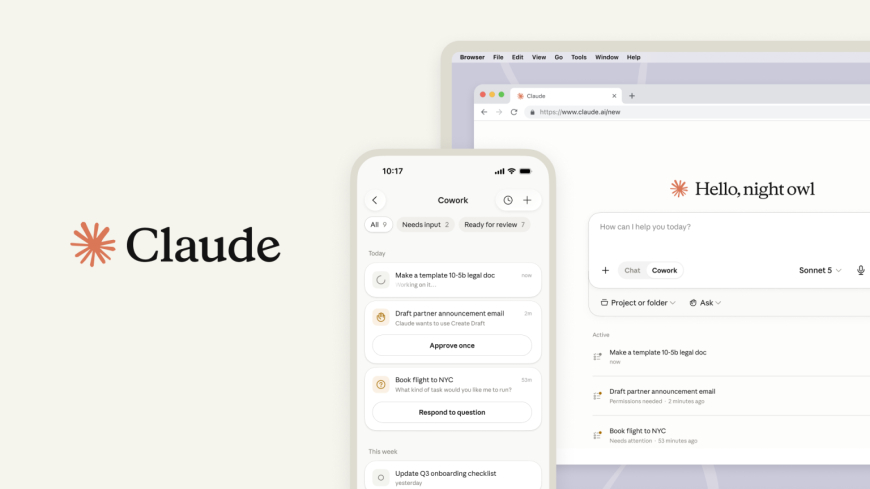
Anthropic is bringing Claude Cowork, its Claude Code-inspired AI agent designed for general workplace tasks, beyond the desktop. Starting Tuesday, the company is making Cowork available to Max subscribers on both web browsers and mobile devices, extending the product's reach across multiple platforms.
Originally introduced as a desktop application in January, Claude Cowork now allows users to start a task on their computer, receive progress updates on their phone, and return later to complete the work—even if the original desktop device is no longer running.
The broader rollout reflects Anthropic's ambition to position Cowork as more than a simplified coding assistant. Instead, the company envisions it as an AI-powered workplace colleague that operates quietly in the background, remains available across multiple devices, and requests user input only when decisions require human judgment.
In many ways, the expansion highlights how the competition among AI coding assistants is evolving into a broader race to build intelligent workplace agents that support everyday business operations.
The announcement also arrives as leading AI companies increasingly move beyond chatbot experiences and into the software environments where people actually complete their daily work.
OpenAI has taken a similar direction with Codex. While originally introduced as a software development assistant, Codex is increasingly used by professionals outside programming for tasks such as creating reports, managing spreadsheets, preparing presentations, conducting research, and analysing business data.
For both Anthropic and OpenAI, the strategic focus appears to be shifting away from simply building the best conversational AI and toward owning the digital workspace where productivity happens.
Anthropic has also been expanding Claude into other workplace applications. The company recently introduced Claude Tag, an always-available AI assistant integrated directly into Slack, where it serves as an AI teammate for everyday collaboration.
Beyond simply offering another interface, Anthropic says making Cowork available across desktop, web, and mobile devices enables AI tasks to continue running independently in the background, even when a user’s personal device is no longer connected.
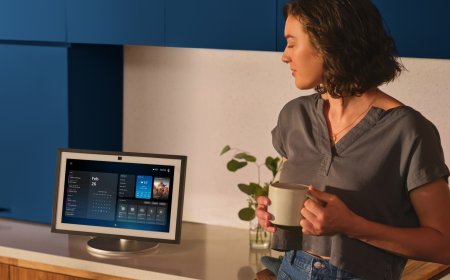
One example shared by the company illustrates this workflow: a user schedules Monday morning client preparation for 6 a.m., and Claude automatically reviews email conversations, meeting transcripts, and recent news coverage before generating a briefing document and preparing—though not sending—a follow-up email, allowing the user to review everything over coffee.
Anthropic says the desktop application will continue serving as the primary environment for deeper work, where Claude has access to local files and browser interactions. However, expanding Cowork to the web and mobile makes the service available to people who have never installed the desktop application. The company also plans to unify traditional Claude chat and Cowork across desktop and web, ensuring projects and generated artefacts remain synchronised across experiences.
Alongside the product expansion, Anthropic released early usage data that offers insight into how customers are using Cowork.
According to the company, the strongest adoption has come from what it describes as the “work around the work”—routine business responsibilities that support an employee’s primary job but are rarely considered central to their role.
The findings are based on a study of 1.2 million anonymised and aggregated Cowork sessions collected from more than 600,000 organisations during the final two weeks of May.
The largest usage category, accounting for 33.4% of all sessions, was business process operations. These tasks included consolidating updates into reports, creating onboarding checklists, and reconciling spreadsheets—activities commonly associated with finance, human resources, and administrative teams.
The second-largest category accounted for 16.4% of usage and focused on content creation and copywriting. Users relied on Cowork to draft documents, build presentation decks, write social media posts, prepare proposals, and produce other communications that marketing departments and management teams frequently handle.
By comparison, software development represented only 8.7% of total Cowork activity.
Commenting on the findings, Anthropic said everyday business tasks are rapidly becoming one of the most important applications for artificial intelligence.
“While coding is still—understandably—one of the uses of AI that gets the most attention, the use of AI for everyday business work is on the rise, and the kinds of tasks people are finding it most helpful for are coming into focus,” the company said.
Anthropic added that its objective is for this research to serve as a practical reference for organisations exploring how to integrate AI into daily operations, while also highlighting the areas where businesses appear to be generating the greatest value from AI-powered productivity tools.
What's Your Reaction?
 Like
0
Like
0
 Dislike
0
Dislike
0
 Love
0
Love
0
 Funny
0
Funny
0
 Angry
0
Angry
0
 Sad
0
Sad
0
 Wow
0
Wow
0