






























Inertia aims to bring one of the world’s most complex science experiments to market
Inertia is working to commercialise a highly advanced scientific experiment, aiming to turn cutting-edge research into real-world industrial applications.
Fusion energy startup Inertia Enterprises announced on Tuesday that it has entered into three agreements with Lawrence Livermore National Laboratory (LLNL) aimed at bringing the lab’s laser-based fusion reactor technology closer to commercial use.
These agreements could provide Inertia with a meaningful advantage over competing startups in the fusion space. The National Ignition Facility (NIF), operated by LLNL, remains the only experiment to demonstrate that a controlled fusion reaction can generate more energy than is required to initiate it. Inertia emerged publicly in February with a $450 million Series A funding round, placing it among the most well-funded companies in the sector.
Inertia and LLNL are collaborating on a fusion method known as inertial confinement. This approach creates the necessary conditions for fusion by compressing a small fuel pellet using external forces, in contrast to other methods that rely on strong magnetic fields to confine plasma until fusion occurs.
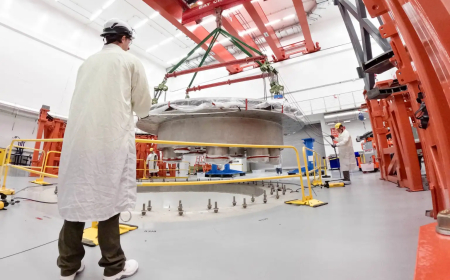
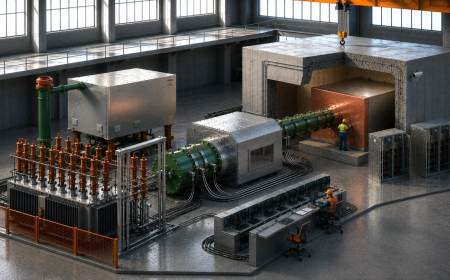
At the NIF, 192 powerful laser beams are directed into a large vacuum chamber, where they converge on a tiny gold cylinder known as a hohlraum, which contains a diamond-coated fuel pellet. When the lasers strike the hohlraum, it vaporises, producing X-rays that bombard the pellet inside. The diamond layer turns into plasma and expands, compressing the deuterium-tritium fuel at the core.
For this system to be viable for energy production, the entire process would need to repeat several times per second to generate a continuous power output for the grid.
The concept of a laser-driven fusion reactor dates back to the 1960s, when it was first explored as a safer means of studying thermonuclear weapons. Over time, scientists also recognised its potential for energy generation. Construction of the NIF began in 1997, and it took 25 years for researchers to reach a breakeven point, where the fusion reaction produced more energy than was required to start it.
Several startups — including Xcimer Energy, Focused Energy, and First Light Fusion — are now working to turn this concept into commercially viable power plants. Since the NIF relies on older laser technology, there is optimism that newer, more efficient laser systems could reduce the energy needed to trigger fusion, making it easier to achieve net-positive energy output at scale.
The agreements between Inertia and LLNL include two strategic partnership projects and one cooperative research and development agreement. Together, the organisations plan to advance laser technologies and refine fuel targets to improve both performance and manufacturability. As part of the collaboration, Inertia will also license nearly 200 patents from the lab.
The continued partnership between the two groups is not unexpected. Annie Kritcher, co-founder and chief scientist of Inertia, played a key role in designing the NIF experiment that achieved scientific breakeven. The CHIPS and Science Act, passed in 2022, enabled her to launch the company while maintaining her position at LLNL.
What's Your Reaction?
 Like
0
Like
0
 Dislike
0
Dislike
0
 Love
0
Love
0
 Funny
0
Funny
0
 Angry
0
Angry
0
 Sad
0
Sad
0
 Wow
0
Wow
0