


































Blue Origin’s New Glenn Rocket Suffers Major Explosion During Florida Test
Blue Origin’s New Glenn rocket exploded during a hot-fire test at Cape Canaveral, Florida, causing significant damage to the launch pad. No injuries were reported as officials launched an investigation into the incident.
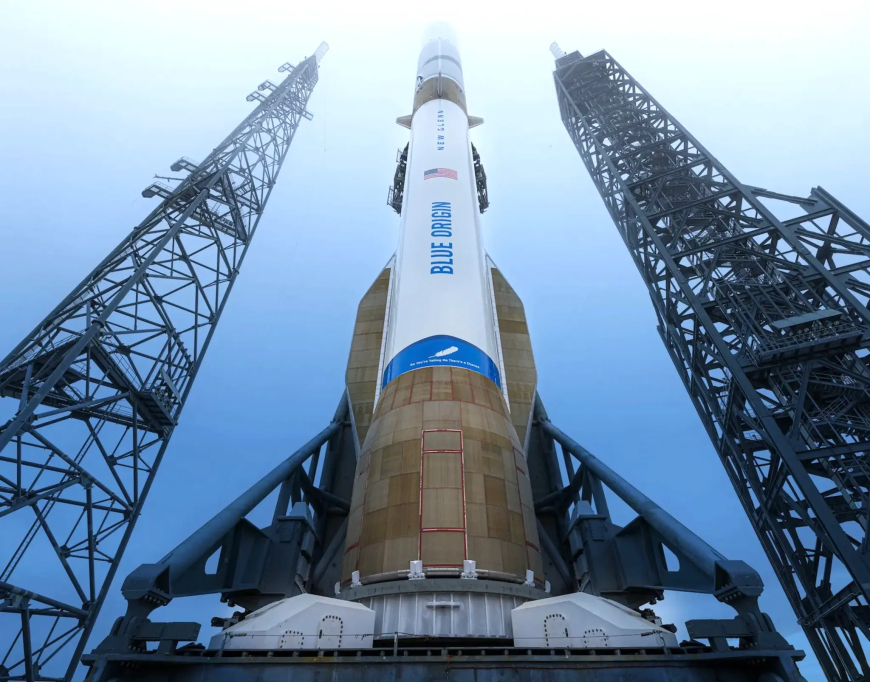
Blue Origin’s New Glenn heavy-lift rocket exploded during testing at a launch complex in Cape Canaveral, Florida, according to live coverage provided by NASASpaceFlight.com and SpaceFlight Now. The company later confirmed that the incident had occurred.
The space company founded by Jeff Bezos was conducting a static fire test in preparation for the rocket’s anticipated fourth flight in the coming weeks. That mission was expected to carry Amazon’s Leo internet satellites into orbit. Because the vehicle was likely fully fueled for the test, the event resulted in what appears to be one of the largest rocket explosions ever recorded in the United States and the most significant setback in Blue Origin’s history.
In a post on X Thursday evening, Blue Origin stated that all personnel had been accounted for, while Bezos separately confirmed that everyone involved was safe. The company did not provide details on the cause of the incident, describing it only as an “anomaly.”
“It’s too early to know the root cause, but we’re already working to find it. Very rough day, but we’ll rebuild whatever needs rebuilding and get back to flying. It’s worth it,” Bezos wrote.
Late Thursday, NASA Administrator Jared Isaacman said the agency would work alongside its partners to support a full investigation into the anomaly, evaluate any immediate mission impacts, and help return launch operations to normal.
In a statement provided, the Federal Aviation Administration (FAA) confirmed it was aware of the explosion and said there had been “no impact to air traffic.” NASA and the U.S. Space Force did not immediately respond to requests for comment.
The incident is expected to force Blue Origin to pause the New Glenn program for a significant period while engineers determine the cause of the failure. The company had planned to conduct as many as 12 New Glenn launches this year after spending roughly a decade developing the rocket to compete with SpaceX, led by Elon Musk.
Blue Origin is also scheduled to play a role in NASA’s Artemis lunar missions, with the agency highlighting the company’s contribution to the program earlier this week. Isaacman said NASA would provide updates regarding any effects on Artemis and Moon Base initiatives as additional information becomes available.
The company has also been working toward launching national security missions for the Pentagon.
“Most unfortunate. Rockets are hard,” Elon Musk wrote on X shortly after the explosion. “I hope you recover quickly.”
The latest setback comes only weeks after New Glenn completed its third flight. That mission ended unsuccessfully when the rocket’s upper stage failed to place an AST SpaceMobile satellite into orbit, resulting in the mission’s loss. Just last week, the FAA authorised New Glenn to resume flights after Blue Origin completed its investigation into the earlier failure.
A New Rocket With a Long Development History
Blue Origin spent years developing New Glenn while continuing to operate its New Shepard program, which served as a testing platform for smaller suborbital rockets. While New Shepard regularly carried paying customers, celebrities, and scientific payloads to the edge of space, the company was simultaneously building a launch vehicle capable of delivering major commercial payloads, including large satellites, into orbit.
The project ultimately took much longer than Blue Origin initially expected, but the effort culminated in January 2025 when New Glenn completed its maiden flight.
The rocket appeared successful from the outset. During its first mission, New Glenn successfully reached orbit, although the booster stage was lost before the company could attempt a landing on a drone ship stationed at sea.
The program achieved greater success during New Glenn’s second launch in November 2025. During that mission, Blue Origin delivered a pair of NASA spacecraft bound for Mars. The company also successfully landed a booster stage for the first time during the flight.
That achievement enabled Blue Origin to reuse the booster on New Glenn’s third mission, demonstrating not only recovery capabilities but also the ability to refurbish and relaunch the hardware. Reusability remains a critical factor in lowering launch costs and improving the economics of commercial spaceflight.
The reused booster performed successfully during its return flight and completed another landing on one of Blue Origin’s drone ships during the third mission in April 2026. However, the mission still suffered a setback when a cryogenic issue developed in the upper stage, ultimately causing the loss of the satellite payload.
The upcoming fourth mission was expected to mark the first of 24 launches contracted by Amazon. The company is currently building Leo, a satellite internet network designed to compete with SpaceX’s Starlink service. On Wednesday, Amazon highlighted its partnership with Blue Origin and described New Glenn as a reusable heavy-lift launch vehicle that would help deploy the constellation.
Amazon confirmed on Thursday evening that no Leo satellites were aboard the rocket during the test.
Late Thursday, Congressman Mike Haridopolos (R-FL), whose district includes Cape Canaveral, said on X that he had spoken with NASA Administrator Jared Isaacman regarding the explosion.
“I am grateful there were no reported injuries and thankful for the first responders, engineers, and launch crews who acted quickly. Praying for Florida’s Space Coast and everyone involved,” he wrote.
What's Your Reaction?
 Like
0
Like
0
 Dislike
0
Dislike
0
 Love
0
Love
0
 Funny
0
Funny
0
 Angry
0
Angry
0
 Sad
0
Sad
0
 Wow
0
Wow
0