

































Well, there goes the metaverse!
Meta is winding down its metaverse ambitions after years of heavy investment, layoffs at Reality Labs, and declining consumer demand for virtual reality, as the company shifts focus toward AI and smart glasses.
Meta’s enormous bet on virtual reality came to an end last week. According to The Wall Street Journal, the company laid off roughly 1,500 employees from its Reality Labs division — around 10% of the unit’s workforce — and shut down several VR game studios. It marks a dramatic reversal for a company that, only four years ago, tied its entire corporate identity to the metaverse.
Few people are likely to miss it.
As many industry watchers will remember, Facebook rebranded itself as Meta in 2021, promising to usher in a new era of technology led by virtual reality devices. Part of that decision was based on a belief that Gen Z preferred socializing in online games such as Fortnite and Roblox rather than on traditional social media platforms. The rebrand also served another purpose: helping Meta distance itself from the growing negativity surrounding the Facebook brand.
Over the years, Facebook’s reputation has been damaged by a long list of controversies. These included the Cambridge Analytica data privacy scandal; disclosures from whistleblower Frances Haugen, who released documents indicating the company was aware of its platforms’ adverse effects on children and teens; congressional hearings over Facebook’s digital surveillance practices; its role in the spread of misinformation; allegations of monopolistic behaviour and more.
At the time, Meta’s vision was that the metaverse would become the next central social platform, where users would interact in a virtual world through its Horizon Worlds app and play games with VR headsets.
Fast-forward to today, and that vision has largely been abandoned in favour of artificial intelligence.
According to CNBC, several internal Meta studios producing VR titles have been affected. These include Armature Studio, known for Resident Evil 4 VR; Twisted Pixel, which developed Marvel’s Deadpool VR; and Sanzaru Games, the studio behind Asgard’s Wrath. Meanwhile, the VR fitness app Supernatural — which Meta acquired in 2023 for $400 million — will stop producing new content and move into what the company calls “maintenance mode.” Camouflaj, the studio behind Batman: Arkham VR, has also been impacted by layoffs, as reported by GeekWire.
Last week, The Verge also reported that Meta is shutting down Workrooms, its initiative to bring virtual reality into the workplace.
These developments followed an earlier Bloomberg report from December stating that Meta was cutting the virtual reality division’s budget by as much as 30%. Around the same time, Meta announced it was pausing its program to license the Meta Horizon operating system — which runs on Quest-branded VR headsets — to third-party device makers.
Unlike the fanfare surrounding Meta’s rebrand, the deprioritization of its metaverse efforts comes as little surprise. Reality Labs lost money at an extraordinary pace, alarming investors, and never turned a profit.
In total, Meta funnelled roughly $73 billion into Reality Labs. To put that into perspective, spending $1 million every single day would take nearly 200 years to reach that level of investment.
“Building in the open” fails.s
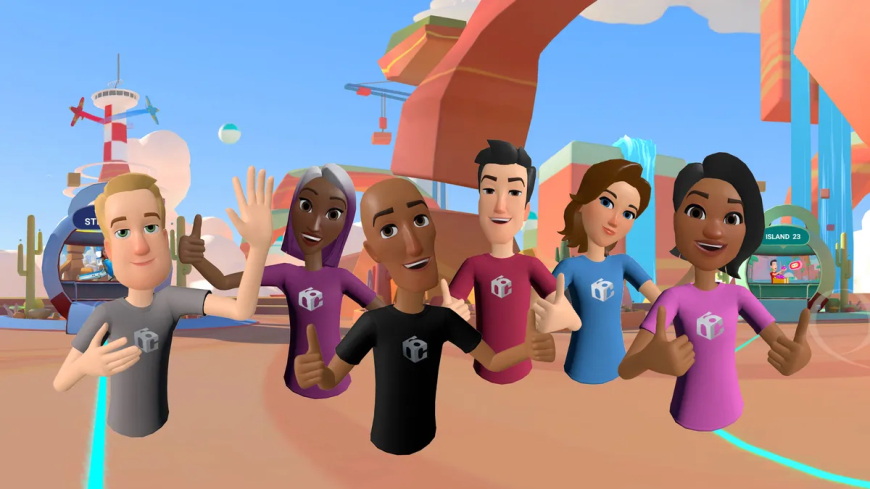
Beyond the hype from investors and analysts, early versions of the metaverse were not good products. The cartoonish, lifeless avatars didn’t even have legs, and one metaverse selfie shared by CEO Mark Zuckerberg was so poorly received that it quickly became a viral meme. In short, Meta overpromised a futuristic vision while its product failed to deliver.
This reflected a failure of the “build in the open” approach, where early-stage technologies are released to consumers with the expectation that feedback will drive rapid improvement.
That model works when users are genuinely excited about a new technology. In the metaverse, consumer interest remained limited.
Although Meta quickly gained a majority share of the VR market through its Oculus headsets, demand declined. Last spring, Counterpoint Research reported that global VR headset shipments fell 12% year over year in 2024, marking the third consecutive year of decline. Meta accounted for 77% of those shipments.
Meta bets on an app store model before VR scales
Meta’s strategy relied heavily on the “if you build it, they will come” mindset. The company appeared more focused on the potential profits from operating its own app and game platform than on whether consumers actually wanted to wear VR headsets at scale.
Zuckerberg, in particular, was seeking a way to bypass Apple and Google’s ability to collect fees from Meta’s revenue through their app stores.
“This period has been humbling,” Zuckerberg said during a keynote at the Facebook Connect 2021 event, referencing the Apple-Google duopoly. “Living under their rules has profoundly shaped my views on the tech industry. I’ve come to believe that the lack of choice and high fees are stifling innovation, stopping people from building new things, and holding back the entire internet economy.”
Zuckerberg predicted that the metaverse could grow to a billion users within a decade and host “hundreds of billions” of dollars in digital commerce. Analysts at firms such as McKinsey & Co. and investment bank Citi echoed those forecasts, projecting the metaverse could become a multi-trillion-dollar market by 2030.
A tiny fraction of Meta’s users adopted VR.
Despite Meta’s ambitions, the adoption of metaverse apps remained small for a company of its scale.
Meta does not provide public visibility into its VR app store, but downloads of the Horizon app on iOS and Android offer a rough proxy. According to estimates from app intelligence firm Apptopia, the Meta Horizon app has been downloaded 60.4 million times globally and 39.8 million times in the U.S. since May 2018.
A better indicator is engagement. Apptopia data from a U.S. panel shows average sessions per daily active user grew from 3.49 in January 2023 to 4.93 in January 2026. While that represents a high-water mark for the app, it was still modest.
For comparison, Meta’s non-VR platforms — Facebook, Instagram, WhatsApp, and Messenger — collectively serve more than 1.5 billion daily active users.
Had the metaverse succeeded, Meta might have built a new social empire powered by VR gaming, similar to Facebook’s early days when partners like Zynga drove double-digit revenue streams with games such as FarmVille and Words With Friends. Ultimately, however, Meta moved too quickly to extract revenue from developers.
Rather than undercutting Apple or Google’s standard 30% fees, Meta charged more. Even before VR became a mature platform, Meta announced it would take a 47.5% cut of digital asset sales within Horizon Worlds — consisting of a 30% hardware platform fee and an additional 17.5% Horizon Worlds fee. Developers reacted negatively.
Metaverse harassment and assaults make headlines.
Compounding these issues, Meta failed to prioritize user safety from the start. As with its social platforms, the company took a largely reactive approach. It rolled out its “Personal Boundary” feature — which places space between avatars — only after reports emerged of sexual harassment in Horizon Worlds. In some cases, users reported incidents of virtual rape and gang rape.
Meta later weakened the feature by defaulting it to “on” only when users interacted with non-friends and allowing it to be turned off entirely.
In May 2022, Meta outlined tools such as blocking, reporting, a “safe zone” button to mute others instantly, and temporary removal of disruptive users. Despite detailing these features, the company declined to specify what actions it would take against repeat offenders.
At the time, users were told that reporting abuse was often impractical. Many removed their headsets during incidents, and by the time they returned, it was too late to submit a report with video or audio evidence attached.
Clear policies defining abuse were slow to appear. Even after a metaverse code of conduct was published, it failed to outline concrete consequences beyond stating that Meta would “take action on users.” Around the same period, Meta also declined to share demographic details about the team building the metaverse.
AR, mixed reality, and AI proved more popular.
Another major blow to the metaverse came from the success of Meta’s Ray-Ban AR glasses. Featuring hands-free recording, music streaming, and interaction with Meta AI, the glasses saw rising consumer demand in 2024 and reportedly outsold traditional Ray-Bans in some retail locations. Bloomberg recently reported that Meta is considering doubling production to meet demand.
With a growing focus on AI, Meta also introduced Ray-Ban Display glasses last year, which include a built-in display for apps, alerts, and navigation. The company has since paused international expansion plans for the product, citing “unprecedented demand.”
As companies including OpenAI, Amazon, and various startups explore AI-first hardware as the next computing platform, VR increasingly looks like a relic of an unrealized vision.
Taken together — declining consumer interest, safety issues, limited adoption, and the rapid rise of AI — Meta has little justification for continuing to pour money into virtual reality. Instead, the company is focusing on AI models, AI-powered applications, smart glasses, and other products it believes still have room to grow, leaving the metaverse largely behind.
What's Your Reaction?
 Like
0
Like
0
 Dislike
0
Dislike
0
 Love
0
Love
0
 Funny
0
Funny
0
 Angry
0
Angry
0
 Sad
0
Sad
0
 Wow
0
Wow
0