
































AI Spending Growth Slowed in August as Top Firms Cut Per-Employee Spend
Ramp data shows business AI adoption growth slowed in August, while per-employee AI spending at the top 1% of AI-using firms fell nearly 10% from July.
Business adoption of AI tools slowed in August, according to spending data from payments company Ramp, while the biggest AI-spending companies also reduced their per-employee spend.
Ramp’s data, drawn from about 70,000 companies, showed that 56% of its customers paid for AI products in August, up just 0.4% from July. The Ramp AI Index has recorded similar seasonal weakness before, with adoption showing little or no growth between August and October last year before accelerating again later in the year.
That makes it hard to tell whether August reflects a temporary summer slowdown or a more meaningful shift in demand. The distinction matters for AI labs and hyperscalers investing heavily in infrastructure, expecting growing business usage to generate enough revenue to support that spending.
AI spending fell among the heaviest users
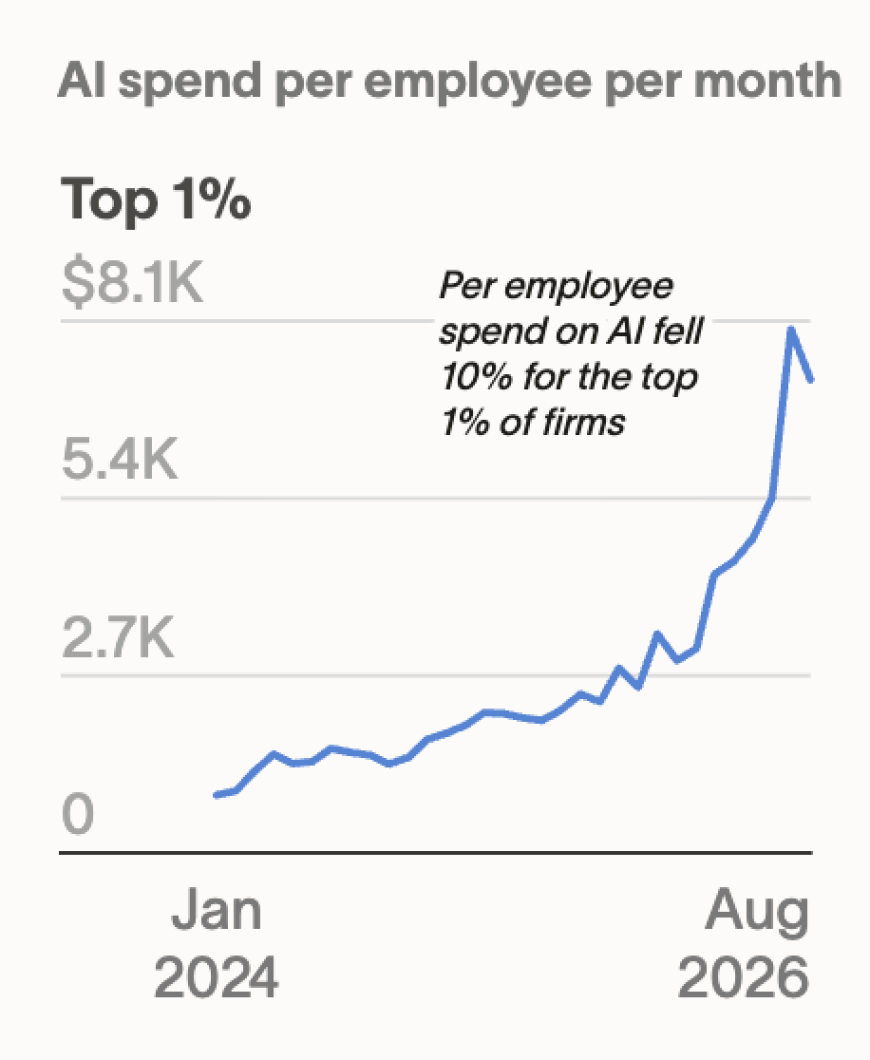
Ramp economist Ara Kharazian highlighted another notable change: AI spending per employee among the top 1% of AI-using companies in the sample fell nearly 10% to $7,205.
Part of that decline may reflect lower summer activity, but AI usage is also becoming cheaper. Average token costs fell to $0.68 per million tokens from a 2026 peak of $1.15 per million in March as companies including OpenAI and Anthropic lowered prices.
Ramp’s data suggests increased usage has not yet fully offset those price reductions. Some customers are also choosing older, lower-cost AI models rather than the newest frontier releases, reducing the amount they need to spend for comparable workloads.
“We are showing that competition between OpenAI and Anthropic is making AI more accessible, and also driving the price down for companies,” Kharazian said, adding that spending is also falling among the top 1% of companies previously expected to contribute heavily to future growth.
Ramp data shows higher adoption than broader surveys
Ramp’s customer base is more technology-focused than the overall U.S. business population, which means its figures may overstate nationwide AI adoption. A continuing U.S. Census Bureau business survey, updated Aug. 23, found that 22% of businesses reported using AI.
Ramp’s figures are therefore not necessarily representative of the wider economy, but they offer one of the relatively few data sets based directly on company spending.
Open-weight models also remain a relatively small part of business AI spending. Only 6.4% of AI-spending companies in Ramp’s sample used model-serving or inference platforms in August, although that share continues to rise.
The latest numbers could be unfavourable for model developers relying on rapidly increasing token consumption, but falling prices benefit companies buying AI services. As Kharazian put it, the interpretation depends on where a company sits in the market: for businesses using AI, lower costs are a positive development.
What's Your Reaction?
 Like
0
Like
0
 Dislike
0
Dislike
0
 Love
0
Love
0
 Funny
0
Funny
0
 Angry
0
Angry
0
 Sad
0
Sad
0
 Wow
0
Wow
0