





































Amazon explores Nobel Prize-inspired dehumidification technology to reduce energy consumption
Amazon is investing in advanced dehumidification technology inspired by Nobel Prize-winning research to lower energy use and improve cooling efficiency.
It’s not just your imagination — restaurants, shopping centres, and office buildings during humid summer days are often kept colder than necessary. Air conditioning systems are used not only for cooling but also for removing moisture from the air, particularly in hot, humid regions like the southern United States, where excess humidity can lead to mould growth.
“The reason they blast the air conditioner so much is that they’re trying to reduce the humidity,” said Sorin Grama, co-founder and CEO of Transaera. “In some cases in commercial buildings, the air is so cold that they have to reheat it back up.”
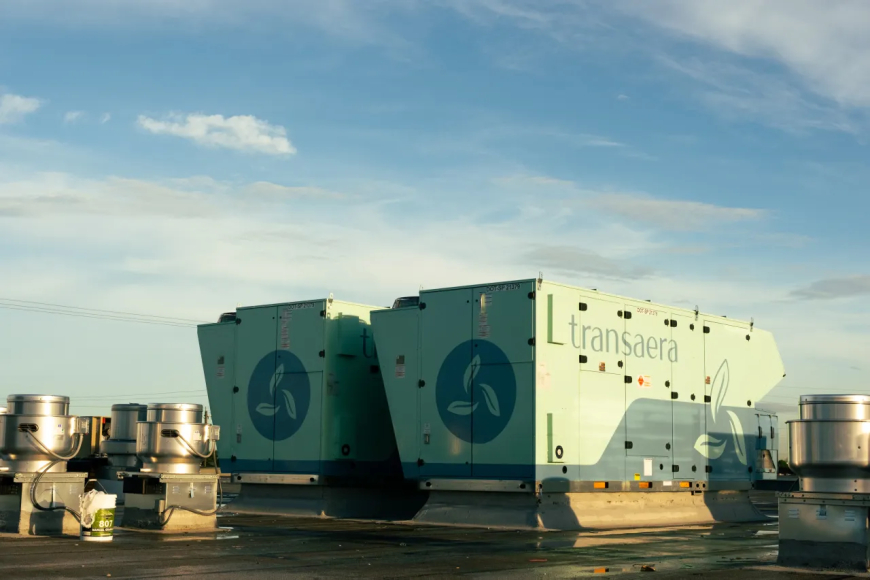
To address this inefficiency, Transaera has developed a new type of ventilation system that the company says significantly improves dehumidification efficiency, helping users cut both energy consumption and operating costs.
Amazon, which has been testing the system in Houston for several months, has recently signed on as a customer. According to Grama, other organisations are also adopting the technology, with Transaera reporting “nine figures” in projected purchase commitments. For Amazon, the agreement secures production capacity over the next three years.
“Amazon is considering this a design solution,” Grama said. “Once they find a solution that works, they put that into their design standard and replicate it across their building stock.”
The system, referred to as a dedicated outdoor air system (DOAS), is designed to maintain fresh indoor air while reducing the workload placed on traditional air conditioning systems. It can remove up to 100 pounds of moisture from the air per hour, so cooling systems do not need to operate as intensively.
While DOAS technology itself is not new, Transaera claims its version can be up to twice as efficient at removing humidity compared to existing solutions.
The key innovation lies in the company’s use of a specialised desiccant material that coats a rotating six-foot wheel inside the unit. “It’s like silica gel on steroids,” Grama explained. Although the company has not disclosed the exact composition of the material, it is based on a class of substances whose discovery was recognised with a Nobel Prize in 2025.
As air enters the system, the desiccant absorbs moisture before the air passes through a heat exchanger and is circulated throughout the building. At the same time, stale air is extracted from the exchanger along with heat and directed through the moisture-laden wheel. This heat releases the moisture captured by the desiccant, allowing it to be expelled outside.
Amazon stated that deploying Transaera’s DOAS units will help reduce its overall energy consumption and support its goal of achieving net-zero carbon emissions by 2040.
To scale production, Transaera is collaborating with established manufacturers, including those based in the United States. Its proprietary desiccant system is designed to integrate seamlessly into standard commercial HVAC equipment.
“It’s a like-for-like replacement of a legacy unit,” Grama said. “I think that’s what’s driving this demand — it’s an easy replacement.”
What's Your Reaction?
 Like
0
Like
0
 Dislike
0
Dislike
0
 Love
0
Love
0
 Funny
0
Funny
0
 Angry
0
Angry
0
 Sad
0
Sad
0
 Wow
0
Wow
0