








































CopilotKit secures $27M to expand app-native AI agent development
CopilotKit has raised $27 million to help developers build and deploy app-native AI agents, accelerating the adoption of AI-powered software experiences.
Many companies today integrate AI into their products primarily as chatbots: users type or dictate requests, and the AI attempts to execute them. However, this approach often feels clunky. A text-based interface doesn't always translate into a seamless experience — for instance, when using a travel app to plan an entire itinerary, but having to sift through long blocks of text to get usable information.
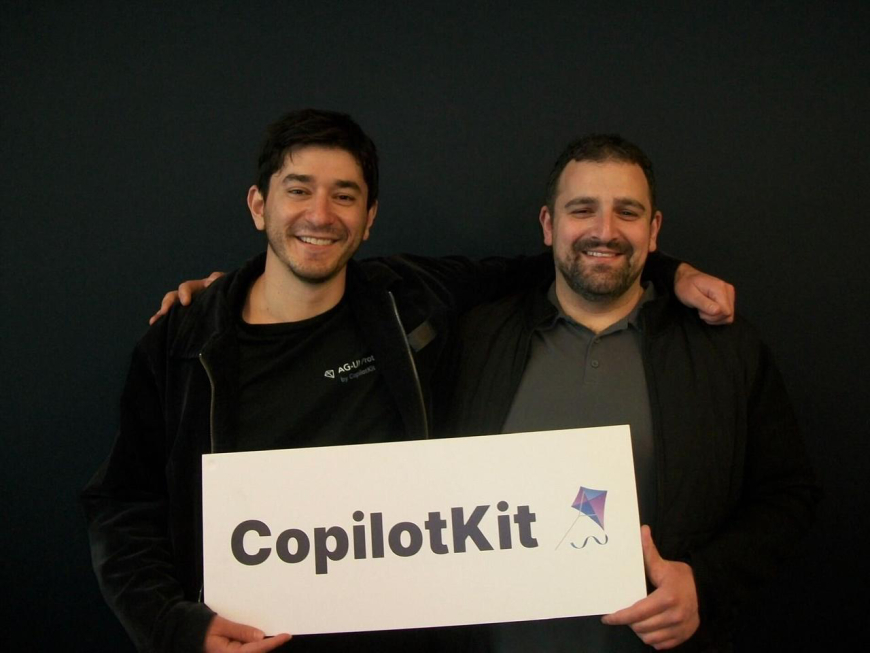
According to the founders of CopilotKit, this model underutilises the capabilities of AI agents and large language models. Co-founders Atai Barkai and Uli Barkai argue that the next step is to embed AI agents directly into applications so they can understand user actions, perform tasks, and present intuitive interfaces rather than returning lengthy text responses.
The company's widely used AG-UI protocol addresses part of this vision. This open-source standard defines how AI agents interact with user interfaces — such as web apps or browsers — enabling features like streaming chat, front-end tool execution, and shared state management that support human-in-the-loop workflows. In essence, AG-UI equips developers with the framework needed to integrate AI agents natively into their applications.
On top of AG-UI, CopilotKit is building an enterprise-focused toolkit that includes support services, self-hosting capabilities, and other essential features for businesses deploying AI agents within their products. To accelerate this effort, the Seattle-based startup has raised $27 million in a Series A funding round led by Glilot Capital, NFX, and SignalFire.
A key differentiator is the fser interface's flexibility. Atai Barkai explained that developers can define UI components and specifications, enabling AI agents to generate interfaces suited to specific user contexts dynamically.
"The agent can reply to you, not just with blocks of text, but with interactive UIs that your own company defines," Atai said. "If, for example, a user asks for breakdown of revenue by category, instead of getting this kind of big, impenetrable paragraph, you get a pie chart, and it's your own design of the pie chart that the user can interact with […] So all of your agents can, very trivially, speak to a UI and use these catalog of components and show that to users."
He also noted that developers retain precise control over how much autonomy the AI agent has in modifying the interface — from strictly "pixel-perfect" designs to more flexible, component-based layouts assembled dynamically by the AI.
The funding comes amid strong adoption of both AG-UI and CopilotKit. The protocol, which works alongside standards such as the Model Context Protocol (MCP) and Agent2Agent (A2A), is supported by major infrastructure providers, including Google, Microsoft, Amazon, and Oracle, as well as frameworks such as LangChain, Mastra, PydanticAI, and Agno.
Atai said that AG-UI and CopilotKit together see millions of installations each week, with a significant share of Fortune 500 companies already using the protocol and tools in production. Enterprise customers include Deutsche Telekom, DocuSign, Cisco, and S&P Global.
To further capitalise on demand, the company is launching CopilotKit Enterprise Intelligence, a self-hostable package that bundles the infrastructure components required to deploy AI agents within applications fully.
Competition in the enterprise AI agent tooling space is intensifying. Vercel offers an open-source AI SDK for building similar applications, while assistant-ui provides UI components for chatbot experiences. OpenAI also offers its Apps SDK for building richer interfaces, though it is currently limited to use within ChatGPT.
Atai Barkai emphasised that CopilotKit differentiates itself by offering a horizontal, enterprise-friendly approach. Rather than providing a vertically integrated stack, it is designed to integrate with whatever frameworks, cloud providers, or back-end systems enterprises already use.
"If there are two things we hear in almost every single enterprise conversation, enterprises want optionality, and they want self-hosting," he said. "Maybe they're already using the Google, Amazon, Oracle, Microsoft, LangChain, Mastra stacks. They want optionality, and they want self-hosting, and these are two things that they don't really get in the Vercel stack."
Maintaining this open positioning will be key. Companies building on open-source infrastructure often face the challenge of balancing neutrality with monetisation. However, Atai noted that AG-UI remains fully open, while CopilotKit's commercial offering is designed to strengthen the ecosystem for enterprise use rather than replace it.
"They're very much complementary. Our strategy is to be the default choice in the ecosystem, and then to monetise the top enterprises," Uli Barkai added. "So it's very much in our interest that the open source is the best out there, and the 95% of users can just go build and get started without paying anyone or talking to anyone."
CopilotKit currently employs around 25 people and plans to use the new funding to expand its team.
What's Your Reaction?
 Like
0
Like
0
 Dislike
0
Dislike
0
 Love
0
Love
0
 Funny
0
Funny
0
 Angry
0
Angry
0
 Sad
0
Sad
0
 Wow
0
Wow
0