































Energy storage industry set aggressive goals for 2025 — and already crushed them
The U.S. energy storage industry has already surpassed its ambitious 2025 target, deploying over 40GW of battery capacity as startups and new technologies accelerate nationwide growth. From lithium-ion systems to next-generation storage innovations, the sector is expanding rapidly and reshaping the future of the American power grid.
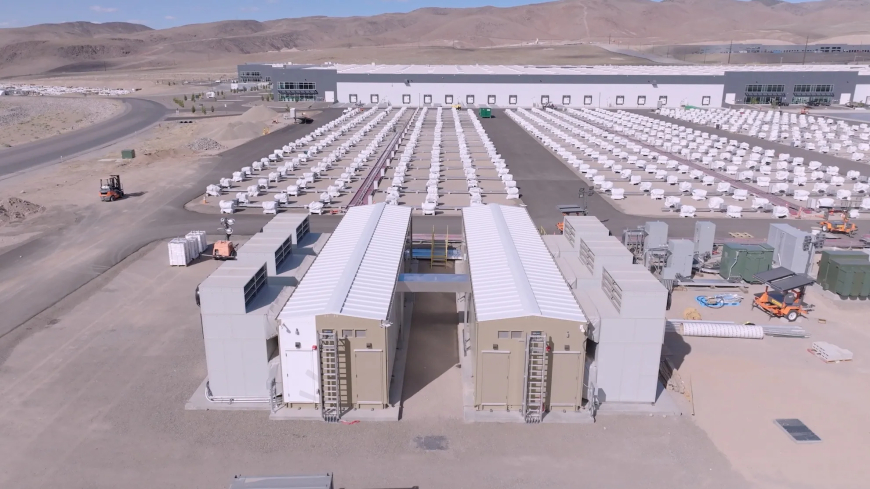
Nearly a decade ago, when the energy storage market was still in its early stages, an industry organisation set an ambitious target: by the end of 2025, the U.S. would deploy 35 gigawatts of grid-connected battery storage.
So how did the storage industry perform? In the third quarter alone, 4.7 gigawatts of batteries were installed. Altogether, more than 40 gigawatts have now been deployed — and the year isn’t even over yet, Canary Media reported. In just eight years, energy storage has grown from a small segment into one of the most significant contributors to new power to the U.S. grid.
Even more striking is that this represents nearly half of all new renewable capacity added to the grid from July through September. Overall, this year, renewables have been the leading source of new energy capacity, according to data from the Federal Energy Regulatory Commission.
A significant portion of the new storage capacity has been added in Arizona, California, and Texas — states where the electrical grid has faced considerable stress in recent years. Experts note that advances in those regions can help accelerate deployment in other parts of the country, such as the Midwest and East Coast, where rising data centre construction is putting pressure on local grids.
Startups have been paying attention to this trend.
Redwood Materials — co-founded by Tesla veteran JB Straubel — expanded its business in June by launching a new division focused on repurposing used EV batteries for grid-scale storage. The company identified two overlapping patterns: many batteries arriving at its recycling facilities still retained substantial usable capacity, and the grid storage sector was experiencing explosive growth.
Redwood plans to deploy 20 gigawatt-hours of energy storage by 2028. Investors have responded enthusiastically, contributing another $350 million to support the new division.
Another startup, Base Power, has pursued a different strategy by leasing batteries directly to homeowners and aggregating them into a large virtual power plant. Based in Austin, the company raised $1 billion in October to build a battery manufacturing facility and expand beyond Texas. So far, it has deployed more than 100 megawatt-hours of residential batteries within the state.
Although lithium-ion batteries dominate current installations, several startups are innovating with technologies that could dramatically lower costs.SiEnergy is developing a novel approach to storing electricity in flexible reservoirs floating on the open ocean. Powerth Power uses carbon blocks to store heat at extremely high temperatures, aiming to deploy them in 2028 at a cost lower than lithium-ion systems or natural gas peaker plants. XL Batteries is rolling out flow-battery systems at petrochemical storage sites, enabling hundreds of megawatt-hours of storage using existing infrastructure. Meanwhile, Cache Energy has developed low-cost calcium hydroxide pellets that can store energy for months with minimal losses.
Collectively, these efforts highlight an industry undergoing exponential growth. When paired with solar and wind — still the cheapest sources of new electricity — energy storage has the potential to reshape both global energy markets and the U.S. power grid.
What's Your Reaction?
 Like
0
Like
0
 Dislike
0
Dislike
0
 Love
0
Love
0
 Funny
0
Funny
0
 Angry
0
Angry
0
 Sad
0
Sad
0
 Wow
0
Wow
0