






































Google’s Deepfake Detection Technology Exposes Fake McConnell Hospital Image
Google’s SynthID deepfake detection technology helped identify an AI-generated image falsely showing Senator Mitch McConnell in a hospital bed. Learn how the system works and why it matters in the fight against online misinformation.
Google’s AI watermarking technology, SynthID, has played a key role in exposing a widely shared AI-generated hoax image, marking one of the system’s most notable real-world successes to date.
Earlier this week, an image began circulating across social media platforms that appeared to show Kentucky Senator Mitch McConnell lying in a hospital bed connected to multiple medical tubes and in an extremely critical condition. The picture spread rapidly across platforms including Reddit and X. By Wednesday, however, the fact-checking organisation Snopes confirmed that the image was not authentic after identifying Google’s SynthID watermark embedded in it, indicating that the picture had been generated using artificial intelligence.
The detection demonstrated the technology functioning exactly as intended, providing an important example of how AI watermarking systems can help identify and counter the spread of deepfake content online.
Speculation surrounding Senator McConnell’s health has intensified since he was admitted to the hospital following an emergency call on June 14. Since then, the senator has remained largely out of public view, leading to widespread rumours about his medical condition. In this instance, however, the viral hospital image was shown to be entirely fabricated.
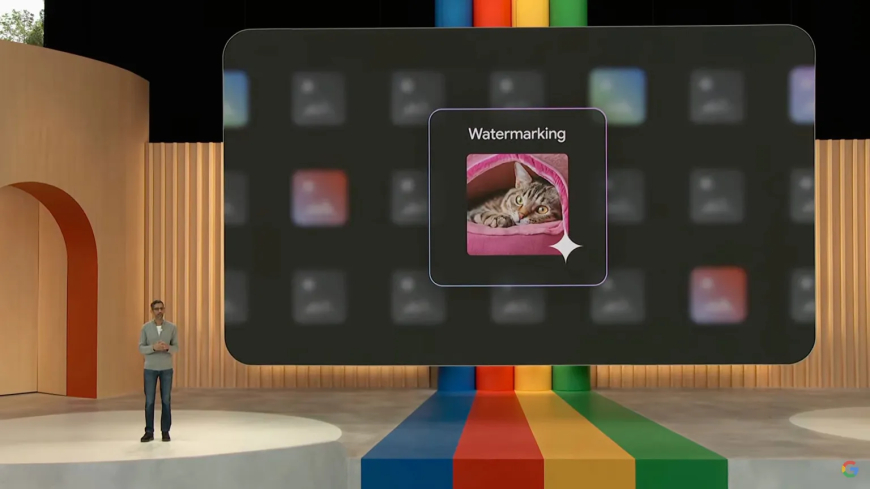
Google first introduced SynthID during its I/O developer conference in 2025. The system embeds an invisible digital watermark directly into AI-generated images. Although the watermark is not visible to the human eye, it can be detected by SynthID verification tools. Because the identifier becomes part of the image itself, it remains intact even if the image is copied, compressed, or shared across multiple platforms through screenshots, as happened with the fake McConnell image.
One important limitation of SynthID is that it only works with AI image generators that choose to implement the watermarking system. Google’s Gemini image-generation models have included SynthID since their launch in 2025. OpenAI joined the initiative in May 2026 as part of broader efforts to reduce the spread of malicious AI-generated images. Anthropic, however, does not currently participate in the SynthID programme.
Users who want to verify whether an image contains the SynthID watermark can do so by asking a Gemini model to analyse the image or by uploading it to OpenAI’s publicly available image verification tool.
What's Your Reaction?
 Like
0
Like
0
 Dislike
0
Dislike
0
 Love
0
Love
0
 Funny
0
Funny
0
 Angry
0
Angry
0
 Sad
0
Sad
0
 Wow
0
Wow
0