







































Meta to Start Manufacturing Its New AI Chips This September
Meta will begin producing its new in-house AI chips in September as it expands AI infrastructure, reduces dependence on third-party chip suppliers, and strengthens its long-term artificial intelligence strategy.
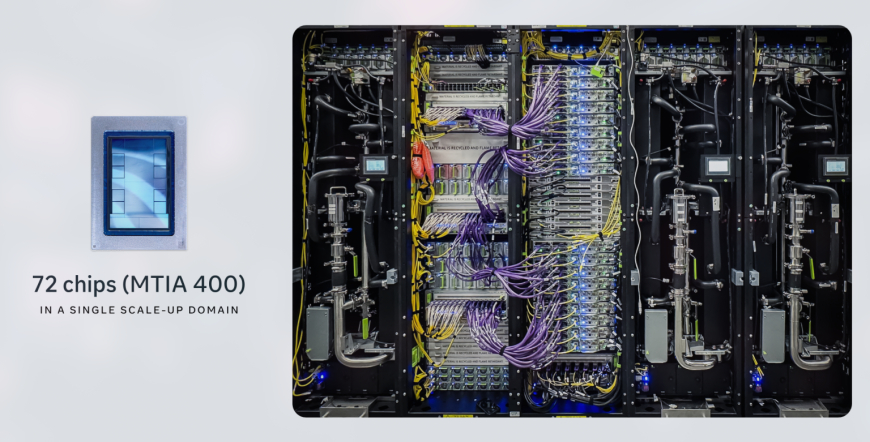
Meta is preparing to begin production of the latest generation of its in-house AI chips in September as the company looks to reduce its dependence on expensive GPUs during an ongoing shortage of AI hardware components. Reuters reported the development, citing an internal company memo.
According to the report, at least one of the new chips completed its testing phase in approximately six weeks. Meta is developing the chips in partnership with Broadcom, while Taiwan Semiconductor Manufacturing Company (TSMC) will handle manufacturing. The company is also sourcing memory from Samsung, storage components from SanDisk, and fibre-optic equipment from Sumitomo Electric, Reuters reported.
Meta first unveiled the four new processors under its Meta Training and Inference Accelerator (MTIA) programme in March. Some of the chips are already being deployed, while others are expected to roll out later this year or in 2026. The company has adopted a modular design strategy, allowing future chip generations to evolve more quickly as AI workloads continue to change.
At the time of the announcement, Meta said each new MTIA generation builds on previous versions by using modular chiplets, incorporates the latest advances in AI hardware, and is designed for a faster development cycle.
The company expects the chips to reduce its reliance on GPUs supplied by Nvidia and AM. However,h Reuters reported that Meta will continue purchasing significant amounts of hardware from both companies. The new processors are intended to support AI model training for Meta’s recommendation and ranking systems, broader AI workloads, and inference across the company’s family of applications. Meta has been designing its own AI chips since 2023.
Meta continues to invest heavily in AI infrastructure. In April, the company said it expects capital expenditures of between $125 billion and $145 billion this year, with a substantial portion allocated to expanding its artificial intelligence capabilities.
To support those ambitions, Meta has signed numerous data centre and energy agreements worldwide while investing tens of billions of dollars to secure the computing capacity required for its Muse Spark family of AI models. Reuters, citing the internal memo, reported that Meta plans to deploy 7 gigawatts of AI compute capacity this year and double it next year.
The company has also expanded partnerships with several major technology suppliers. Last year, Meta signed an agreement with Arm to strengthen compute resources for its recommendation systems, in addition to multi-billion-dollar deals with AMD for Instinct GPUs and with Amazon to use the cloud provider’s in-house processors for AI workloads.
Meta is not alone in pursuing custom AI hardware. OpenAI recently introduced its own inference processor developed with Broadcom, while Anthropic is reportedly exploring chip development with Samsung. Amazon and Google have also invested heavily in designing their own AI processors, joining a growing number of startups working to address the rapidly increasing demand for AI computing infrastructure.
What's Your Reaction?
 Like
0
Like
0
 Dislike
0
Dislike
0
 Love
0
Love
0
 Funny
0
Funny
0
 Angry
0
Angry
0
 Sad
0
Sad
0
 Wow
0
Wow
0