






































How India’s Gig Workforce Is Helping Train the Next Generation of Robots
Discover how India’s fast-growing gig economy is powering global robotics training through data labelling, AI support, and human-assisted automation services.
India’s online services economy has expanded rapidly over the past few years. Food delivery giants like Zomato and Swiggy have gone public, cloud kitchens have multiplied across cities, and home-service startups such as Urban Company, Snabbit, and Pronto have become increasingly popular among consumers.
Now, Silicon Valley-based startup Human Archive is trying to turn that workforce boom into something entirely different: training data for robots.
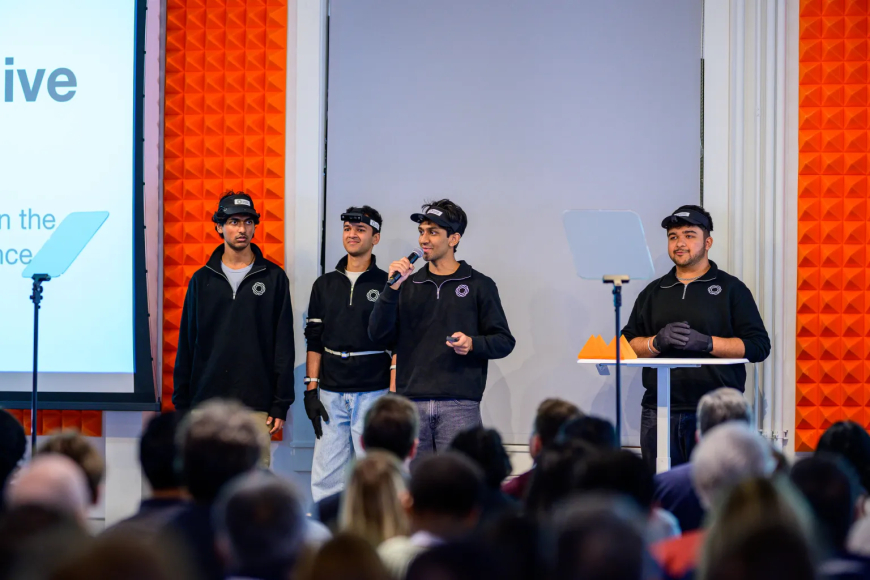
The company is partnering with businesses across India to equip workers with specially designed camera-enabled caps that record egocentric, or first-person, video footage of everyday tasks. The collected footage is intended to help train robots and AI systems to understand better and perform real-world physical work.
Human Archive did not publicly identify the companies it is currently working with, but said its partnerships span home services, hotels, and restaurants. According to the startup, more than 1,000 active headsets are already deployed across multiple locations.
The traction has helped Human Archive secure fresh funding. On Tuesday, the company announced it had raised $8.2 million from investors including Wing Venture Capital, NVP Capital, Y Combinator, and angel investors connected to OpenAI, Nvidia, Google, Meta, Mercor, AfterQuery, BAIR, SAIL, and Brad Boa.
Human Archive was founded by four students — Samay Maini, Rushil Agarwal, Shloke Patel, and Raj Patel — with three from UC Berkeley and one from Stanford. Raj Patel currently serves as the company’s CEO. All four founders have backgrounds in robotics, hardware systems, and tactile data research.
The startup’s business model is built around a growing challenge facing the AI industry. Robotics companies and advanced AI labs are racing to develop machines capable of handling physical tasks in real-world environments. However, one of the biggest obstacles is the lack of large-scale, high-quality training data showing humans performing everyday work.
Human Archive believes India’s rapidly growing gig economy provides an ideal environment for collecting that data at scale.
Despite working with several partners, the company said it also faced rejection from major Indian home-service startups, including Urban Company and Pronto.
The issue gained public attention after the Indian publication Entrackr reported that Pronto had explored partnerships to collect worker data for robotics training. The report also said Snabbit had held discussions with Human Archive before the collaboration fell apart.
Urban Company CEO Abhiraj Singh Bhal later posted on X that his company would not participate in such data-sharing arrangements. Patel responded publicly, arguing that companies unwilling to adapt risk losing relevance as robotics technology evolves. Human Archive co-founder Rushil Agarwal also claimed that Pronto founder Anjali Sardana had dismissed the idea during discussions. However, Pronto denied insulting him and said it simply chose not to proceed.
Beyond simple video recording, Human Archive is differentiating itself by developing additional hardware systems to collect more detailed data. The company is working on tactile gloves, wrist-mounted cameras, full-body motion-capture suits, and other devices capable of capturing synchronised data, including movement, force feedback, and RGB-D imagery, which combines colour visuals with depth data.
The startup argues that video alone is insufficient to train advanced robots effectively. Combining visual data with motion and tactile feedback could make the datasets significantly more valuable for AI labs.
Initially, Human Archive relied on iPhones and off-the-shelf recording equipment. Over time, the company began building custom hardware systems designed to work together across multiple data-collection methods. Patel said the company now has more than 50 devices deployed to gather various forms of data.
“To capture data, we started with iPhones, then developed custom rigs and camera caps,” Patel explained during a recent interview. “Now we use more than seven different hardware products interchangeably across different modalities, while synchronising data from multiple sources.”
The company is also working on methods to fine-tune AI models using its own datasets and test them directly on robots. Human Archive believes this will help demonstrate the quality and usefulness of its data to potential clients.
Wing Venture Capital partner Zach DeWitt said the startup’s ability to collect synchronised data from multiple sensors gives it a significant advantage.
“No one else has managed to synchronise headset RGB-D, force feedback, full-body motion capture, and chest and wrist camera data at this scale,” DeWitt said. “Major labs and universities are interested because of both the novelty of the sensors and the size of the datasets being developed.”
Although some larger companies declined to work with Human Archive, the startup partnered with smaller service providers. It introduced a system in which customers could choose between discounted services with recording enabled and full-price unrecorded visits.
Patel said many consumers accepted the recording option because service disputes are relatively common, and video evidence can help resolve disagreements over work quality.
Workers participating in the data-collection program currently receive a base rate of around $1 per hour. Other reports suggest competing companies offer significantly higher rates, ranging from roughly $2.60 to $4.20 per hour. Patel acknowledged competitors may pay more, but said Human Archive’s direct presence in India allows it to operate more efficiently.
“Human Archive’s network provides flexible earning opportunities while helping build infrastructure for future AI systems,” DeWitt said.
Still, the company’s approach has also sparked privacy concerns. Critics have questioned how clearly workers understand the long-term use of the footage being collected. Human Archive said its contracts comply with India’s Digital Personal Data Protection Act and that participants receive privacy notices and consent information explaining how the data will be processed.
The startup also said all data is anonymised and that faces are blurred in recordings before the information is shared or processed further.
Last week, Moneycontrol reported that India’s Ministry of Electronics and Information Technology had begun examining the consent mechanisms and data-collection practices used by companies gathering egocentric worker footage.
While India remains the company’s primary focus, Human Archive has started expanding into Southeast Asia and the United States. It is also building a broader platform that would allow anyone to participate in data collection and earn income.
The startup eventually hopes to offer home services, such as cleaning and cooking, in the U.S. through workers who participate in its data-collection network. However, those efforts are currently still in the pilot stage.
As competition intensifies among robotics and physical AI companies, the demand for large-scale real-world training data is expected to grow significantly. Human Archive is betting that its ability to collect synchronised human activity data at scale will make it a valuable supplier to the next generation of AI and robotics labs.
Whether that strategy succeeds may ultimately depend on the partnerships it can secure, the scale of the datasets it can build, and how effectively it addresses growing concerns about worker privacy and data collection.
What's Your Reaction?
 Like
0
Like
0
 Dislike
0
Dislike
0
 Love
0
Love
0
 Funny
0
Funny
0
 Angry
0
Angry
0
 Sad
0
Sad
0
 Wow
0
Wow
0