






































XPRIZE Founder Peter Diamandis Sparks Debate Over Global Surveillance and Human Behaviour
XPRIZE founder Peter Diamandis says people behave better when they are being watched, reigniting the global debate over surveillance, privacy, transparency, and accountability. Read the latest developments.

Xprize Foundation founder Peter Diamandis has joined a growing number of technology leaders who believe widespread surveillance could benefit society, arguing that “humans behave better when they’re being watched.”
Diamandis shared the view in a post on X earlier this week and expanded significantly on the idea in a Substack article, in which he described a future resembling a global surveillance network that he believes could yield positive outcomes.
“Radical transparency is coming—a future where you can know anything, anytime, anywhere. A future where no one can hide,” Diamandis wrote on Substack. “We are wrapping the planet in a ‘Sensor Ecosystem’: a living, multi-layered sensing system that runs from the cameras in your home, to the phone in your pocket, to autonomous cars and humanoid robots on the ground, to drones and flying cars in the air, all the way up to a constellation of satellites imaging every square meter on the Earth every single day.”
His remarks echo comments made roughly two years earlier by Oracle founder Larry Ellison, who expressed a similar outlook on the role of surveillance technology.
“Citizens will be on their best behaviour, because we’re constantly recording and reporting everything that is going on,” Ellison said during an Oracle event in 2024.
Diamandis appears to have been motivated to revisit the topic after interviewing the CEO, Will Marshall, on his podcast. Planet operates the world’s largest fleet of Earth-observing satellites.
During that discussion, Marshall told Diamandis, “No one can hide anymore. If you build a school, we’re going to see the school. If you build a data centre, we’re going to see it. And the accountability is going to be there for the whole world to see, no matter what.”
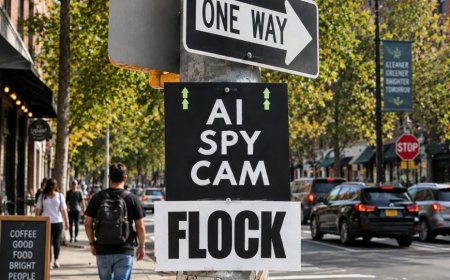
Diamandis, Ellison, and Marshall are correct that many of these surveillance technologies already exist and continue to expand. It has become increasingly difficult for people to go about their daily lives without being captured by devices such as Ring home security cameras, Tesla vehicles equipped with multiple cameras, or automated licence plate readers developed by Flock. Even when they avoid physical cameras, smartphones continue to generate data that advertising networks and data brokers collect.
However, Diamandis’ latest comments are among the clearest endorsements yet of a future in which personal privacy is dramatically reduced.
“Your kids will grow up in a world with no ‘off the record’,” Diamandis wrote, addressing parents directly. “Teach them that the best privacy strategy is integrity, living so that being seen costs you nothing. And fight hard for a world where the watching goes both ways.”
Diamandis presents this future as largely unavoidable, yet public reaction to expanding surveillance technology has often been far less accepting. In several cities, residents have covered Flock surveillance cameras with trash bags following reports that ICE, the FBI, and other law enforcement agencies had accessed the company’s data. Public criticism of Ring’s “Search Party” feature, designed to help locate lost dogs, also contributed to the company’s decision to end its partnership with Flock.
Meta has likewise faced criticism over its Ray-Ban smart glasses, which are equipped with cameras, and continues to defend itself against legal action centred on privacy concerns.
Much of Diamandis’ Substack article is framed as guidance for entrepreneurs and business leaders preparing for a future with little or no privacy. His central recommendation is essentially that people should strive to behave ethically. Even so, he acknowledges uncertainty over whether individuals would choose to act responsibly because it is the right thing to do or simply because they know they may be under constant observation. He describes that question as one he has “been chewing on” since finishing his conversation with Marshall.
What Diamandis does not fully address is a broader concern that frequently arises in discussions about surveillance technology. The meaning of terms such as “good” or “honest” is often subjective and may ultimately be defined by the powerful technology companies that own and operate the surveillance systems themselves.
Although Diamandis briefly argues that technology companies merely provide transparency and that “transparency is a tool, and tools don’t have ethics,” he does not examine how tools can reflect the assumptions and biases of their creators. Questions such as who determines whether behaviour captured on a security camera is considered “good” or “honest” remain largely unanswered.
Ultimately, Diamandis concludes only that transparency “only builds trust when it points both ways” Achieving that balance, however, may prove difficult in a world where the technologies enabling such widespread transparency remain concentrated in the hands of a relatively small number of companies.
What's Your Reaction?
 Like
0
Like
0
 Dislike
0
Dislike
0
 Love
0
Love
0
 Funny
0
Funny
0
 Angry
0
Angry
0
 Sad
0
Sad
0
 Wow
0
Wow
0