







































Airbnb expands into hotels and enhances AI-powered host and customer support tools
Airbnb is expanding its hotel offerings while introducing new AI-powered tools for host onboarding and customer support to improve user experience and platform efficiency.
For most of its history, Airbnb’s business model has centred on enabling travellers to book accommodations owned by individual hosts. Whether it was a spare room, an apartment, or an entire home, the platform primarily connected guests with property owners offering short-term stays that typically included basic amenities such as a bedroom, bathroom, and kitchen. Now, the company is broadening its approach by introducing hotel bookings directly into its platform, a move designed to create new revenue opportunities while giving travellers more accommodation choices.
After quietly testing hotel listings over the past several months, Airbnb is officially integrating hotels into its app experience. The company is introducing a dedicated hotel search filter that allows users to find hotel properties alongside traditional Airbnb listings.
Initially, Airbnb is partnering with boutique hotels across 20 cities worldwide. Among the launch locations are major travel destinations including New York City, Paris, London, Madrid, Rome, and Singapore.
The company says the new hotel option will appear contextually within the app. For example, users searching for accommodations in a city for only one or two nights may receive hotel recommendations via a pop-up suggestion. Travellers who specifically prefer hotels can also activate a dedicated filter to display only hotel listings within search results.
Airbnb is additionally introducing a price-match guarantee for hotel bookings. If a traveller finds the same hotel listing available elsewhere at a lower rate, the company says it will refund the difference as Airbnb credits that can be used on the platform.
According to Jud Coplan, Airbnb’s vice president of marketing, certain travel scenarios are naturally better suited to hotels than short-term rental properties.
“There are a few examples of the types of trips for which a hotel is probably better suited, such as last-minute bookings, one-night stays, and business trips,” Coplan explained. “What we’ve done in the Airbnb app is that when we can see you’re searching for that kind of stay, we can recommend hotels without sending you to another part of the app or tapping on another tab.”
The hotel expansion also provides Airbnb with a strategic advantage in markets where short-term rental regulations have limited or prohibited its traditional business model. Cities such as New York and Singapore have implemented restrictions on short-term stays, reducing the availability of Airbnb-style accommodations.
By offering hotel inventory in those locations, Airbnb can continue to serve travellers even in markets where regulatory barriers restrict its traditional offerings. This effectively expands the company’s reach into some of the world’s most valuable travel destinations despite local restrictions on short-term rentals.
Accommodation bookings, however, are only one component of Airbnb’s broader vision. The company increasingly wants to become a platform that manages multiple aspects of a traveller’s journey rather than focusing solely on where people sleep.
Last year, Airbnb expanded into experiences and services, enabling travellers to book activities and additional offerings during their trips. Over the past several months, the company has continued adding new travel-related services to its ecosystem.
Recent additions include grocery delivery directly to booked properties and airport pickup options for travellers arriving at their destinations. As part of its summer product expansion, Airbnb is introducing luggage storage services available at more than 15,000 locations worldwide.
The company also plans to launch car rental services later this summer, further extending its role within the travel ecosystem.
These developments reflect a broader convergence taking place across the travel technology industry. Companies that have historically focused on a single category are increasingly expanding into adjacent markets to become comprehensive travel platforms.
For example, Uber, traditionally known for ride-hailing services, has been expanding into hotel reservations and trip-planning features. Meanwhile, Airbnb is moving deeper into transportation and travel logistics. Both companies appear to be pursuing a similar objective: creating a single application that manages the entire travel experience from beginning to end.
Airbnb is also strengthening its experiences marketplace. The company announced it is adding guided visits to approximately 3,000 landmarks worldwide, allowing travellers to explore destinations alongside local experts.
Additionally, Airbnb is introducing more than 2,500 food-related experiences, expanding options for travellers interested in local cuisine and culinary activities. These enhancements position Airbnb more directly against travel experience providers such as Viator and GetYourGuide.
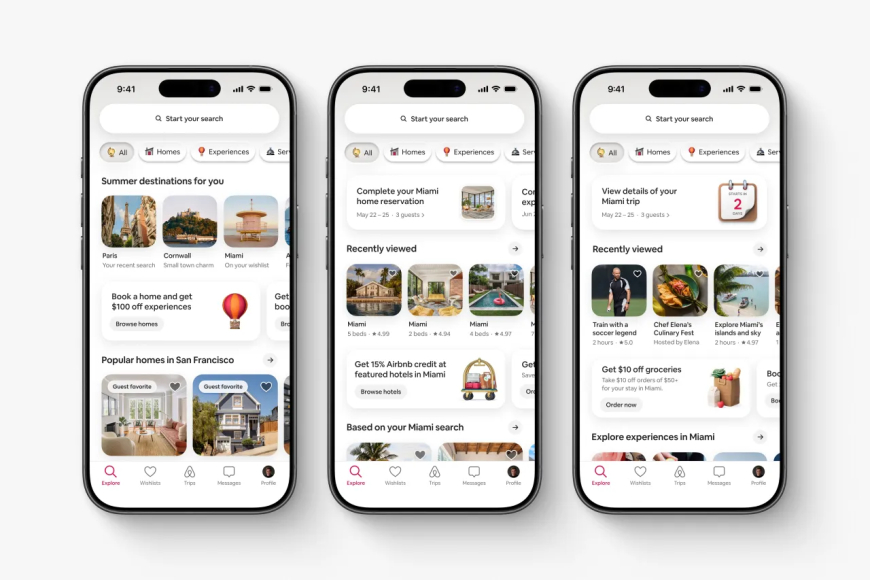
To support the growing range of services available through the platform, Airbnb is redesigning its application interface. The updated app will organise accommodations, experiences, transportation services, and other offerings in a more integrated manner.
The redesigned home screen will display recommendations from multiple categories, giving users a broader overview of available options. At the same time, dedicated tabs will allow travellers to browse specific services independently when desired.
Although Airbnb is not formally launching a loyalty rewards program at this time, the company is introducing incentives intended to encourage repeat usage. Customers will receive Airbnb credits for their first car rental booking, while hotel reservations may qualify for credits worth up to 15% of the booking value.
These credits can be applied to future bookings within the Airbnb ecosystem, creating additional incentives for users to remain engaged with the platform. Industry observers view the initiative as a potential step toward a more comprehensive loyalty program.
Airbnb’s Approach to Artificial Intelligence
While many travel companies have embraced AI-powered itinerary builders and trip-planning assistants, Airbnb has largely avoided positioning conversational AI as the primary interface for travel planning.
During a recent earnings call, Airbnb CEO Brian Chesky suggested that chatbot-based interfaces may not be ideal for managing travel experiences.
Instead, the company is incorporating artificial intelligence into specific features designed to simplify tasks for both guests and hosts.
“I think that the way in which we think about AI is how it can be used to help people find what they’re looking for more effectively and efficiently,” Coplan said. “And you see with this release that we have AI spread across several features across the app on the guest side and the host side.”
For hosts, Airbnb is introducing AI-assisted listing creation tools. Property owners can enter an address, after which the AI system automatically fills in relevant details to streamline the listing process and reduce manual data entry.
On the guest side, Airbnb is using artificial intelligence to make review information easier to navigate. The platform is introducing category tags such as location quality, family friendliness, and available amenities, allowing travellers to quickly browse reviews on specific topics rather than reading lengthy review sections in full.
The company is also launching a comparison tool for wish-listed properties. Using AI-generated summaries, the feature analyses multiple saved accommodations and highlights important differences, helping travellers decide which property best matches their needs.
Perhaps the most significant application of AI at Airbnb involves customer support.
The company introduced an AI-powered customer service chatbot in the United States last year and is now preparing for a broader global rollout. The system is being expanded to support 11 languages, making it available to a much wider international audience.
During Airbnb’s first-quarter 2026 earnings call, Chesky revealed that the chatbot currently handles approximately 40% of customer inquiries. The updated support experience will also include interactive cards that allow users to manage reservations, update travel plans, and resolve common issues more efficiently.
Looking ahead, Airbnb plans to expand its AI capabilities with voice-based support. Later this year, the company expects to introduce an AI assistant that customers can speak with directly over the phone.
Airbnb confirmed that it is collaborating with multiple external partners on the voice assistant project, though it has not yet disclosed which companies are involved.
With hotels, transportation services, travel experiences, and increasingly sophisticated AI-powered tools becoming part of its ecosystem, Airbnb is evolving beyond its origins as a home-sharing platform. The company’s latest initiatives show it aims to be a comprehensive travel platform that manages every stage of a traveller’s journey and uses AI to simplify both hosting and the customer experience.
What's Your Reaction?
 Like
0
Like
0
 Dislike
0
Dislike
0
 Love
0
Love
0
 Funny
0
Funny
0
 Angry
0
Angry
0
 Sad
0
Sad
0
 Wow
0
Wow
0