

































AMD Confirms FSR 4 Is Coming to Gaming Handhelds by End of 2026
AMD plans to bring FSR 4 AI upscaling to gaming handhelds, laptops and APUs by late 2026, but support for existing devices, including the Steam Deck, remains uncertain.
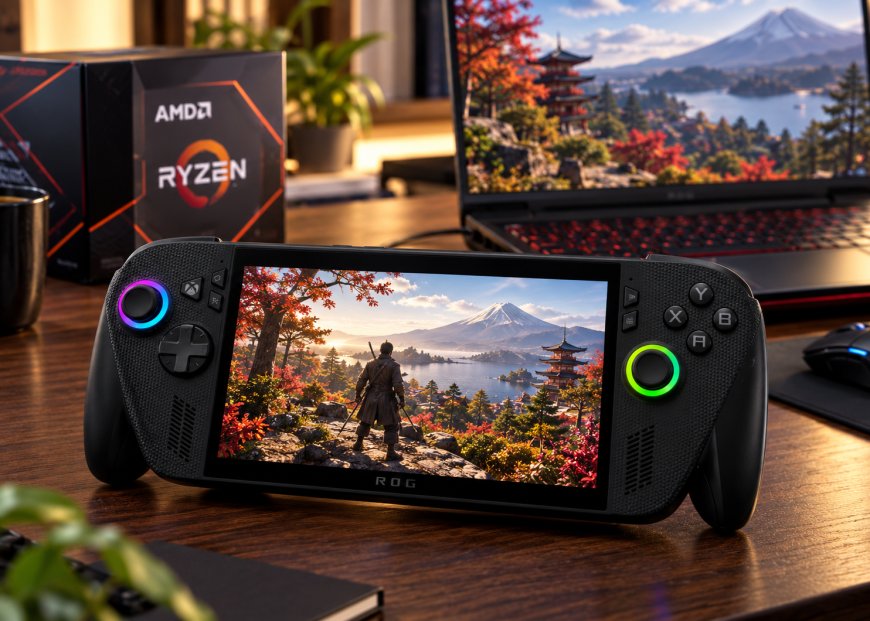
AMD plans to bring FSR 4, its machine learning-based graphics upscaling technology, to gaming handhelds, laptops, and integrated-graphics processors before the end of 2026. The expansion could bring the company’s latest image reconstruction technology to portable gaming hardware, although AMD has not confirmed which existing devices will receive official support.
Jack Huynh, AMD’s senior vice president and general manager of Computing and Graphics, outlined the plans during a briefing with South Korean journalists. The company is preparing a new generation of APUs designed to support FSR 4 while developing a lighter version of the technology for some existing hardware.
The announcement marks an important change for a feature previously associated primarily with dedicated Radeon graphics cards. However, owners of popular handhelds such as Valve’s Steam Deck and ASUS ROG Ally should not assume their devices will receive the same version of FSR 4 or the same performance benefits.
AMD Plans FSR 4 Support for Handhelds by Late 2026
During the briefing in Seoul, Huynh said AMD intends to expand FSR 4 support to integrated graphics processors, gaming laptops and handheld PCs before the end of the year. The company is approaching the rollout through both new hardware and an optimised model intended for existing processors.
According to TechSpot’s October 7 report, AMD is preparing a new generation of APUs capable of running FSR 4, potentially introducing the technology to processors designed specifically for portable gaming systems.
Huynh also discussed a lightweight version intended to reduce the computational demands of machine learning-based upscaling. This could help AMD bring improved image reconstruction to hardware that lacks the processing resources available on recent desktop graphics cards.
The distinction between the two approaches is important. New APUs may be designed with FSR 4 requirements in mind, while older processors may need a simplified model to meet performance and power targets.
AMD has not published a complete list of compatible handhelds or laptop processors. It also hasn’t confirmed whether the portable implementation will deliver the same image quality as FSR 4 on supported discrete Radeon graphics cards.
What FSR 4 Does Differently From Earlier Versions
FidelityFX Super Resolution is AMD’s technology for improving gaming performance by reconstructing higher-resolution images from frames rendered at a lower resolution. Instead of asking the graphics processor to calculate every pixel at the final display resolution, the technique reduces rendering demands and uses additional processing to produce the output image.
FSR 4 represents a significant technical change because it uses machine learning rather than relying exclusively on the analytical algorithms employed by earlier versions. The technology analyses information from multiple frames to reconstruct fine details, improve temporal stability and reduce visual artefacts.
AMD’s official FSR Upscaling documentation explains that it trained the machine learning model on high-quality game data using AMD Instinct GPUs. The technology is designed to preserve small details and moving objects better while reducing ghosting compared with earlier FSR implementations.
These improvements matter because upscaling is not simply about increasing the number of displayed pixels. Image reconstruction must also handle movement, transparency, reflections, and rapidly changing scenes without producing distracting visual inconsistencies.
AMD has since incorporated FSR 4 into its broader FSR Upscaling technology under the FSR Redstone branding. The underlying objective remains the same: improving the balance between rendering performance and perceived image quality.
Why FSR 4 Could Matter More on Gaming Handhelds
Portable gaming PCs operate under tighter power and thermal limits than desktop gaming systems. Their processors and integrated graphics must share a relatively small power budget while maintaining playable frame rates and acceptable battery life.
Upscaling can help address these restrictions by letting games render internally at lower resolutions. The graphics processor performs less rendering work, while the upscaling algorithm reconstructs the image for the handheld’s display.
For example, a demanding game running on a 1080p handheld screen may benefit from rendering below the display’s native resolution and using upscaling to recover image detail. The actual improvement depends on the game’s workload, the selected graphics settings and the performance cost of the upscaling process itself.
Earlier versions of FSR already provide this functionality on a wide range of hardware. FSR 4’s potential advantage is improved image reconstruction, particularly in scenes where older techniques struggle with fine patterns, moving foliage, or small objects.
However, machine learning also introduces processing requirements. A model that works efficiently on a recent desktop GPU may not deliver the same results on a low-power integrated processor. This explains why AMD is developing a lighter implementation for portable hardware.
No verified benchmarks show how much additional performance the new handheld version will deliver. AMD has also not published battery-life measurements or direct image-quality comparisons for the upcoming portable implementation.
Will Steam Deck and ASUS ROG Ally Support FSR 4?
Compatibility with existing handhelds remains the biggest unanswered question. Valve’s Steam Deck uses a custom AMD processor based on RDNA 2 graphics technology, while different ASUS ROG Ally models use AMD Ryzen processors with newer integrated graphics architectures.
These differences matter because AMD’s machine learning-based upscaling has specific hardware requirements. The official FSR 4 implementation initially targeted RDNA 4 discrete graphics cards, and later updates extended support to Radeon RX 7000 Series GPUs based on RDNA 3.
The current AMD FSR SDK documentation lists Radeon RX 9000 and RX 7000 Series discrete graphics cards as supported hardware for machine learning-based FSR Upscaling 4.1.1. On unsupported graphics processors, the SDK can select the older FSR 3.1.5 upscaling path instead.
AMD’s planned lightweight model could broaden those requirements, but it doesn’t mean every RDNA 2- or RDNA 3-based handheld will qualify. Device manufacturers may also need to update drivers, firmware or software before official support becomes available.
Unofficial efforts have demonstrated FSR 4 running on hardware outside AMD’s original support list. Those experiments suggest that alternative implementations are possible, but they should not be confused with manufacturer-approved support or guaranteed compatibility.
For Steam Deck owners in particular, the operating system introduces another consideration. AMD’s officially documented FSR 4 implementation targets Windows and DirectX 12, while Steam Deck primarily uses SteamOS. Bringing an equivalent feature to Valve’s handheld would require software support and compatible graphics hardware.
Owners of existing devices therefore have reason to follow the rollout, but not enough information to assume an update is guaranteed.
AMD Is Preparing New APUs With FSR 4 Support
The portable FSR 4 announcement also points to AMD’s next-generation processors with integrated graphics. Huynh indicated that new APUs supporting the technology are expected before the end of 2026.
Reports have linked the roadmap to potential successors to AMD’s Ryzen Z-series gaming processors, including rumoured Ryzen Z3 models. AMD has not confirmed the final product names, specifications, or availability of those processors in statements from the Seoul briefing.
A new APU designed around machine learning-based graphics features could provide advantages beyond upscaling compatibility. Integrated graphics processors must balance CPU performance, graphics workloads, memory bandwidth and power consumption within a compact thermal envelope.
Hardware designed to accelerate the relevant calculations could reduce the cost of running an advanced reconstruction model, potentially making higher-quality upscaling more practical in handheld gaming devices.
That does not necessarily mean future handhelds will achieve desktop-class image quality or significantly longer battery life. Such outcomes depend on processor architecture, power configuration, game optimisation, and how the upscaling technology is implemented.
Until AMD releases detailed specifications, comparisons between rumoured processors and existing Ryzen Z-series hardware remain speculative.
FSR4’s Expansion Follows Broader Radeon Support
AMD’s move toward portable devices follows an earlier expansion of FSR 4 beyond its original hardware requirements. The technology first became available for Radeon RX 9000 Series graphics cards using the RDNA 4 architecture.
Subsequent software updates extended machine learning-based FSR Upscaling 4.1 to Radeon RX 7000 Series discrete GPUs. That change showed AMD’s willingness to adapt the technology for additional graphics architectures when performance and software support are available.
The company’s broader FSR technology overview distinguishes machine learning-based upscaling from older FSR versions and explains the different hardware compatibility requirements.
The planned handheld rollout is more complicated because integrated graphics processors generally operate with less available power and memory bandwidth than desktop graphics cards. AMD’s decision to develop a lightweight model acknowledges that hardware differences exist rather than assuming the same implementation will work everywhere.
Another consideration is game compatibility. Even when a device supports FSR 4, players will still need compatible software or supported integration methods. Hardware availability alone does not guarantee that every game will immediately offer the newer upscaling option.
FSR 4 Is Not the Same as Frame Generation
AMD’s graphics software includes several technologies that can improve game presentation or performance, but they address different problems.
FSR Upscaling reconstructs higher-resolution images from lower-resolution rendering inputs. Frame generation, by contrast, creates additional intermediate frames between rendered frames to increase the displayed frame rate.
AMD offers both technologies as part of its FSR software ecosystem, alongside features such as ray regeneration and Radeon Anti-Lag. They can complement one another in supported games, but enabling one does not automatically mean the others are available.
This distinction matters most for handheld buyers. The announcement of FSR 4 for portable processors concerns machine learning-based upscaling. It should not be interpreted as confirmation that AMD’s newest frame-generation technology will receive the same handheld support.
For portable gaming, better upscaling could be valuable even without additional frame generation. Improving the clarity of a lower-resolution image may help developers and players choose graphics settings that balance visual quality with the limited resources of handheld hardware.
What Gaming Handheld Owners Should Expect Next
AMD’s late-2026 target provides a general timeframe, but the company still needs to identify supported processors and explain how the lightweight FSR 4 implementation differs from the full version.
Questions remain about graphics architecture requirements, Windows and SteamOS compatibility, driver availability and whether existing handhelds will receive support through software updates. Independent performance testing will also be necessary to determine the practical benefits.
For owners considering a new gaming handheld, the announcement is relevant but not yet a reason to choose one specific device. A processor’s advertised graphics architecture does not establish FSR 4 compatibility unless AMD or the device manufacturer explicitly confirms support.
Existing handheld owners should also avoid assuming their hardware will become obsolete. Earlier FSR versions remain available across a broad range of GPUs, and game performance still depends on factors beyond upscaling technology.
AMD’s Handheld FSR 4 Rollout Could Improve Portable Gaming
AMD’s decision to extend FSR 4 beyond dedicated graphics cards is an important development for portable gaming PCs. Advanced upscaling is especially relevant for devices that must run demanding games within tight power and thermal limits.
The planned combination of new FSR 4-capable APUs and a lightweight model for existing hardware suggests AMD is looking for ways to make machine learning-based image reconstruction practical across more processor configurations.
However, the announcement is a roadmap, not a confirmed list of compatible products. Steam Deck, ROG Ally, and other handheld owners will need to wait for official hardware requirements to know whether their devices can use the technology.
If AMD can deliver better image quality without adding excessive processing costs, FSR 4 could be a useful addition to future handheld gaming systems. The real measure of success will be how efficiently the technology runs on portable hardware, not simply how many devices AMD says it intends to support by the end of 2026.
What's Your Reaction?
 Like
0
Like
0
 Dislike
0
Dislike
0
 Love
0
Love
0
 Funny
0
Funny
0
 Angry
0
Angry
0
 Sad
0
Sad
0
 Wow
0
Wow
0