
































Etched Draws Funding Offers at a $40B+ Valuation as AI Chip Race Heats Up
AI chip startup Etched is reportedly reviewing funding offers at valuations of $40-$50 billion, just weeks after raising $700 million at a $21 billion valuation.
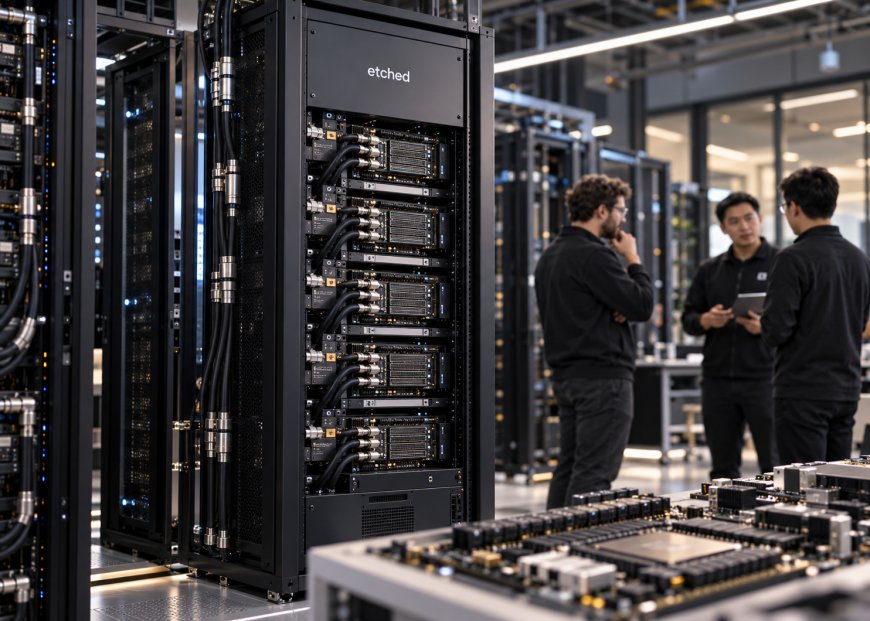
Etched is reportedly attracting funding offers that could value the AI chip startup at $40 billion or more, an extraordinary jump for a company that was valued at $21 billion only weeks ago.
The startup is reviewing proposals from investors at valuations ranging from about $40 billion to as much as $50 billion, according to people familiar with the discussions cited by TechCrunch. The talks are still early, and there is no guarantee Etched will accept an offer or complete another financing round on those terms.
Etched has not announced a new $40 billion valuation. For now, the figure represents the level at which investors are reportedly trying to buy into the company. Even so, the offers underline how quickly investor enthusiasm is building around companies developing alternatives to Nvidia for artificial intelligence computing.
TechCrunch reported the new funding discussions on October 5.
Etched’s $40B Valuation Offers Come Weeks After Its Last Round
The timing is unusually aggressive even by the standards of the current AI investment boom.
Etched raised $700 million in August at a $21 billion valuation in a round led by Jane Street. That financing itself came only weeks after a $300 million Series C valued the company at $10.3 billion.
If Etched eventually completes a new round near $40 billion, its private-market valuation would have almost doubled again in less than two months.
TechAmerica.ai previously reported on Etched’s $700 million funding round and $21 billion valuation, when Jane Street moved from testing the startup’s hardware to becoming both an investor and customer.
The latest reported offers therefore do not represent the beginning of investor interest in Etched. They represent another acceleration of a valuation that has already risen unusually quickly. Etched was valued at roughly $5 billion in December 2025. By July 2026, that figure had climbed to $10.3 billion. A month later, it reached $21 billion, and investors are now reportedly discussing figures beginning around $40 billion.
Jane Street Gave Etched Something More Valuable Than a Check
Part of the interest surrounding Etched comes from the fact that Jane Street did more than invest.
The quantitative trading firm tested Etched’s hardware and became its first announced customer. Etched said in August that it had shipped its first rack to Jane Street, which was deploying the system in its own data centre.
That provided Etched with important validation. Semiconductor startups can raise large amounts of money on technical promises, but delivering functioning hardware to a demanding commercial customer is a different milestone.
In its August announcement, Etched said Jane Street led the $700 million financing after the firm tested the hardware. Other investors included Kleiner Perkins, Sequoia Capital, Andreessen Horowitz, Tiger Global, Bain Capital Ventures and Blackstone.
Etched confirmed the $700 million round and the first Jane Street delivery in its own announcement.
The company has also said it has secured around $1 billion in customer demand for its systems. Those orders and the Jane Street deployment help explain why investors may be willing to discuss valuations that would otherwise appear difficult to justify for a four-year-old hardware startup.
Etched Is Betting on AI Inference Rather Than Training
Etched’s technology is focused heavily on inference, the part of artificial intelligence computing that happens when a trained model is actually used.
When someone sends a prompt to an AI model, the infrastructure must process the request and generate the response. At large scale, that process consumes enormous amounts of computing power, memory bandwidth and electricity.
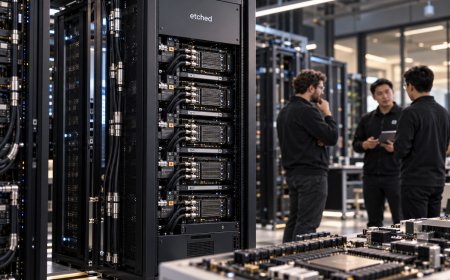
Etched is building what it calls frontier inference clusters: complete systems that combine its own chips, memory architecture, networking, racks and software.
The company says its approach is designed to improve both major stages of inference. The first, known as prefill, processes the user’s prompt and surrounding context. The second, decode, produces the tokens that form the model’s response.
Etched has developed its own hardware for both workloads rather than relying entirely on conventional GPU architectures.
Its broader argument is that specialised inference hardware designed around these workloads can deliver better throughput, lower latency and lower operating costs than general-purpose AI accelerators.
Those claims will ultimately need to be proven at scale across a wide range of customer workloads. Nvidia remains overwhelmingly dominant in accelerated computing and benefits from years of software development around CUDA as well as deep relationships with cloud providers and AI labs.
Etched does not need to replace Nvidia across the entire market, however, to build a significant business. AI inference spending is growing fast enough that even a relatively small share could support a major semiconductor company.
Manufacturing Makes the Etched Story More Difficult
AI chip startups face a problem that software companies do not: hardware expansion consumes huge amounts of capital before revenue arrives.
Etched must design chips, secure manufacturing capacity, build server systems, coordinate memory and networking components, develop software and deploy complete infrastructure for customers.
TSMC manufactures its processors, and the company has established operations in Taiwan to work closer to the semiconductor supply chain.
Etched has also opened a 10-megawatt facility in Silicon Valley as it expands prototyping and deployment capacity.
That helps explain why another funding round so soon after raising $700 million would not necessarily mean the previous financing was insufficient.
Building semiconductor and data centre infrastructure can quickly consume hundreds of millions of dollars. TechCrunch reported that another round comparable in size to Etched’s previous financing could give the company roughly three and a half years of runway, according to a person familiar with the offers.
A larger cash position could also allow Etched to secure manufacturing capacity and expand deployments before competitors capture the same customers.
Nvidia’s Dominance Is Creating Opportunities for Challengers
Investment interest in Etched is also part of a wider effort to loosen Nvidia’s grip on AI computing.
Nvidia continues to dominate the market for high-end AI accelerators, but the amount of money flowing into artificial intelligence infrastructure has created room for alternative architectures.
Cloud companies including Google, Amazon and Microsoft are developing their own chips. Other startups are attacking specific parts of the AI hardware stack, from inference processors to memory systems and high-speed interconnects.
The opportunity is particularly large in inference because every successful AI application creates recurring demand for computing after a model has been trained.
An AI model may be trained periodically, but inference happens every time someone uses it. As AI services reach hundreds of millions of users, the economics of generating those responses become increasingly important. Small improvements in latency, throughput or power efficiency can translate into significant savings at data centre scale.
For a quantitative trading firm such as Jane Street, speed can carry additional value because even very small performance improvements can matter in demanding computational workloads.
Etched Has Built Rapidly, but the Valuation Is Moving Even Faster
Etched has grown to more than 400 employees, according to its website. Its team includes engineers with backgrounds at Nvidia, Google TPUs, Broadcom, SK Hynix and TSMC.
The company says it manufactured its first silicon using TSMC’s N4P process and is validating rack-scale systems with customers.
Those are meaningful milestones for a young semiconductor company, but they still do not make a $40 billion valuation conventional.
At that level, investors would be placing a very large bet on Etched’s ability to turn early technical progress and customer interest into substantial commercial deployments.
The company will need to manufacture enough hardware, maintain competitive performance, secure additional customers and continue improving its systems as Nvidia and other chipmakers release new generations of products.
The reported offers suggest some investors are willing to take that risk.
The Latest Figure Is an Offer, Not a Completed Valuation
The speed of Etched’s rise makes precision especially important.
The company has not yet announced a $40 billion or $50 billion valuation, and the terms being discussed could change before any agreement is reached. Etched declined to comment on the reported offers.
Its last confirmed valuation remains $21 billion, attached to the $700 million financing announced in August.
What has changed is the price investors are reportedly willing to discuss only a short time later.
That may be the clearest signal yet of how aggressively venture capital is chasing companies positioned around AI infrastructure. Investors are no longer placing the largest bets only on companies building frontier AI models. They are also competing for ownership of the hardware companies that could make those models cheaper and faster to run.
Etched has moved from a $5 billion valuation to a reported discussion range above $40 billion in less than a year. Whether it actually closes a financing at that level will determine whether that rapid rise becomes another confirmed milestone or remains a striking example of how far investors are currently willing to reach for promising AI-chip companies.
What's Your Reaction?
 Like
0
Like
0
 Dislike
0
Dislike
0
 Love
0
Love
0
 Funny
0
Funny
0
 Angry
0
Angry
0
 Sad
0
Sad
0
 Wow
0
Wow
0