


























Sunday Hits $1.15B Valuation as Memo Household Robot Moves Toward Real Homes
Sunday has raised $165 million at a $1.15 billion valuation to move its Memo household robot from demonstrations into a late-2026 beta in real homes.
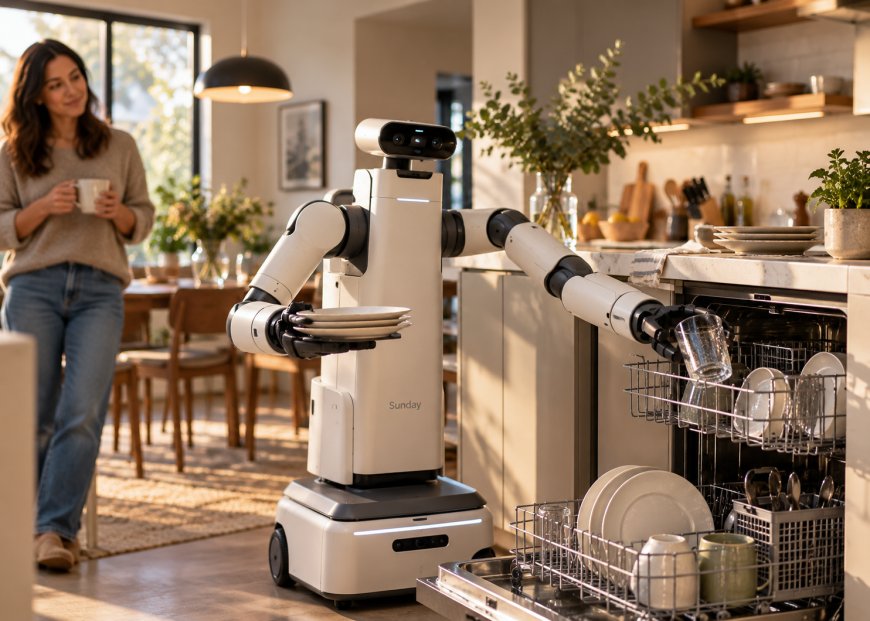
Sunday has joined the growing ranks of billion-dollar robotics startups after raising $165 million at a $1.15 billion valuation, giving the young company substantially more capital to test whether a household robot can become useful outside a carefully controlled demonstration.
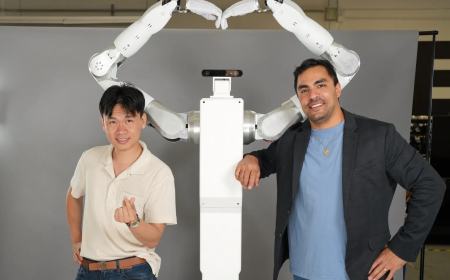
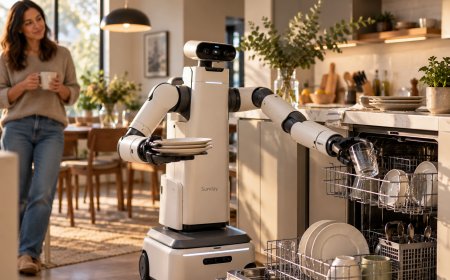
The Mountain View startup is building Memo, a wheeled, two-armed robot designed to handle repetitive domestic work such as clearing dishes, loading a dishwasher and dealing with laundry. Sunday says the new Series B will help move Memo from staged demonstrations into a beta program with real households later in 2026.
Coatue led the round, with Thomas Laffont joining Sunday’s board. Bain Capital Ventures, Fidelity Management & Research Company, Tiger Global, Benchmark, Conviction and Xtal Ventures also participated.
Sunday confirmed the $165 million Series B on March 12, saying the financing was oversubscribed and valued the company at $1.15 billion.
Sunday’s $1.15B valuation puts household robotics back in the spotlight
The funding comes amid renewed investor interest in physical AI, but Sunday’s bet is narrower than building another general-purpose robot.
Memo is intended specifically for the home.
That is one of the most difficult environments for robotics because houses are inconsistent. A factory robot can repeat the same movement around equipment placed in known positions. A household robot may encounter different table heights, glasses, plates, fabrics, clutter, people, pets and unexpected obstacles every day.
Sunday argues that solving this problem requires more than impressive hardware.
Its focus is on collecting large amounts of real-world manipulation data and rapidly feeding that information back into its models. The company says its full-stack approach covers data collection, AI models, robot hardware and manufacturing rather than relying on separate suppliers for each layer.
The ambition is straightforward: Memo should learn enough household skills to become useful without requiring a family to control it constantly.
Whether Sunday can make that reliable at consumer scale is the harder question.
Memo is designed to do chores rather than imitate a person
Memo is sometimes grouped with humanoid robots, but its design avoids one of the most difficult parts of humanoid engineering.
It does not walk on two legs.
Sunday uses a wheeled base with a torso and two arms, allowing Memo to move around a home without continuously balancing like a bipedal machine. The company says the robot can lower itself to reach the floor and extend high enough to reach roughly seven feet with its arms, although it normally operates at a lower height.
That choice reflects Sunday’s emphasis on practical household work rather than reproducing the human body.
The company’s current demonstrations show Memo clearing dining tables, handling dishes and glasses, disposing of food scraps and loading a dishwasher. Sunday also highlights laundry and tidying as target tasks.
Its current Memo product page makes clear that the robot is not yet commercially available. Families can instead apply for the company’s 2026 beta program.
Sunday says its priority during that phase will be improving reliability, safety, hygiene, maintenance and usefulness inside messy real homes rather than optimising the machine for polished demonstrations.
The real challenge is training data.
One ofSunday’ss central arguments is that robotics has a data problem.
Large language models benefited from enormous quantities of text, images and other material available online. Robots need a different kind of information: examples of how to perform physical actions.
Folding clothing, picking up a wine glass or loading a dishwasher may seem routine to a person, but each task involves changing object shapes, weight, friction, position and force.
Sunday built a system it calls the Skill Capture Glove to collect human manipulation data. The company uses those demonstrations in its model-training pipeline to create examples of how people perform household tasks.
Sunday introduced its first major robotics model, ACT-1, when it emerged publicly in November 2025. The company said it trained the model without conventional robot teleoperation trajectories, relying instead on human-generated data collected through its system.
Sunday’s ACT -1 research announcement describes data availability as the central bottleneck it is trying to solve.
That strategy also gives Sunday a potential competitive advantage if every household deployment produces additional information that can improve later versions of the system.
The idea resembles the data flywheels that helped software AI models improve, except the input comes from physical actions rather than documents and webpages.
Sunday says it is moving beyond robotics demos
Robotics companies have become exceptionally good at producing videos.
Those clips can show machines folding clothes, preparing food or navigating a room. Still, they don’t necessarily show that a robot can perform the same task reliably hundreds of times in unfamiliar homes.
Sunday has made that gap central to its pitch.
The company titled its Series B announcement “No More Demos” and said the new capital would fund real-world deployment.
Engineering has expanded threefold, research fourfold and data operations fivefold, according to Sunday. The company plans to begin public beta deployment in fall 2026.
TechCrunch reported that Sunday already had around 1,000 people on its waitlist when it announced the funding. TechCrunch’s March report also noted that the company had emerged from stealth only months earlier.
The speed of that rise helps explain why investors are paying close attention to home robotics again.
A consumer version still has an unresolved price question
Sunday has not announced a final retail price for Memo.
The company says building one robot today using custom components and hand assembly costs about $20,000. It does not expect that figure to become the consumer price.
Large-scale manufacturing should reduce production costs by at least half, according to Sunday’s current estimate, but final pricing will not be announced until closer to commercial launch.
That will be crucial to the product’s prospects.
A household robot could be technically impressive and remain a niche product if it costs far more than the value consumers believe it will deliver by automating chores.
Reliability will matter just as much.
A machine that loads the dishwasher correctly nine times out of ten may look capable in a demonstration but could still create frustration or safety concerns in everyday use. Homes contain fragile items, children, pets and environments that change constantly.
Sunday says its beta is intended to expose Memo to exactly those conditions before wider production begins.
Home robotics is becoming crowded again.
Sunday is not alone in betting that recent advances in AI can finally make domestic robots viable.
Tesla continues to develop Optimus as a general-purpose humanoid platform. Figure has been testing humanoid systems for commercial and eventual household applications. 1X has explicitly targeted the home with Neo, while other startups are approaching the market with different hardware and autonomy strategies.
TechAmerica.ai has also been tracking the broader shift toward physical AI, where improvements in foundation models, vision systems and training data are being applied to robots that must operate outside digital environments. Sunday’s approach stands out because it has made the home itself the primary product environment rather than a distant long-term goal.
That makes the coming beta particularly important.
A $1.15 billion valuation still has to meet real-world reality
Sunday’s funding milestone says a great deal about investor appetite for robotics, but it does not yet prove that Memo can become a successful consumer product.
The company has raised enough money to move into a much harder phase.
In a laboratory, engineers control many of the variables. In a customer’s kitchen, they control almost none of them.
Memo will have to work around different furniture, lighting, floor plans, objects and human habits. It will need to manipulate fragile items consistently and fail safely when something unexpected happens. It will also need to deliver enough useful work to justify whatever price Sunday eventually sets.
That is why the late-2026 beta matters more than another polished demonstration.
Sunday has already convinced prominent investors that household robotics deserves a billion-dollar valuation. The next challenge is convincing families that Memo deserves a place in their homes.
What's Your Reaction?
 Like
0
Like
0
 Dislike
0
Dislike
0
 Love
0
Love
0
 Funny
0
Funny
0
 Angry
0
Angry
0
 Sad
0
Sad
0
 Wow
0
Wow
0