































Google’s Genie AI model can now recreate real-world streets using Street View data
Google’s Genie AI world model can now simulate real streets using Street View imagery, advancing interactive environment generation, navigation research, and AI-powered virtual worlds.
Many people have used Street View on Google Maps to revisit familiar places, whether it is checking out the neighbourhood where they grew up, showing friends an old home, or virtually exploring a destination before travelling there. With a few clicks, users can drop the Street View icon onto streets in cities around the world and get a ground-level look at the surroundings. Google now wants to take that experience much further by making those locations interactive, immersive, and dynamically generated through artificial intelligence.
Imagine being able to explore a real-world street not just through static panoramic images, but in a simulated environment where you can move around naturally, adjust weather conditions, and observe how an area might appear under completely different circumstances. Users could see a neighbourhood covered in snow, experience heavy rainfall, or even witness a dramatic disaster-style scenario similar to one portrayed in a major Hollywood film.
That vision is one of the primary objectives behind Google's newest AI initiative. Beginning today, Google DeepMind is integrating Street View data with Project Genie, the company's general-purpose world model designed to generate a wide range of interactive digital environments. The announcement was made during the Google I/O 2026 developer conference.
According to Jack Parker-Holder, a research scientist on DeepMind's open-endedness team, the technology has significant value not only for AI agents and robotics applications but also for people who want to explore and interact with virtual environments." It's really powerful for both the agent [and robotics] use case and for humans to play with, and that's always been the thesis of Genie," Parker-Holder explained.
To illustrate the concept, Parker-Holder described a scenario involving a newly deployed robot operating in London. Because London experiences limited sunshine throughout much of the year, a robot might rarely encounter certain lighting conditions. Genie could simulate those uncommon moments when sunlight reflects brightly off Victorian-era buildings, helping the robot become familiar with such situations before encountering them in the real world.
At the same time, the technology could be useful for travellers preparing for future trips. Parker-Holder suggested a situation in which someone plans to visit New York City during a season different from the one currently being experienced."
"Simultaneously, you might say, 'I'm going to New York City, but not this time of year,'" he said. 'It's going to be snowy. I want to see what that block looks like in the snow. Google's ability to pursue this type of project is built on two decades of Street View data collection. For approximately 20 years, the company has gathered imagery through specially equipped vehicles carrying advanced camera systems, as well as through individuals wearing mapping devices often referred to as tracker backpacks. Through these efforts, Google has accumulated more than 280 billion images spanning 110 countries across all seven continents.
According to Parker-Holder, the scale and diversity of this data provide a unique foundation for building realistic AI-generated worlds."
"With Street View, we have imagery from a large portion of the world," he said. You can imagine how potentially powerful it is to combine this rich source of real-world information and data with an ability to simulate worlds."
Google first introduced the latest version of its world model, Genie 3, in a research preview released last August. Access to the tool was later expanded to Google AI Ultra subscribers in the United States in January. The platform enables users to generate interactive virtual worlds from text prompts or image inputs. Google's long-term vision for the technology includes applications in education, gaming, and robotics training.
The company has already begun using Genie 3 to support one of Waymo's simulation systems. Through the technology, Waymo can expose its autonomous vehicles to highly unusual situations that would rarely occur in real-world driving conditions. Examples include severe weather events, such as tornadoes, or unexpected encounters with large animals, such as elephants, while crossing a roadway. Integrating Street View data into those simulations could further Waymo's ability to prepare autonomous vehicles for deployment worldwide.
Waymo already operates its own sophisticated simulation platform, which has played a major role in helping the company expand to 11 cities across the United States while testing its AI driving systems in additional locations. Parker-Holder noted that the primary distinction between existing Waymo simulations and Genie-powered environments is perspective.
Traditional driving simulators generally recreate the world from a vehicle's viewpoint. Street View integration, however, makes it possible to simulate environments tied to real-world locations while also allowing entirely different viewpoints. Instead of experiencing the simulation solely from inside a car, users could explore the same environment from the perspective of a human pedestrian, a robot, or another type of intelligent agent.
Google is making the Street View integration available to a select group of Ultra subscribers in the United States starting today. The company plans to expand availability over time gradually. According to Google, Ultra subscribers in other regions worldwide are expected to gain access in the coming weeks. DeepMind's researchers say their long-term goal is to place the technology in the hands of as many users as possible. Diego Rivas, a product manager at DeepMind, emphasised that both Genie and the Street View integration remain experimental projects and still require significant refinement.
Rivas cautioned that improvements are needed in several areas, particularly in accuracy and realism.
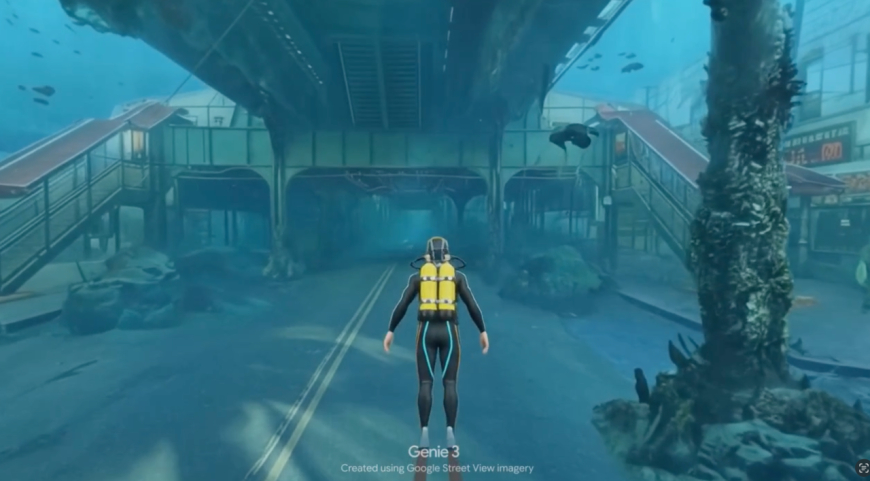
In Google demonstrations, including an underwater simulation of a neighbourhood where the reporter had previously lived, the generated environments appeared impressive and instantly recognisable. However, the visuals still resembled high-quality video game graphics rather than true photorealistic recreations of the real world.
Another current limitation involves physics awareness. The models do not yet possess a complete understanding of cause-and-effect relationships within the physical environment. For example, Google demonstrated a simulation of a woman running through a snowy version of Joshua Tree. During the sequence, the character moved directly through cacti and bushes without realistically interacting with them.
This contrasts with some of Google's AI systems, such as Nano Banana, the company's age-generation model, which can produce highly accurate text for use in infographics. Likewise, GooGoogle's video-generation model demonstrates a sophisticated understanding of physical behaviour, accurately depicting situations such as paper boats floating with the water currents, smoke dispersing naturally into the air, and fabric draping over objects in realistic ways.
Google researchers note that these understandings of physical behaviour are not manually programmed into the models. Instead, the systems gradually learn such concepts through observation and exposure to vast amounts of visual information, much like how living organisms learn about the world around them over time.
Parker-Holder believes that GeGenie's current limitations are temporary and expects the technology to improve substantially in the near future."
"""think for this kind of model, itit'saybee six to 12 months behind video in terms of the accuracy and quality, so I thinkitit'somethingg we will solve"""" e said.
Jonathan Herbert, director of Google Maps and a longtime member of the Street View team who originally joined the project as an intern 12 years ago, acknowledged that Genie cannot yet produce a perfectly faithful reconstruction of a real street.
However, Herbert believes the most important achievement lies elsewhere. In his view, the breakthrough is the model's ability to maintain spatial continuity. When a user turns around within a generated environment, the system correctly remembers and recreates what exists behind them. From that foundation, the model can continue to expand and generate a coherent environment that remains logically connected to the original location."
“"" Have long thought about how we can build out the best and richest model of the world on top of Street View data," Erbert said. "It's definitely been an idea of ours to use Maps Data in new ways and for new kinds of AI research for a pretty long time."
The integration of Street View with Project Genie represents another step in Google's path toward combining massive real-world datasets with advanced generative AI systems. While the technology is still evolving and remains far from perfect, Google believes it has the potential to transform how people explore locations, train robots, develop autonomous systems, and interact with digital representations of the physical world. As improvements continue, the company hopes Genie will become an increasingly accurate and versatile platform capable of creating richly detailed, interactive simulations derived directly from real-world environments.
What's Your Reaction?
 Like
0
Like
0
 Dislike
0
Dislike
0
 Love
0
Love
0
 Funny
0
Funny
0
 Angry
0
Angry
0
 Sad
0
Sad
0
 Wow
0
Wow
0