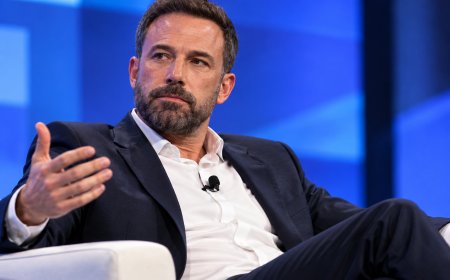
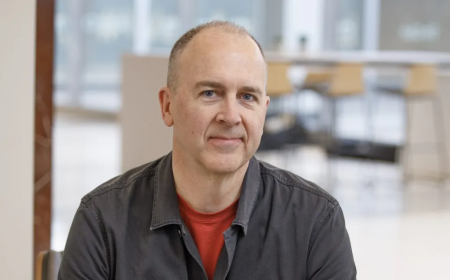
OpenAI’s chief operating officer, Brad Lightca,p, says that, despite the excitement around AI tools, businesses still haven’t reached true large-scale adoption, where AI is deeply embedded in day-to-day enterprise processes.
Earlier this month, OpenAI introduced a new enterprise platform called OpenAI Frontier, designed to help companies build and manage AI agents. But speaking on the sidelines of the India AI Impact Summit held last week in New Delhi, Lightcap said the broader enterprise world is still early in turning AI into something that truly runs inside business workflows.
“One of the interesting things and some of the inspiration for the work we’ve been doing lately around OpenAI Frontier is we have not yet really seen enterprise AI penetrate enterprise business process,” Lightcap said.
He added that while powerful AI tools are already widely available to individuals, enterprises operate very differently.
“You’ve got really powerful AI systems that any person can use in their individual capacity. And enterprises are these highly complex organisations with a lot of people and teams, all of whom have to work together, with a lot of context. There are very complex goals that have to be achieved using a lot of different systems and tools.”
The market has been full of bold claims that AI agents will replace business software and that “SaaS is dead.” Those predictions have sometimes influenced SaaS stock performance, but in practice, the shift hasn’t happened in a meaningful way yet. Lightcap pointed to OpenAI’s own internal habits as an example, noting that the company was a heavy Slack user last year — a signal that even major AI organisations still depend on traditional enterprise platforms.
In January, OpenAI CFO Sarah Friar posted that the company’s revenue continues to climb, with OpenAI ending 2025 at more than $20 billion in annualised revenue. Lightcap did not disclose additional figures, but said customer demand remains strong.
“We almost always find ourselves having to manage too much demand. We are still an organisation that is growing, and so there is this global demand factor that we would love to be able to meet, and we are working as best as we can to be able to meet,” Lightcap said.
At the same time, he said OpenAI is thinking carefully about how enterprise success should be measured. Rather than focusing on the standard SaaS approach — selling access by the number of users — Lightcap said the company intends to assess Frontier through real results.
Lightcap said OpenAI plans to evaluate Frontier’s value based on “business outcomes, not on seat licenses.” OpenAI has not yet publicly shared Frontier’s pricing.
“Frontier is a way for us to experiment iteratively with how to actually bring AI into the really messy and complex areas of businesses that I think if we get that right, we’re going to learn a lot about both businesses and also AI systems,” he said.
Only days after those remarks, OpenAI moved further into enterprise distribution by partnering with major consulting firms such as Boston Consulting Group (BCG), McKinsey, Accenture, and Capgemini to help deploy its technology to large organisations. Competition in this space is intensifying as well. Rival AI company Anthropic has also released enterprise plug-ins in areas like finance, engineering, and design, enabling companies to build agents using Claude.
Lightcap was also asked about OpenAI’s plans for OpenClaw, an open-source tool whose creator recently joined the company. OpenAI does not yet have a clear roadmap for integrating OpenClaw. Still, Lightcap said it offers OpenAI “a glimpse into the future” in which agents can do “almost anything you want them to be able to do on a computer.”
In line with the India-focused summit, OpenAI has made multiple announcements tied to its business growth in what is now the world’s largest market. The company said India represents the second-largest ChatGPT user base outside the United States, with more than 100 million weekly users. Lightcap said voice usage is rising quickly in India and helping OpenAI reach a broader segment of the population.
“Voice is so important here. And voice models now feel good enough and also good enough to run in low-latency and low-bandwidth environments, where you really can start to enable access to technology for a group of people who maybe were more disenfranchised than not,” Lightcap said.
OpenAI has also signed an enterprise agreement in India covering the use of its tools and the deployment of compute. Lightcap noted that India ranks fourth in Asia by enterprise seats, which he described as low given the country’s size, and he said OpenAI sees significant room to expand its enterprise footprint there.
The company is also preparing to open two new offices in India, in Mumbai and Bengaluru. These locations are expected to focus on sales and go-to-market operations. When asked whether the new offices would also include technical staff, Lightcap responded, “Never say never.”
The growth of AI also continues to raise concerns around employment, particularly in India, where IT services and BPO (business process outsourcing) play an outsized role in the economy. In recent weeks, Indian IT stocks have dipped as investors factor in the idea that some work — including coding and other repetitive tasks — may need fewer people as AI capabilities improve. Lightcap said OpenAI is trying to stay “grounded” in what it has actually observed about the labour market.
“Our view is that over time, jobs will change. I think we don’t yet know where, how, or what, but it seems inevitable that work will look different in the future than it looks today. And that’s natural, that’s part of the business cycle. It’s part of the global, dynamic economy we live in. And so I think what we have to do is be able to obviously have empathy for where jobs are changing at a high rate,” he said.

































 Like
0
Like
0
 Dislike
0
Dislike
0
 Love
0
Love
0
 Funny
0
Funny
0
 Angry
0
Angry
0
 Sad
0
Sad
0
 Wow
0
Wow
0