


























The Pixel 11 Pro Fold Is Google's Best Foldable. That Might Not Be Enough Anymore.
The Pixel 11 Pro Fold brings Google’s best foldable camera, AI features, seven years of updates, and improved hardware, but faces stronger competition from Samsung and Motorola.
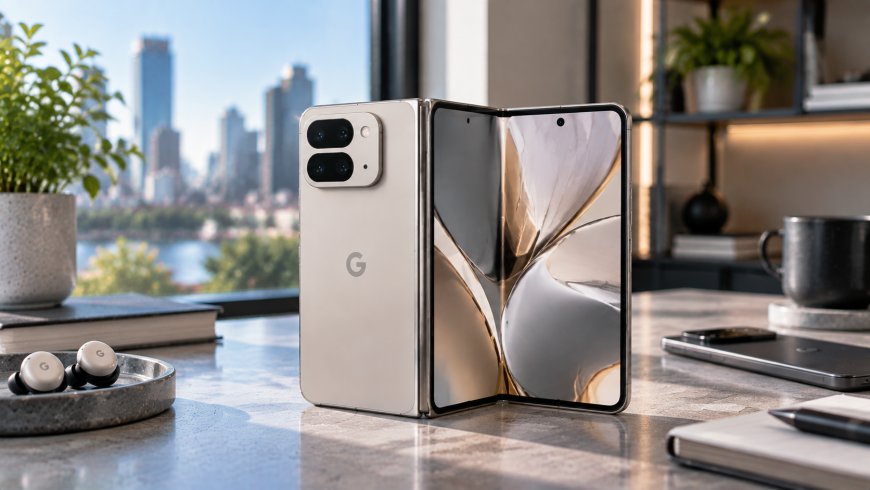
Google has been making foldable phones for four generations now. Each one has improved a little. The cameras have improved. The displays have gotten brighter. The software has gotten smarter. And the Pixel 11 Pro Fold, the latest in that progression, is genuinely the best foldable Google has ever shipped.
The problem is that “best Google foldable” and “best foldable” are no longer the same sentence.
At $1,899, the Pixel 11 Pro Fold costs $100 more than its predecessor. It competes with Samsung’s Galaxy Z Fold 8 lineup and Motorola’s Razr Fold, both of which are thinner, lighter in some configurations, and powered by chips that significantly outperform Google’s Tensor silicon in raw benchmarks. The Pixel 11 Pro Fold’s advantages are real: the best cameras on any foldable, seven years of software updates, the only IP68 water-resistance rating in the foldable category, and AI features no competitor matches. But in a year when the competition got meaningfully better, incremental improvement from Google isn’t enough to lead.
Here is what the phone does well, what it does not, and whether it is worth $1,899.
What Actually Changed This Year
If you put the Pixel 11 Pro Fold next to last year’s model, the physical differences are subtle. The design language is the same. The screen sizes are the same: a 6.5-inch exterior OLED and an 8-inch interior OLED, both running at 120Hz. The hinge mechanism, button placement, and magnetic accessory support are carried forward.
The changes are under the surface and around the edges.
The phone is 10% lighter at 239 grams, down from 258. Google achieved this partly through a new glass fibre composite back panel that the company claims is “nearly impossible to crack.” That weight reduction is noticeable in the hand, though the phone remains thicker than both Samsung options and the Motorola Razr Fold when closed at 10.1mm.
Display brightness increased from 3,000 to 3,600 nits peak, meaningfully improving outdoor visibility. The exterior screen now has a ceramic cover glass for improved durability. IP68 water and dust resistance carries over, making this still the only foldable with that rating.
The Tensor G6 chip replaces the G5, bringing roughly 25% faster web browsing and 15% faster app loading. Charging speeds improved, and all models ship with 16GB of RAM and at least 256GB of storage, with options up to 1TB.
And the camera system got a genuine upgrade: a new 48-megapixel main sensor that is physically larger than the previous generation, paired with a 10.8-megapixel 5x telephoto and a 10.5-megapixel ultra-wide.
The Camera Is the Real Story
If you care about photography and you want a foldable phone, the Pixel 11 Pro Fold is the only serious option. That has been true for two generations now, and the gap widened this year.
The new 48-megapixel main sensor with an f/1.7 aperture captures more light and more detail than any foldable competitor. In both bright daylight and low-light conditions, reviewers across multiple publications found the Pixel 11 Pro Fold produced sharper, more detailed images than the Galaxy Z Fold 8, the Razr Fold, and the Honour Magic V6—Night Sight mode, already strong on previous Pixels, benefits from the larger sensor.
Google also added Camera Looks, a set of customizable colour profiles that let you quickly shift the visual character of your photos. The default Natural mode remains the most colour-accurate, but options like Shadows (increased contrast, more dramatic) and Digi (a nostalgic digital-camera aesthetic) give you quick access to distinct visual styles without post-processing.
The standout new feature is Magic Capture. Instead of timing the shutter yourself, you press the Magic Capture button and let thephone’ss AI monitor the scene continuously. It automatically saves the most interesting moments as both still images and a short video. For fast-moving subjects like sports, dance, or active children, this removes the guesswork of trying to hit the shutter at exactly the right millisecond.
Magic Capture works best with dramatic, dynamic movement. It excels at catching peak action in sports and dance. It struggles more with unpredictable movement in confined spaces, like a child on playground equipment, where the interesting moment is harder for the AI to anticipate. Processing time for the video output is also slower than you would want.
The camera's weak point is parity with Google's own non-folding phones. The telephoto and ultra-wide sensors on the Pro Fold (10.8MP and 10.5MP respectively) are significantly lower resolution than the 48MP sensors in the standard Pixel 11 Pro and Pro XL. Digital zoom maxes out at 30x versus 120x on the slab phones. The physical constraints of a folding design make it difficult to fit the same sensor hardware, but at $1,899, the gap between Google's most expensive phone and its Pro siblings is hard to justify.
Tensor G6: Still Behind, Still Fine
Google’s Tensor chips have never been about raw speed. They have always been about AI processing, and the G6 continues that philosophy.
In Geekbench 6, the Pixel 11 Pro Fold scores roughly 2,687 single-core and 7,381 multi-core. Those numbers represent a modest improvement over the previous generation and a significant deficit compared to Qualcomm’s Snapdragon 8 Elite Gen 5 in competing foldables. The gap is around 30% in general workloads and widens to roughly 50% in gaming scenarios.
In daily use, the difference is less dramatic than the benchmarks suggest. Apps launch quickly. Split-screen multitasking is smooth. Most games run well. But demanding titles will hit lower frame rates than Samsung’s hardware, and the phone lacks support for some newer Vulkan graphics features, so certain games automatically turn off their highest visual settings.
Where Tensor G6 earns its place is AI workload performance. Magic Capture, on-device Gemini processing, real-time translation, Circle to Search, and the phone’s various computational photography features all benefit from the chip’s AI-focused architecture. If your priority is raw gaming performance, this is the wrong phone. If your priority is having AI features that actually work well on-device, Tensor continues to deliver where it matters most for how Google envisions the phone being used.
HiLight: A Good Idea, Barely Implemented
Google added a set of LEDs inside the rear flash module that can glow through a small window when the phone is face-down on a table. The idea is useful: a subtle notification indicator that works without picking up the phone.
The implementation is disappointing. At launch, HiLight can do only two things: light up when you activate Gemini and light up when you receive a call from a designated contact. It cannot show battery status, general notifications, or text message alerts. Google says text and message support is coming, but it is not available yet.
The fact that the first supported use case is “the light changes colour when you talk to Gemini” rather than “the light tells you when you have an unread message” says something about where Google’s priorities are right now. It is not where most users’ priorities are.
The Software: Where the Fold Actually Shines
Android 17 on the Pixel 11 Pro Fold is where the foldable form factor finally starts to justify itself beyond just having a bigger screen.
Bubble Anything is the standout. You can now launch any app in a free-floating window by long-pressing its icon. This means you can keep a food delivery tracker, a text conversation, or a video playing in a small movable window while using another app on the full 8-inch display. It is the same concept as picture-in-picture video, extended to everything. A small app switcher appears in the corner, making it fast to flip between your bubbled apps.
Rambler, another new addition, is a voice-to-text tool that does not just transcribe what you say. It reorganizes your spoken thoughts into structured notes, handling the “um” and “let me think about this” messiness of how people actually talk and turning it into something readable.
Seven years of guaranteed OS and security updates remains a significant advantage. No competing foldable matches that commitment, and for a $1,899 device, knowing it will receive software support through 2033 materially changes the long-term value calculation.
The Honest Assessment
The Pixel 11 Pro Fold is a good phone. The cameras are the best available on any foldable by a clear margin. The software experience is polished and increasingly smart. The build quality is excellent, with an IP68 rating that no one else in the category offers. Seven years of updates provide genuine long-term value.
It is also an incremental update at a non-incremental price. At $1,899, it costs $100 more than last year while offering improvements that most users would struggle to notice without a side-by-side comparison. It is heavier and thicker than Samsung’s latest foldables. Its chip trails the competition by a margin that matters for gaming and will become more visible as apps grow more demanding. The camera sensors, despite being the best in the foldable category, are significantly weaker than Google’s own non-folding Pro phones.
For Pixel loyalists who want the foldable form factor, nothing else matters. Google’s AI features, camera processing, and software update commitment are unmatched in this specific intersection.
For anyone else shopping for a foldable in 2026 with $1,899 to spend, the question is whether the best foldable cameras and the best foldable software are enough to outweigh a phone that is thicker, heavier, and measurably slower than its competition. Last year, Google could make that argument comfortably. This year, with the competition closing the camera gap and extending the hardware gap, the argument is harder to make.
The Pixel 11 Pro Fold is available for pre-order now in Porcelain, Obsidian, Hazel, and Olive, starting at $1,899 for the 256GB model.
What's Your Reaction?
 Like
0
Like
0
 Dislike
0
Dislike
0
 Love
0
Love
0
 Funny
0
Funny
0
 Angry
0
Angry
0
 Sad
0
Sad
0
 Wow
0
Wow
0