




























HTC Vive Eagle Smart Glasses Review: What You Get for $200 More Than Meta
HTC’s Vive Eagle smart glasses cost $499 and offer privacy-focused features, flexible AI assistant support, better controls, and unique hardware options compared with Meta’s $299 smart glasses.
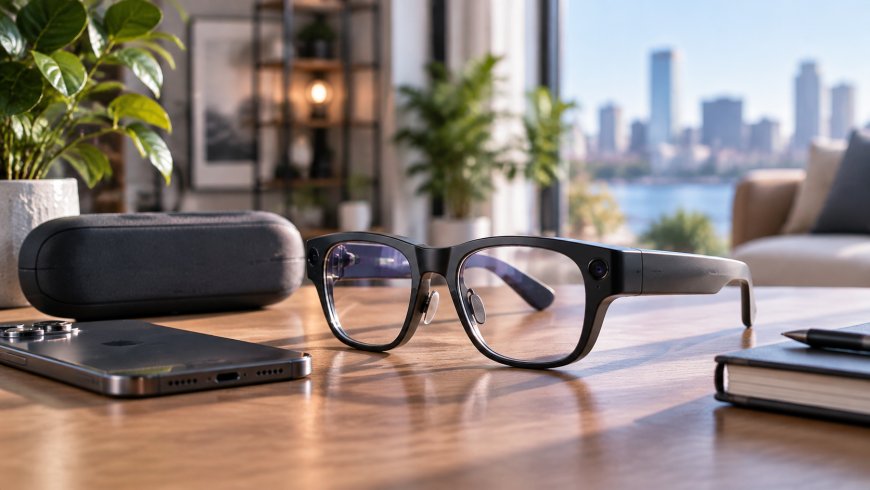
The smart glasses market has a problem that nobody has solved yet. The technology works. You can put a camera on a pair of glasses, connect it to an AI assistant, and do things hands-free that would normally require pulling out your phone. The problem is that almost nothing you can do with smart glasses is actually faster or easier than doing it with the phone already in your pocket.
Meta has dealt with this problem by making its glasses cheap and culturally visible. When your product costs $299, and celebrities wear it, you don’t need to justify why it exists. You need people to think it looks cool.
HTC does not have that luxury. The Vive Eagle costs $499. HTC does not have a celebrity marketing machine. And the company that once competed with Samsung and Apple for smartphone dominance pulled in just $19 million in revenue last quarter while posting a loss. At this price, the glasses need to earn their place on your face through hardware and experience alone.
They do some things well. They do not do enough.
What You Are Actually Buying
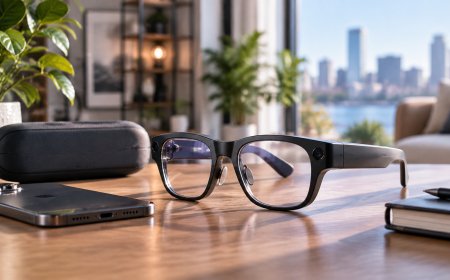
The Vive Eagle is a pair of camera-equipped smart glasses in a Wayfarer or Panto (rounded) frame design. They look like regular glasses. That is intentional and, at this point, table stakes for the category. A white LED near the camera lens lights up when recording, signalling to people around you that they are being captured. However, how many bystanders actually notice or understand that indicator is an open question.
Inside: a Qualcomm Snapdragon AR1 Gen 1 chip, 4GB of RAM, and 32GB of encrypted local storage. The camera is a 12-megapixel ultra-wide sensor that can shoot vertical 2K video in clips up to 10 minutes long, plus slow motion at 120 frames per second at reduced resolution. A four-microphone array handles voice input. Open-ear stereo speakers handle audio output. Battery life lasts about 4.5 hours for music playback, 3 hours for calls, and 36 hours on standby.
The frame weighs roughly 49 grams, which is light enough that you will forget you are wearing them and also light enough that they feel fragile. These don’t feel like glasses that would survive a drop on concrete.
HTC offers six configurations across the two frame styles with options for clear, sun, or photochromic lenses. The photochromic version bumps the price to $599. Prescription lenses are available through partner opticians at additional cost.
The Privacy Pitch
The most interesting thing about the Vive Eagle is not the hardware. It is the privacy architecture.
Meta’s smart glasses sync media to your phone automatically, and Meta’s ecosystem touches the data along the way. HTC deliberately does not do this. Photos and videos stay on the glasses’ local storage until you manually import them over Wi-Fi through the Vive companion app. That extra friction is intentional: HTC positions it as a privacy feature rather than a limitation. Your media does not leave the device until you explicitly move it.
HTC also lets you choose your AI backend. You can use OpenAI’s ChatGPT, Google’s Gemini, or HTC’s own Vive AI assistant. That flexibility is unusual in a product category where most devices lock you into one ecosystem.
Nobody can verify whether HTC’s privacy commitments will hold up through future software updates and policy changes. But the positioning is clear, and it lands at a pointed moment: Meta is currently facing a US class action lawsuit over how it handled footage from its smart glasses.
What Works
The physical controls are better than most smart glasses offer. A button on the left arm handles power and AI activation. A button on the right handles the camera. A touchpad running along the right arm lets you scroll, tap to answer calls, control music, and cycle through AI responses. That variety of input options means you are not stuck relying entirely on voice commands in situations where talking to your glasses would be awkward.
The charging solution is clever. Instead of a bulky charging case like Meta uses, HTC provides a magnetic pogo-pin cable long enough (1.2 meters) to plug into a power bank in your pocket while you wear the glasses. An optional Power Boost accessory clips directly to the frame and adds roughly half a battery of charge while you wear them. For a product with a 3-hour active-use battery life, on-the-go charging is not a nice-to-have. It is a necessity, and HTC handled it better than the competition.
Live translation across 13 languages works through the AI assistant and is one of the more genuinely useful features for travellers. Voice-triggered photo capture and hands-free note-taking both function as advertised.
What Does Not
The camera produces images that look like smartphone photos from five years ago. There is no depth-of-field processing, no computational photography sophistication, and no attempt at the kind of image processing that modern phone cameras use to make even casual shots look polished. The results are flat, evenly exposed rectangles that document what happened but do not make it look interesting. For social media stories that disappear in 24 hours, that is fine. For anything you would want to keep or share as a real photograph, it is not enough.
The speakers are tuned for speech, which means calls, podcasts, and AI responses sound clear enough. Music is a different story. The highs are harsh,h and the bass is either absent or distorted. Open-ear speakers have inherent limitations, but even at the standard, the Vive Eagle’s audio isn’t good enough to replace earbuds for music. The open design also means anyone sitting next to you can hear what you are listening to, which makes phone calls in public settings a privacy problem for everyone involved.
The AI assistant experience is inconsistent. Translation and basic queries work. More complex requests, like asking the glasses to read text from a book through the camera, produce unreliable results. The system can struggle with content it flags as potentially violating content guidelines, sometimes erroneously refusing to read ordinary text and then contradicting itself when challenged. If you are in a situation where the AI cannot help, you are going to pull out your phone anyway, which defeats the purpose of having a hands-free assistant on your face.
Transferring media off the glasses is deliberately friction-heavy. You open the companion app, connect to the glasses’ own Wi-Fi network, import the photos, and then separately choose which ones to save to your phone’s gallery. Every step is manual. HTC frames this as privacy-first design, and they are not wrong, but the practical result is that moving your photos takes so many steps you probably won’t do it often.
The $200 Question
The Vive Eagle costs $499. The Ray-Ban Meta smart glasses start at $299. That $200 gap is the core question, and the answer is not flattering to HTC.
For $200 more, you get a privacy-first architecture that does not auto-sync your media, the ability to choose between AI assistants, better physical controls, and a more flexible charging system. Those are real advantages, and for a specific buyer who cares deeply about privacy and AI flexibility, they may justify the premium.
You do not get a better camera. You do not get better speakers. You do not get a more reliable AI experience. You do not get the ecosystem integration, app support, or cultural relevance that Meta’s glasses carry. And you are buying from a company in a precarious financial position, which raises fair questions about long-term software support and accessory availability.
The smart glasses category grew 210% year over year in the first quarter of 2026, and Meta controls roughly 84% of it. HTC is entering a market where the dominant player has more money, more brand recognition, more developer support, and a lower price point. The Vive Eagle needed to be dramatically better to justify costing dramatically more.
It is not dramatically better. It is slightly different, in ways that will matter to some buyers and go unnoticed by most. At $499, “slightly different” is not enough to change which pair of smart glasses most people should buy. At $299 or $349, the conversation would be very different. At $499, the Eagle is asking a premium price for a product that hasn’t earned it yet.
What's Your Reaction?
 Like
0
Like
0
 Dislike
0
Dislike
0
 Love
0
Love
0
 Funny
0
Funny
0
 Angry
0
Angry
0
 Sad
0
Sad
0
 Wow
0
Wow
0