



































Thea Energy Previews Helios, Its Pixel-Inspired Fusion Power Plant
Thea Energy unveils Helios, its pixel-inspired fusion power plant using advanced magnet arrays and AI control to reshape the future of clean, scalable fusion energy.
Demonstrate that their designs can operate effectively and affordably. Both goals are notoriously tricky, mainly when traditional fusion systems rely on massive magnets or lasers that must be placed with extreme precision.
Fusion startup Thea Energy believes its pixel-inspired reactor and advanced control software will enable it to generate power without requiring such painstaking perfection.
Today, the company is publicly releasing the full details of its reactor design — including the physics behind it — and has shared the paper exclusively with TechCrunch.
A Stellarator Reinvented
Thea is developing a novel twist on the stellarator, a class of fusion reactors that use magnets to shape and confine superheated plasma. Magnets are one of two foundational approaches to fusion; the other uses lasers or pressure to compress fuel pellets, known as inertial confinement.
Traditional stellarators rely on magnets with highly complex geometries—often resembling surreal sculptures—to match the plasma's behaviour. Although stellarators offer advantages such as longer confinement times and lower power requirements than tokamaks, their highly irregular magnetic field shapes make manufacturing extremely difficult.
The Resolution:
Use hundreds of identical, small superconducting magnets arranged in arrays to create a "virtual" s "ellarator, using software to finely tune the magnetic fields rather than relying on perfectly machined hardware.
Iterative Design Without the Cost Penalty
Because the magnets are small and identical, Thea has rapidly iterated through more than 60 design variations in just two years, CEO Evgeni Berzin said.
By contrast, traditional fusion companies typically work with magnets the size of a vehicle — each costing tens of millions and taking years to produce.
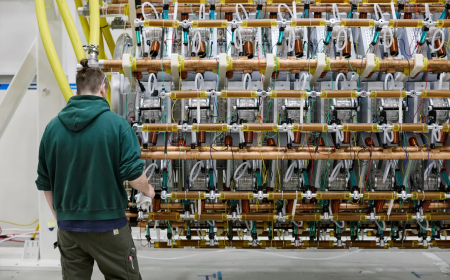
Thea also tested its design's tolerance to fabrication imperfections using a 3×3 magnet array packed with sensors. In addition to physics-driven control algorithms, the company trained an AI-based reinforcement-learning system to correct irregularities automatically.
The team intentionally misaligned magnets by more than a centimetre and beyond acceptable precision nd introduced flawed materials from five manufacturers. Each time, the control system corrected the defects without human intervention.
Inside Helios: The Magnetic Architecture
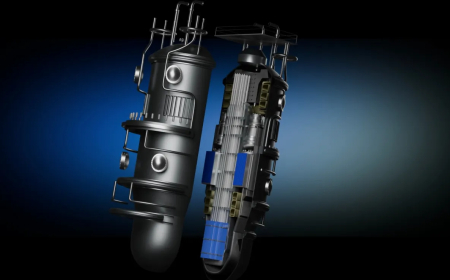
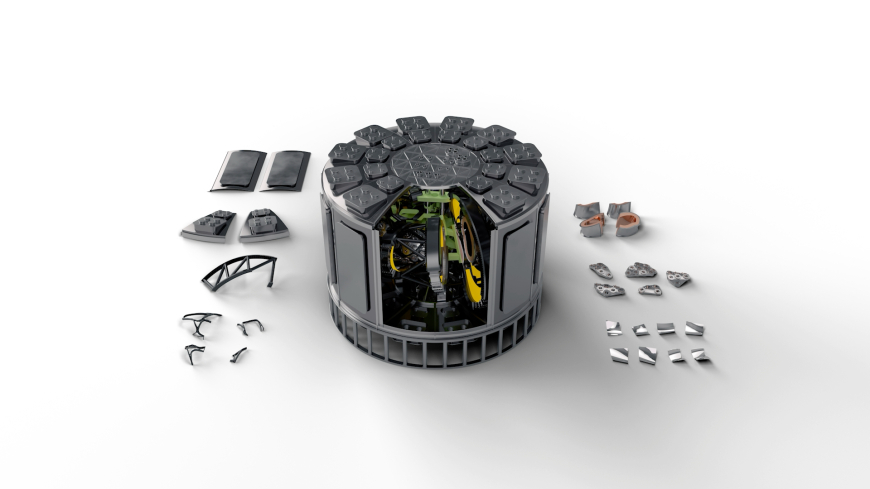
Thea's all-scale reactor design, Helios, will use:
- 12 large external superconducting magnets (four shapes), similar to those used in tokamaks, to provide the main confinement field
- 324 smaller circular magnets positioned inside to fine-tune plasma shaping in real time
The company projects that Helios will generate:
- 1.1 gigawatts of heat
- Converted to 390 megawatts of electricity
- At an initial cost under $150 per MWh, dropping to $60 per MWh by the seventh or tenth plant
- With an 88% capacity factor, exceeding gas plants and approaching modern nuclear performance
Helios will require maintenance roughly every two years, with an 84-day downtime period.
The Roadmap: Eos First, Then Helios
Helios remains in the conceptual stage. Thea must first complete Eos, a smaller-scale scientific demonstrator.
- The site for Eos will be announced in 2026
- The device is expected to turn on around 2030
- Work on Helios will proceed in parallel with the approach used by Commonwealth Fusion Systems for its ARC and SPARC reactors.
Berzin says the company is now preparing for broad scientific engagement:
This is the release of the overview paper. It will be followed by peer-reviewed work. Now is the moment to set up partnerships, collaborations, and engage end users to build the first one."
What's Your Reaction?
 Like
0
Like
0
 Dislike
0
Dislike
0
 Love
0
Love
0
 Funny
0
Funny
0
 Angry
0
Angry
0
 Sad
0
Sad
0
 Wow
0
Wow
0