







































Xona Prepares Six-Satellite Launch for Commercial GPS Alternative
Xona plans to launch six Pulsar satellites in October 2026 to begin testing a stronger, more precise satellite navigation service for commercial users.
Xona Space Systems is preparing to launch six satellites this month, bringing its commercial GPS alternative closer to operation. The startup’s Pulsar network promises centimetre-level positioning, stronger navigation signals and improved resistance to interference, targeting applications that conventional satellite navigation systems struggle to support.
The satellites are scheduled to launch aboard a SpaceX rocket in October 2026, allowing Xona to begin testing its service with commercial customers. The mission marks an important step toward its planned 258-satellite constellation, designed to provide precise location and timing information independently of government-operated networks.
How Xona Plans to Improve on GPS
Founded in 2019 by five engineers who met through Stanford University’s aerospace engineering program, Xona Space Systems is developing satellite-based navigation technology in low Earth orbit. Its approach builds on doctoral research by co-founder and Chief Technology Officer Tyler Reid, who studied how lower-orbiting satellites could improve positioning accuracy.
Traditional GPS and comparable systems operated by Europe, China and Russia provide navigation signals used worldwide. However, their relatively weak signals can be disrupted by jamming or spoofing, and standard positioning accuracy alone is insufficient for some autonomous vehicles and agricultural robots.
Xona says Pulsar is designed to deliver centimetre-level accuracy rather than the meter-level positioning typically available through conventional GPS. Its stronger signals are also intended to improve reception inside buildings and densely developed urban areas, where satellite navigation can be unreliable.
Developing the system required solving significant engineering challenges. Rather than equipping every spacecraft with expensive atomic clocks, Xona developed an architecture that uses frequent communication with ground-based timing references to maintain accuracy.
The company also designed Pulsar’s signals to work with existing GPS receivers through relatively simple software modifications. This compatibility could allow manufacturers and customers to adopt the service without replacing large amounts of navigation hardware.
Six Satellites Will Begin Commercial Testing
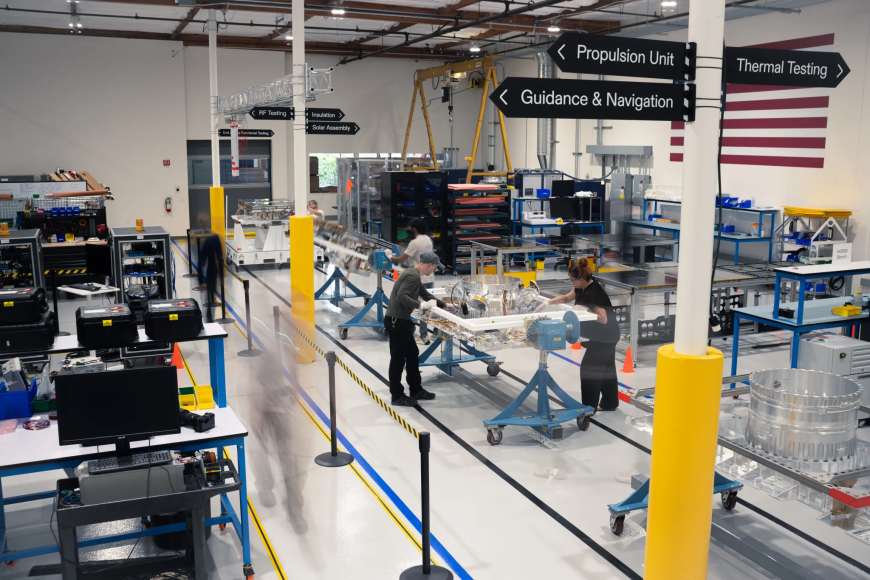
Four spacecraft in the upcoming launch use satellite platforms supplied by Aerospacelab and follow a design similar to Xona’s earlier demonstration satellite. The remaining two were manufactured at the company’s Burlingame, California, headquarters and represent the design intended for its larger operational constellation.
Once deployed, the satellites are expected to pass over mid-latitude regions approximately eight times daily, providing opportunities for initial customer testing. The limited number of spacecraft means continuous commercial coverage will require additional launches.
One early customer is TimeBeat, a company specialising in precision timing technology. CEO Ian Gough said its engineers plan to use the initial Pulsar service to verify and correct timing information across devices operating in different parts of the world.
Xona aims to provide full coverage across the United States, Europe, Japan and South Korea by 2028. That expansion remains a company target dependent on deploying the larger satellite constellation.
Funding and Applications Beyond Traditional Navigation
Xona has secured more than $300 million since its founding, including $20 million from the U.S. Space Force. The military’s involvement reflects interest in alternatives to conventional satellite navigation as signal interference becomes a growing concern in conflict zones.
Commercial applications extend beyond navigation for individual drivers. Precision timing supports communications and electronic systems, while improved positioning could benefit industrial robotics, automated agriculture and autonomous transportation.
Reid previously worked on self-driving vehicle technology at Ford, giving him direct experience with the limitations of existing navigation systems. Xona CEO Brian Manning has also identified transportation safety as a potential long-term application, particularly for vehicles that must determine their position reliably without constant human intervention.
The October launch will not immediately deliver worldwide GPS replacement coverage. Instead, it will let Xona begin demonstrating its technology to customers while building the satellite network needed for continuous, high-precision commercial navigation.
What's Your Reaction?
 Like
0
Like
0
 Dislike
0
Dislike
0
 Love
0
Love
0
 Funny
0
Funny
0
 Angry
0
Angry
0
 Sad
0
Sad
0
 Wow
0
Wow
0