The fashion industry continues to grapple with a significant waste problem, with roughly one garbage truck of textiles discarded every second. At the same time, the sector produces more carbon emissions than international aviation and maritime shipping combined.
In response, companies are exploring new approaches to sustainability. Some are focusing on recycling textile waste, while others are developing alternative materials that reduce reliance on fossil fuels. One such effort comes from startup Rubi, which is working to transform captured carbon dioxide into usable textile inputs.
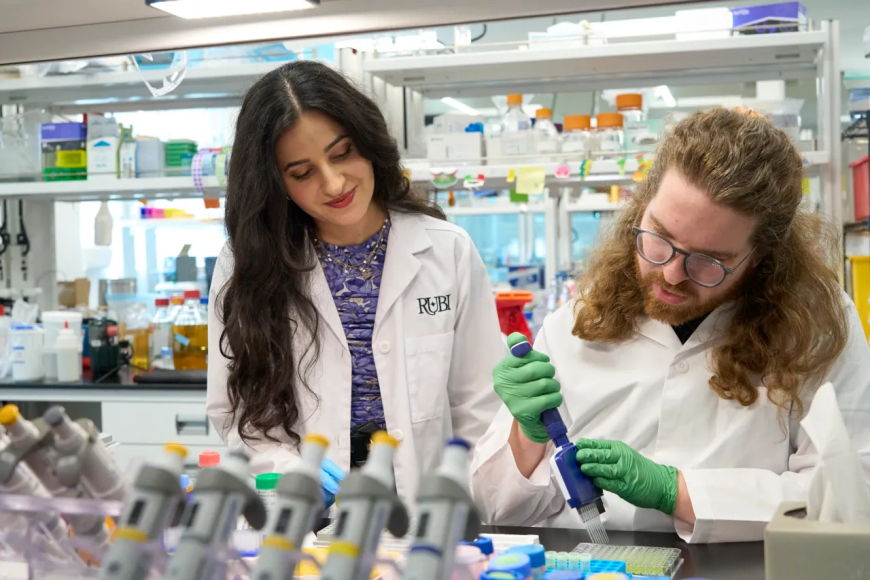
Rubi’s approach involves what co-founder and CEO Neeka Mashouf describes as taking “the machinery of biology outside of the cell” to create the building blocks of materials like lyocell and viscose. The company’s technology enables manufacturers that rely on cellulose to produce it using CO2 as a primary input.
The startup recently secured $7.5 million in funding to build a demonstration-scale version of its cellulosic production system. This system is designed to produce tens of tons of material derived from carbon dioxide. The funding round was led by AP Ventures and FH One Investments, with participation from CMPC Ventures, H&M Group, Talis Capital, and Understorey Ventures.
Rubi has also signed more than $60 million in non-binding off-take agreements with partners and has tested its material with 15 pilot collaborators, including H&M, Patagonia, and Walmart.
To produce cellulose for lyocell and viscose, Rubi relies on enzymes rather than alternative methods such as engineered bacteria or chemical catalysts. Currently, most cellulose used in textiles is sourced from trees, including plantation-grown wood and even virgin rainforests.
“These textile and raw material supply chains are very long,” Mashouf said. “Here in the U.S., we’ve gotten interest in being able to actually produce cellulose pulp that’s textile-grade, where that doesn’t exist today.”
The idea of using enzymes emerged when Mashouf, who has a background in materials science, collaborated with her twin sister, Leila, who was studying medicine at Harvard Medical School. After evaluating various technological approaches, they determined that enzymes offered the most viable path forward.
Mashouf noted that the enzyme industry is already well established, with applications ranging from the production of high-fructose corn syrup to wastewater treatment. “The capacity is out there already and can be very low cost,” she said.
Rubi’s process uses a sequence, or “cascade,” of enzymes to convert carbon dioxide into cellulose. The company has applied artificial intelligence and machine learning techniques to improve the performance and stability of these enzymes.
In its current setup, the enzymes are suspended in an aqueous solution. When carbon dioxide is introduced, cellulose begins to form inside the reactor within minutes. These reactors are designed to fit within modules roughly the size of shipping containers. Over time, Rubi plans to evolve the system to support continuous production.
While the company’s initial focus is on supplying the apparel industry, it ultimately aims to expand into other sectors that rely on cellulose. “This really is a platform,” Mashouf said. “We think of it as a platform to make all the important chemicals and materials across the economy in a low-cost way.”






































 Like
0
Like
0
 Dislike
0
Dislike
0
 Love
0
Love
0
 Funny
0
Funny
0
 Angry
0
Angry
0
 Sad
0
Sad
0
 Wow
0
Wow
0