

































How Quilt Addressed One of Heat Pumps’ Biggest Technical Hurdles
Quilt has introduced a data-driven three-zone heat pump designed to stay efficient in extreme conditions, addressing a major technical challenge facing heat pump systems.
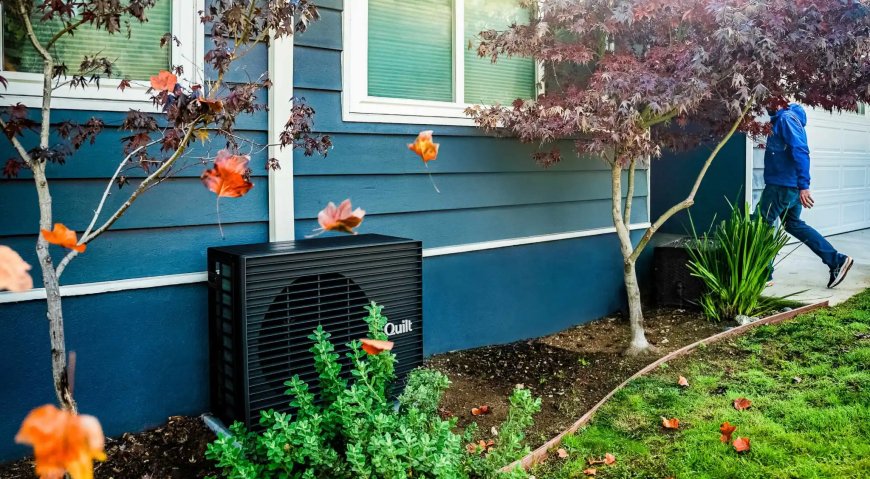
Smart home startup Quilt on Tuesday unveiled a new three-zone heat pump designed to remain efficient even under conditions that often challenge traditional HVAC systems.
As the name suggests, the system allows a single outdoor unit to power three indoor heads, simplifying large installations while reducing both cost and outdoor space requirements. The product is central to Quilt’s expansion strategy, which recently received a boost from a $20 million Series B funding round to scale sales.
While the hardware itself is notable, the larger story lies in how Quilt developed the system.
Since its founding, Quilt has differentiated itself by collecting extensive performance data from its heat pumps. The company’s systems are not only internet-connected but also equipped with significantly more sensors than conventional heat pumps, enabling Quilt to monitor real-world performance closely.
That data-driven approach has already delivered tangible results. In September, Quilt rolled out an over-the-air software update that unlocked an additional 20% of heating and cooling capacity in existing installations. The extra capacity could be directed to one or two zones, helping customers stay comfortable during extreme heat or cold without requiring hardware changes.
The same dataset was instrumental in developing the new three-zone unit — and in solving a long-standing industry challenge.
Multi-zone heat pumps are most efficient when operating at variable speeds, adjusting compressor output to match demand. When demand is low, the compressor slows down, delivering only the required heating or cooling. However, compressors become increasingly unstable at very low speeds, making precise control difficult.
Matthew Knoll, Quilt’s co-founder and chief technology officer, likens it to driving a car. Maintaining a steady 70 miles per hour is relatively easy, he said, but holding a constant 11 miles per hour is far more difficult.
To avoid instability, many systems shut off the compressor when the speed drops below a threshold, reducing efficiency and comfort.
Quilt took a different approach, analysing operational data from approximately 1,000 installed systems across homes and businesses in a wide range of climates. That real-world insight allowed engineers to fine-tune performance in ways that lab testing alone typically cannot.
“Most systems are tested in a lab under a handful of scenarios because testing is expensive,” Knoll said. “You end up with something that’s kind of an average product.”
By contrast, Quilt can examine how its systems perform across thousands of real-world installations, helping engineers determine whether performance issues represent optimisation opportunities or rare edge cases.
Hardware design choices also played a role. Quilt uses a larger copper coil than many competitors, allowing the system to operate within a smaller compressor. Combined with other design refinements, this allows the new unit to deliver nearly 90% of its rated 27,000 BTUs at temperatures as low as -13°F (-25°C) — without sacrificing efficiency during low-demand operation.
According to the company, the result is the most efficient three-zone mini-split system currently on the market.
Each indoor head can be controlled independently and can supply as little as 2,210 BTUs of heat or 1,570 BTUs of cooling. When a zone doesn’t require conditioning, refrigerant continues to circulate as in conventional systems, but the outdoor unit’s low-speed capability limits heat output to about 300 BTUs in heating mode—roughly the amount of heat emitted by an adult human.
Looking ahead, Quilt has not disclosed specific upcoming products. Knoll said only that the company aims “to have a solution for all homes.” Given Quilt’s emphasis on data-driven design, future developments are likely to continue building on insights gathered from its growing fleet of deployed systems.
What's Your Reaction?
 Like
0
Like
0
 Dislike
0
Dislike
0
 Love
0
Love
0
 Funny
0
Funny
0
 Angry
0
Angry
0
 Sad
0
Sad
0
 Wow
0
Wow
0