






































HYTE X50: A Bold ATX Case Built Around Airflow and Curved Glass
HYTE X50 review covering its curved acoustic glass, cooling layout, hardware support, build design, pricing and position among modern ATX PC cases.
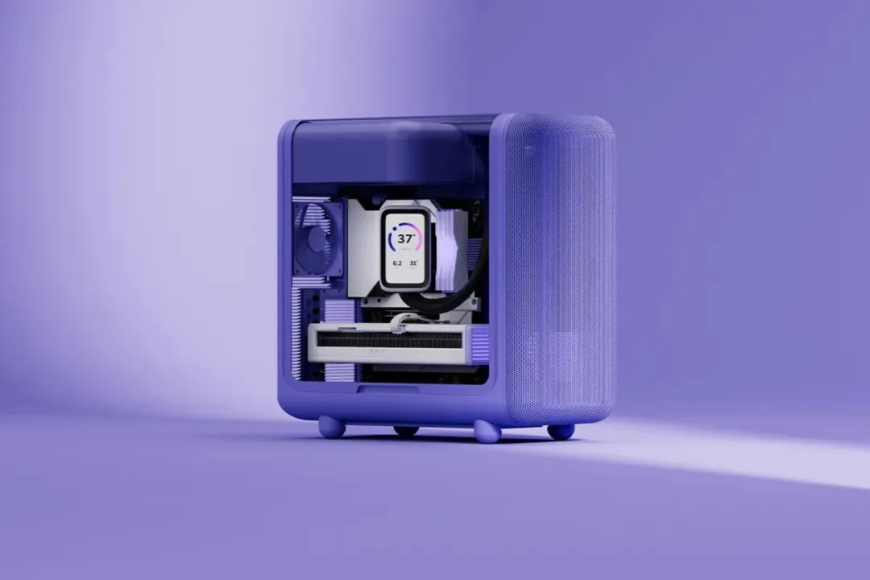
The HYTE X50 is an ATX mid-tower for PC builders who want a distinctive case without sacrificing the cooling and component space expected from modern enthusiast hardware. Its rounded exterior, sweeping laminated-glass side panel, and unusually playful colour options immediately set it apart from the rectangular black towers that still dominate the category.
Underneath the styling, however, the X50 is a serious performance-oriented chassis. HYTE has designed it around high airflow, large graphics cards and substantial radiator support, making the case suitable for powerful gaming systems as well as visually focused builds. The main question is whether its unconventional layout and $149.99 price make sense compared with the many airflow-focused mid-towers already available.
A PC Case Designed Around Curves
The X50 takes a different visual direction from HYTE’s panoramic Y-series cases. Instead of relying on multiple flat glass panels, it uses a large curved side window and rounded forms throughout the chassis. The result is softer and less architectural than many showcase gaming cases.
According to HYTE’s official X50 specifications, the chassis measures 485mm high, 510mm long and 255mm wide, giving it a 63-litre internal volume. The frame uses 1mm-thick steel and ABS, while the window is made from 4mm laminated acoustic glass.
The laminated construction is more than a styling decision. HYTE says it is intended to reduce sound transmission while adding a bonding layer that helps keep the glass together if it breaks. That makes the panel different from the conventional tempered-glass sheets found on many competing cases.
Colour is another important part of the X50’s identity. HYTE offers versions including Snow White, Pitch Black, Wild Cherry, Taro Milk, Strawberry Milk and Matcha Milk. Those options give builders considerably more freedom than the usual choice between black and white.
Airflow Is Built Into the Structure
The rounded exterior does not mean HYTE has sacrificed ventilation. Large sections of the chassis use high-porosity micro-mesh, while patent-pending louvred vents are designed to move exhaust air out of the system with less restriction.
One of the more interesting decisions is wHYTE’scold-floor cooling layout. The bottom of the case can accommodate three 120mm fans up to 32mm thick, directing fresh air toward the graphics card. This is increasingly useful as high-end GPUs become larger and generate more heat.
The case can accommodate up to 10 fans total. The front supports three 120mm or three 140mm fans, the side supports three 120mm units, and the rear accepts another 120mm fan. HYTE does not include case fans as standard, so buyers need to account for that additional cost when planning a build.
That omission is one of the X50’s more significant practical drawbacks. A builder targeting strong thermals will need to add fans immediately, rather than using a reasonable factory configuration out of the box.
Plenty of Space for Modern Hardware
The X50 supports standard ATX, Micro-ATX and Mini-ITX motherboards, along with E-ATX boards measuring up to 10.6 inches wide. Graphics cards can be up to 430mm long and 160mm high, leaving enough room for many of today’s oversized enthusiast GPUs.
CPU air coolers can reach 170mm in height, and the case supports power supplies up to 223mm long. HYTE places the PSU beneath a structural canopy rather than using a conventional bottom-mounted shroud. The company has also incorporated cable tie-down points and included Velcro straps to help manage wiring around the chassis.
Storage support is more restrained. The X50 provides mounting for two 2.5-inch drives and one 3.5-inch drive. That should be sufficient for many current gaming PCs built primarily around M.2 SSDs, but users with large collections of SATA drives may find the layout limiting.
Strong Radiator Support for Liquid Cooling
Liquid-cooling support is one of the X50’s strongest hardware features. The front can accommodate radiators up to 360mm long, with HYTE allowing substantial thickness for radiator-and-fan combinations. The side also supports a radiator up to 360mm long and 70mm thick, while the rear can take a 120mm radiator.
This provides builders with considerable flexibility when positioning an all-in-one liquid cooler or planning a more complex cooling configuration. Supporting large radiators in more than one location also means the case does not force every high-performance build into the same arrangement.
Independent testing provides some useful context for the airflow design. In thermal testing conducted by Tom’s Hardware with HYTE FA12 fans installed, the X50 produced competitive CPU and GPU cooling results. Those measurements apply to that specific test configuration. They shouldn’t be treated as guaranteed temperatures for every build, but they support the idea that the chassis can deliver strong cooling when properly equipped.
Front Connectivity Covers the Essentials
The front I/O includes two USB 3.2 Gen 1 Type-A ports, one USB 3.2 Gen 2x2 Type-C connection and a 3.5mm combination audio jack. It also has a tactile mechanical power switch with an integrated LED.
That selection covers the connections most current gaming systems need, particularly the faster USB-C port for modern storage devices and accessories. The X50 doesn’t try to overload the front panel with ports, but the available selection suits a contemporary mid-tower.
HYTE X50 vs. X50 Air
HYTE also sells the X50 Air, which uses a full-coverage micro-mesh side panel instead of the curved laminated-glass window. Most of the underlying dimensions and component clearances remain similar, so the choice is primarily about priorities.
The standard X50 is the more visually dramatic model and keeps internal components visible. The X50 Air emphasises open ventilation and gives up the showcase window. Builders can compare both versions in HYTE’s X50 product overview.
Neither approach is inherently better. A builder assembling a visually coordinated system may prefer the glass model, while someone focused primarily on airflow could find the Air version more appropriate.
Price and Value
HYTE currently lists the standard X50 at $149.99 in the United States, although prices can vary by colour, retailer and promotion. At that level, it sits above many mainstream airflow cases and competes in a segment where buyers can reasonably expect strong construction, extensive cooling support and thoughtful cable management.
The lack of included fans weakens the value somewhat because a complete cooling setup adds to the final build cost. On the other hand, builders who already intend to select their own fans may prefer not to pay for bundled models they would immediately replace.
The case therefore makes the most sense for someone who values its styling and wants to use its cooling flexibility. Buyers looking strictly for the lowest-cost enclosure that can hold an ATX gaming system have many cheaper alternatives.
Pros and Cons
Pros:
- Distinctive rounded design with curved laminated acoustic glass.
- Strong support for large graphics cards and high-end components.
- Up to 10 fan positions and substantial radiator support.
- Bottom fan mounts can provide direct airflow to the GPU.
- Wide selection of unusual colour options.
- USB-C is included in the front I/O.
- Four-year manufacturer warranty.
Cons:
- No case fans are included as standard. At
- $149.99, it costs more than many mainstream mid-towers.
- Storage capacity is limited for builders using several SATA drives.
- The rounded styling may not appeal to buyers who prefer understated PC cases.
Final Verdict
The HYTE X50 is more than an unusual-looking PC case. Its curved glass, rounded frame and broad colour palette give it a recognisable identity. Still, the chassis also provides the cooling capacity and internal space required for powerful modern gaming hardware.
The ability to mount large radiators, direct substantial airflow toward the graphics card, and accommodate GPUs up to 430mm long makes the X50 well suited to performance-oriented builds. At the same time, the absence of included fans means buyers should consider the full cooling budget rather than judging the case on its purchase price alone.
Builders who want an inexpensive, understated enclosure can find better-value options elsewhere. For someone who wants a visually distinctive ATX case and plans to choose a custom fan or liquid-cooling setup, the X50 offers a convincing combination of design freedom, component space and cooling flexibility without turning its unusual appearance into a functional compromise.
What's Your Reaction?
 Like
0
Like
0
 Dislike
0
Dislike
0
 Love
0
Love
0
 Funny
0
Funny
0
 Angry
0
Angry
0
 Sad
0
Sad
0
 Wow
0
Wow
0