































My Experience With the Strongest Tech of 2026
Rugged laptops, smartwatches, and reinforced electronics promise extreme durability, but true toughness takes more than a protective shell. Here is what testing some of the strongest tech of 2026 revealed.
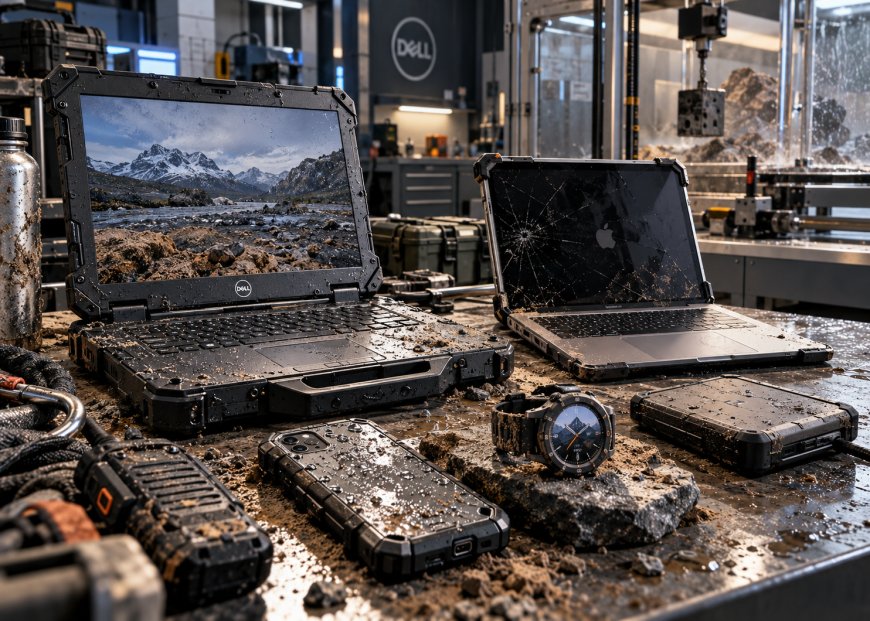
A protective case can make a laptop look ready for a construction site. That does not make the computer inside it rugged.
The distinction became unusually clear in a destructive test involving thousands of dollars of electronics built or marketed to survive conditions that would normally end a consumer device. A conventional MacBook Air was fitted with a heavily reinforced case and dropped alongside a purpose-built Dell rugged laptop. The case absorbed visible damage and the MacBook still looked largely intact, but the computer would no longer start. The Dell came away with little more than cosmetic damage and continued working.
That result gets to the heart of rugged technology. Durability is rarely about one especially strong material wrapped around ordinary electronics. Products that survive harsh environments are usually designed around the assumption that water, dust, vibration, impact and temperature extremes will eventually reach them.
The engineering response affects nearly everything: the chassis, display, ports, battery arrangement, internal mounting, seals and even the controls.
Rugged Design Starts Before the Outer Shell
Dell’s Latitude 5430 Rugged illustrates how different that approach can be from simply protecting a normal notebook after it has already been designed.
Dell lists the machine as tested to MIL-STD-810H methods, with IP53 protection and support for two batteries that can be swapped without shutting the computer down. Its design also accommodates situations that ordinary ultraportables rarely have to consider, including outdoor visibility and continuous operation away from reliable power.
Those features do not make for the sleekest laptop. Rugged computers are thicker, heavier and often less elegant than mainstream machines because elegance is not the main engineering constraint.
The goal is to keep the computer usable when normal assumptions no longer apply.
That is why a rugged case can only go so far. It may absorb energy at the corners and prevent an aluminium chassis from denting. Still, it cannot redesign how a battery is mounted, protect a motherboard connector from a sudden shock, or make unsealed internal components tolerate water.
The source testing demonstrated exactly that problem. The conventional laptop’s exterior remained recognisable after the drop, yet something critical inside had failed. The rugged Dell had been designed around the impact rather than merely wrapped for it.
The same principle applies to smaller electronics.
Apple’s Watch Ultra 2 was built for substantially harsher environments than a typical smartwatch. Apple rates it for 100 meters of water resistance and IP6X dust resistance and says the device was tested using MIL-STD-810H methods covering conditions including temperature extremes, freezing, immersion, vibration and shock.
In hands-on testing, the Ultra resisted scratches better than the cheaper comparison watches and survived an extreme impact far beyond ordinary use. A regular Apple Watch also performed surprisingly well, which is an important reminder that premium rugged products often improve on consumer hardware that is already reasonably durable, rather than starting from something fragile.
The extra money buys a larger safety margin, not immortality.
“Military Grade” Does Not Mean Indestructible
MIL-STD-810H appears constantly in marketing for rugged phones, watches and laptops, but the label is easy to misunderstand.
The U.S. Department of Defence standard is a collection of environmental engineering and laboratory test methods covering stresses such as temperature, rain, vibration, shock, dust and immersion. It is not a single universal durability test that every product must pass in the same way.
The standard itself says it does not impose one fixed set of design or test specifications. Tests are intended to be tailored around the environmental conditions relevant to a particular system.
That means consumers should look beyond a generic “MIL-STD-810H tested” claim and ask what was actually tested.
HMD’s Nokia XR21, for example, was marketed with MIL-STD-810H durability alongside IP68 and IP69K protection and a body using impact-resistant materials. HMD also specified drop testing for the phone rather than relying on the military-standard name alone.
That matters because water resistance, impact resistance and temperature tolerance are separate engineering problems.
The original Nokia 3310 became famous for surviving drops partly because it was small, light and mechanically simple. Its removable cover and battery could separate during impact, dissipating energy rather than forcing the entire load through a large glass structure.
But the old phone was never designed around modern waterproofing.
In the source test, immersion quickly defeated the 3310 while the much newer rugged Nokia continued operating. A subsequent high drop also demonstrated how far engineered display protection and impact-resistant smartphone structures have come. The old phone’s legendary simplicity remained useful, but it couldn’t compensate for the lack of environmental sealing.
Modern ruggedness is more sophisticated than simply making something thick.
The Best Rugged Products Protect the Vulnerable Parts
Cameras make this especially obvious because they contain moving controls, optical assemblies, displays, batteries and storage doors that all create potential points of failure.
OM System’s Tough TG-7 is designed to be waterproof to 15 meters, survive drops from up to 2.1 meters, tolerate crushing loads of 100 kilograms and operate in freezing conditions down to minus 10 degrees Celsius. Those figures describe specific operating limits, not an undefined claim that the camera is “indestructible.”
The test pushed the camera substantially beyond some of those published conditions, including exposing it to far colder temperatures. It continued recording, although surviving an abuse test outside the specification should not be interpreted as a new guaranteed operating limit.
That distinction matters in technology journalism because dramatic durability demonstrations can easily become misleading. A device surviving one extreme incident does not establish that every unit will survive the same event repeatedly.
What it can reveal is whether the original engineering has meaningful headroom.
Storage media offered a similar lesson. A specially reinforced SD card resisted conditions that deactivated an ordinary card, but eventually failed after much more aggressive physical abuse. The outcome was arguably more useful than an “indestructible” result would have been: the tougher design raised the failure threshold substantially, but the threshold still existed.
Every rugged product has one.
Sometimes the Best Rugged Upgrade Is the Container
Not every device needs a redesign from scratch.
For cameras, drives, and other equipment that only needs protection during transport, a properly engineered case can be the more sensible solution.
Pelican’s Air series uses a proprietary polymer construction the company says can be up to 40% lighter than conventional polymer cases while remaining waterproof, dustproof and crush-resistant. Current models use O-ring sealing, pressure-equalisation valves and reinforced closures, with several carrying IP67 ratings.
That is a very different proposition from snapping a decorative shell onto a laptop.
A hard equipment case surrounds an object while it is not being used and can dedicate almost its entire structure to isolating that object from impact and the environment. A laptop case still has to leave the keyboard, ports, hinges and cooling system usable.
The source experiment ended with a deliberately absurd demonstration involving a fragile egg placed inside a Pelican Air case before a severe impact. The egg did not survive perfectly, but the test made the larger point: well-designed protective packaging can dramatically reduce the forces transferred to what is inside.
For some users, that is a better investment than buying ruggedised versions of every device they own.
Rugged Tech Is Really About Predictable Failure
The phrase “indestructible technology” works well in advertising because it sounds absolute. Engineering rarely is.
A truly useful rugged product is not one that cannot break. It is one whose manufacturer understands the most likely ways it will be damaged and has designed the product to keep operating through them.
Construction workers need protection from dust, drops and rain. Field technicians may need batteries they can replace without shutting down a system. Outdoor photographers need controls and sealed compartments that continue working around water and freezing temperatures. A consumer smartwatch designed for diving has very different requirements from an office laptop wearing a thick plastic shell.
That is why the strongest products in rugged technology often look overbuilt. Their extra material, strange latches, covered ports, and thick bezels aren’t there to create an aggressive aesthetic. They show that durability shaped the architecture from the start.
The tests also expose the limits of buying durability as an accessory. Cases can prevent scratches and soften impacts, but they cannot always protect the vulnerable electronics buried inside a product that was never designed for repeated abuse.
Rugged technology costs more because manufacturers are not merely trying to keep the outside intact. They are trying to control what happens to the entire device when something goes wrong.
That is a much harder problem than making a gadget look tough.
What's Your Reaction?
 Like
0
Like
0
 Dislike
0
Dislike
0
 Love
0
Love
0
 Funny
0
Funny
0
 Angry
0
Angry
0
 Sad
0
Sad
0
 Wow
0
Wow
0