

































Flipper launches Linux-powered networking device designed for hackers and makers
Flipper has introduced a Linux-powered networking gadget aimed at hackers, developers, and tech enthusiasts, offering advanced networking and security testing capabilities.
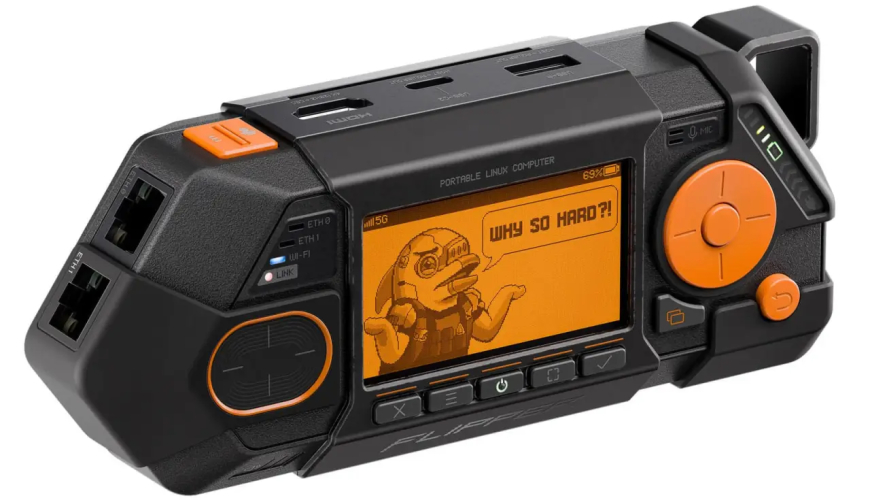
Flipper Devices, the company behind the popular Flipper Zero hacking gadget, has announced a new product called Flipper One. Designed with extensive networking capabilities and the ability to run Linux, this new device is for hackers, developers, makers, and technology enthusiasts who want a highly customisable platform. The company says it has already sold more than one million Flipper Zero units and generated over $150 million in revenue. Despite the new announcement, Flipper One is not intended to replace Flipper Zero, as the company says the two products operate at different layers and serve different purposes.
Flipper Zero has become a well-known toy within the hacking and maker community because of its ability to communicate with a wide range of wireless technologies. The device supports Bluetooth, RFID, NFC, sub-1 GHz radio communication, and infrared connectivity. These capabilities allow it to emulate devices such as key fobs and access cards, while also enabling a variety of wireless testing and experimentation use cases.
Flipper One takes a different approach by focusing on networking and computing. The device features multiple connectivity options, including dual Gigabit Ethernet ports, USB Ethernet with speeds up to 5 Gbps, and Wi-Fi 6E support across the 2.4 GHz, 5 GHz, and 6 GHz bands. In addition, it includes an M.2 expansion slot that can accommodate a range of hardware modules. Users will be able to connect 5G modems, software-defined radio modules, AI acceleration hardware, NVMe or SATA solid-state drives, and additional Wi-Fi cards through compatible adapters. The project remains under development, and the company says it is currently sharing its roadmap rather than releasing a finished product.
The hardware will feature two separate processors alongside 8 GB of memory. The primary processor is an eight-core RK3576 chip running an open Linux environment. This processor includes a Mali-G52 graphics processor and a neural processing unit designed to run local AI workloads directly on the device.
According to the company, it collaborated with Collabora to ensure support for the RK3576 chip was integrated into the mainline Linux kernel. As a result, developers can obtain the software directly from Kernel.org and experiment with the platform freely.
A second processor, the dual-core Raspberry Pi RP2350 microcontroller, manages essential system functions. This chip controls the display, buttons, touchpad, LED indicators, and power management systems. Even when the Linux portion of the hardware is powered down, users can continue interacting with the device through these independently managed components.
Flipper Devices CEO Pavel Zhovner revealed that the company is also working on its own Linux distribution, tentatively known as FlipperOS. In a blog post, he explained that while he appreciates the flexibility of Raspberry Pi OS, restoring a clean environment after installing packages often requires reflashing storage media for each new project. FlipperOS aims to simplify that process by introducing user profiles with different sets of preconfigured applications and settings. This approach would allow users to experiment freely with software and quickly return to a clean environment without repeatedly swapping or reflashing storage devices.
Alongside the operating system effort, the company is developing a management interface called FlipCTL. The software is designed to make it easier to control compact LCD screens with directional pad controls and touch input on devices such as the Flipper One.
Flipper Devices says the networking capabilities will allow users to configure the device for a variety of applications. Potential uses include serving as a router, a VPN gateway, or a network bridge between systems. Users will also be able to connect a monitor, keyboard, and mouse through a USB hub to create a complete Linux desktop environment. Through its HDMI 2.1 output, the device can also serve as a portable media centre, supporting 4K video playback at up to 120 Hz. Additionally, local AI models could be used to help manage the device, generate configuration files, and provide assistance even when no internet connection is available.
While the company has outlined an ambitious vision for Flipper One, many of the software components required to support those capabilities remain unfinished. Features such as neural processing unit acceleration for AI workloads and hardware video decoding still lack full support in the mainline Linux kernel. Likewise, both FlipperOS and FlipCTL currently remain conceptual projects rather than finalised products. The team has also not yet completed the development of offline large language models intended to assist users with system configuration and setup tasks.
To accelerate progress, Flipper Devices is encouraging developers to participate in the project and contribute software components that could eventually become part of the final consumer product. The company says additional details regarding availability and launch plans will be announced later. Based on current expectations, the base version of Flipper One is likely to be priced below $350, excluding optional cellular connectivity modules.
What's Your Reaction?
 Like
0
Like
0
 Dislike
0
Dislike
0
 Love
0
Love
0
 Funny
0
Funny
0
 Angry
0
Angry
0
 Sad
0
Sad
0
 Wow
0
Wow
0