
































Glimpse Launches Explore to Speed Industrial CT Quality Inspections
Glimpse launched Explore, expanding its CT analysis software beyond batteries to help hardware teams inspect critical parts faster across multiple industries.
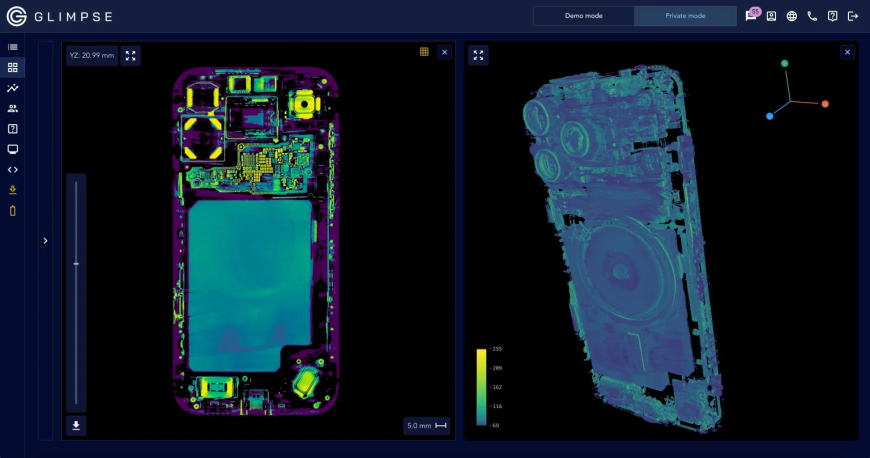
Glimpse is expanding its industrial CT scanning software beyond batteries with a new product called Explore, giving hardware companies a faster way to inspect critical components for defects. The company says its image-processing technology can make existing CT systems substantially more useful for routine quality control by reducing the time required to process and review scans.
The startup initially focused on battery manufacturing, where internal defects can be difficult to detect without X-ray or computed tomography imaging. CEO Eric Moch said CT inspection could identify many serious quality problems, but traditional scanning is often too slow for meaningful statistical sampling across large production volumes.
Glimpse wants to make CT inspection faster
Glimpse says its software can increase battery-cell inspection throughput by roughly 10 to 30 times on existing CT scanners. Moch said manufacturers using the technology could move from scanning only a limited number of cells to inspecting tens of thousands per day in some production environments.
The company is also developing what Moch described as a high-throughput scanner with partners. He said the planned system could complete individual scans in about one or two seconds, potentially making CT inspection practical at much larger manufacturing volumes.
Explore extends that approach to industries including aerospace, automotive, electronics and medical devices. Instead of focusing only on battery cells, the software is designed to help engineering and quality teams inspect a wider range of components using CT scanners already installed in laboratories and development facilities.
Deep learning helps process scans at the edge
Glimpse has built its own image-processing pipeline to improve and compress CT scan data. The system uses deep learning algorithms, with much of the initial processing performed on edge computers installed at customer locations before the resulting data is transferred to the cloud.
Moch said the architecture lets the software handle computationally intensive processing locally while reducing the amount of data that needs to move between systems. Glimpse says the resulting images can be opened in a web browser within seconds instead of requiring users to wait minutes or, in some cases, hours for large scan files to load.
The platform can also track customer-specified measurements alongside the scanned images. In a battery cell, for example, a manufacturer could monitor spacing between internal layers and use the software to identify measurements that begin moving outside the expected range.
When the system detects a deviation, it can flag the issue and highlight the relevant area of the CT image. Moch said this lets engineers inspect the defect visually rather than relying only on a numerical warning, while the underlying algorithms can incorporate customer feedback as the models are retrained.
Glimpse is also offering scanning as a service
Companies do not need to own a CT scanner to use Glimpse’s technology. Customers can ship components to the startup for inspection using Glimpse’s own equipment in the Boston area, and the company said it is opening another Scan On Demand centre in the San Francisco Bay Area.
Moch said the scanning service could ultimately represent a larger market because customers can spend hundreds or thousands of dollars on inspections without first purchasing expensive CT hardware. Companies that later reach the point where owning a scanner makes economic sense could then run Glimpse’s software on their own equipment.
Glimpse says it now has more than 100 customers, including Anker, Lucid and the U.S. Navy, with customers spanning both battery buyers and sellers. Moch said the company currently generates revenue in the mid-seven-figure range.
By moving beyond battery inspection with Explore, Glimpse is positioning the same processing and analysis technology for a broader set of hardware manufacturers. The central proposition remains the same: make CT inspection fast enough that companies can use internal imaging more routinely to identify defects before they become larger production or quality problems.
What's Your Reaction?
 Like
0
Like
0
 Dislike
0
Dislike
0
 Love
0
Love
0
 Funny
0
Funny
0
 Angry
0
Angry
0
 Sad
0
Sad
0
 Wow
0
Wow
0