






































Reservoir Raises $8 Million to Build Smarter, More Efficient Water Heaters
Reservoir raised $8 million to expand its smart heat pump water heaters, which aim to cut energy costs while helping reduce pressure on the power grid.
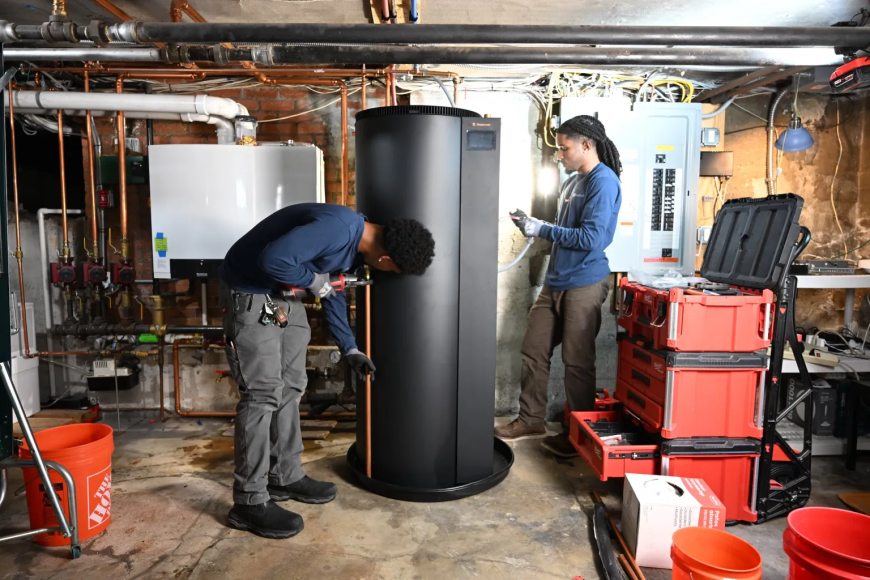
Reservoir has raised $8 million to expand a new generation of smart heat pump water heaters designed to lower household energy use while turning an often-overlooked appliance into a potential resource for the electric grid.
The seed round was led by Asymmetric Capital Partners, with participation from Founder Collective and MCJ—Reservoir plans to use the funding to install more systems around the Boston area, its first market.
The startup has installed about 100 water heaters so far and aims to reach roughly 1,000 installations by the end of next year, co-founder Luke Winston-Almanzar said. At that scale, the combined appliances could represent about a megawatt of capacity.
Reservoir wants water heaters to help the grid
Water heating accounts for about 18% of household energy consumption, according to the source material. Traditional water heaters generally respond to temperature changes inside their tanks without considering electricity prices, grid demand or when residents are most likely to need hot water.
Reservoir’s system takes a different approach. The water heater learns household usage patterns and attempts to heat water when electricity demand and prices are lower, while maintaining enough hot water for residents.
The device spends its first month gathering information about a home’s water use to train a model. It then uses those patterns to determine when its heat pump should operate most efficiently and economically.
Reservoir says its heat pump is nearly four times more efficient than a conventional electric water heater and five times more efficient than a natural gas model.
Hot water becomes a form of energy storage
Thecompany’ss broader strategy involves using hot water as stored energy. By shifting when large numbers of water heaters consume electricity, Reservoir believes its systems could help reduce demand during periods when the power grid is under greater strain.
Winston-Almanzar said Reservoir has demonstrated its ability to reduce grid pressure at the neighbourhood level. Longer term, the company could aggregate its installed water heaters and participate in utility demand-response programs, which compensate customers for reducing electricity consumption at certain times.
Reservoir is exploring whether revenue from those programs could eventually help lower the cost of its products.
Reservoir adds leak detection and predictive heating
Reservoir was founded by Winston-Almanzar, formerly chief business officer at 3D-printing company Formlabs, alongside Gabriel Parisi-Amon and Jake Felser. The founders concluded that energy efficiency alone would not be enough to persuade homeowners to seek out their product specifically.
The company’s water heaters therefore include features uncommon in conventional models. An ultrasonic flow sensor can monitor water use and help identify plumbing leaks elsewhere in a home, with alerts delivered through Reservoir’s app.
The higher-end Max model includes a recirculation valve designed to provide faster access to hot water and a mixing valve that can help protect pipes during cold weather. Its 50-gallon tank can provide as much as 150 gallons of hot water using a “party mode” activated through the appliance’s touchscreen or app.
Reservoir starts its own plumbing operation
The startup has also created its own plumbing company to handle installations, a strategy intended to simplify pricing and the sales process. Winston-Almanzar said the decision was influenced by his experience at Formlabs, where direct customer relationships helped the company introduce unfamiliar technology. Reservoir’s Core model costs $5,000 including installation, while the Max costs $6,500. Massachusetts residents can qualify for a $1,050 rebate, reducing the Core model’s effective price to $3,950 for eligible buyers.
Winston-Almanzar said a typical Boston homeowner could save as much as $1,000 annually on energy costs using Reservoir’s system. The company provides a 10-year warranty.
Heat pump water heaters remain a relatively small portion of the overall water-heater market despite their efficiency advantages. Reservoir is betting that combining lower energy consumption with predictive software, leak detection and grid services can make the technology attractive to homeowners while also creating a distributed source of energy flexibility for utilities.
What's Your Reaction?
 Like
0
Like
0
 Dislike
0
Dislike
0
 Love
0
Love
0
 Funny
0
Funny
0
 Angry
0
Angry
0
 Sad
0
Sad
0
 Wow
0
Wow
0