

































Steam Deck 2: Valve Is Waiting for a True Generational Leap Before Upgrading
Valve says Steam Deck 2 will arrive only when new hardware can deliver a major performance increase without sacrificing battery life or efficiency.
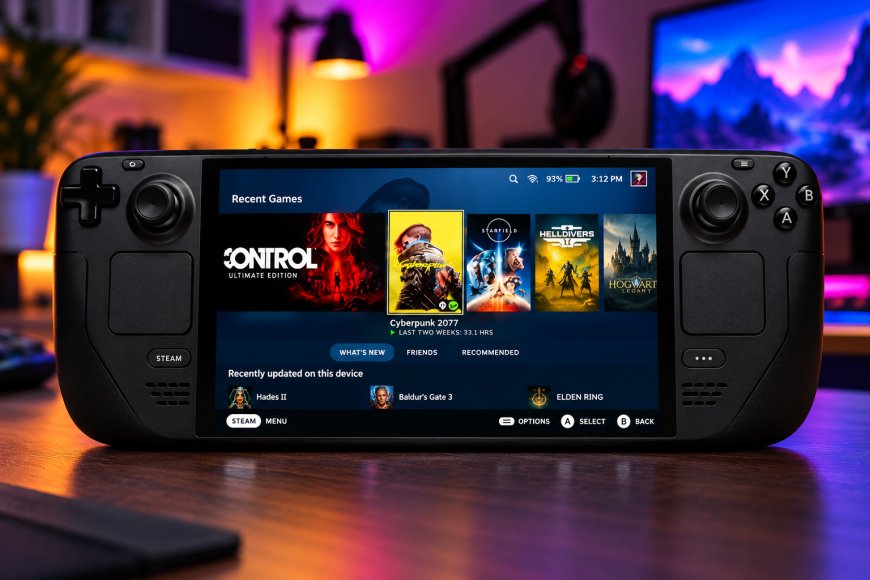
Valve has no intention of turning the Steam Deck into a handheld that receives a routine processor upgrade every year. More than four years after the original device arrived, the company is still waiting for hardware that delivers a large enough performance improvement to justify a true second-generation model.
That approach makes Steam Deck 2 unusual in a handheld PC market where manufacturers regularly introduce faster processors and higher-specification models. Valve has repeatedly made clear that it wants the eventual successor to feel meaningfully different, not just deliver higher benchmark numbers.
Valve Still Wants a Clear Generational Performance Jump
Valve software developer Pierre-Loup Griffais recently reiterated that the company wants a future Steam Deck to deliver a clearly defined performance improvement. The fundamental strategy has not changed even as memory prices, component availability and the wider PC hardware market have become more difficult.
The company has been making the same argument for several years. Steam Deck designer Lawrence Yang previously explained that Valve wanted to wait for a genuine generational leap rather than release incremental annual revisions.
A processor that is simply faster is not enough. Valve has to consider performance, thermals, battery demands, physical size and cost together when deciding whether new silicon is suitable for a portable system.
That philosophy explains why the existing Steam Deck OLED hardware still uses four Zen 2 CPU cores and eight RDNA 2 GPU compute units, rather than adopting one of the newer processors already available in competing handheld PCs.
Steam Deck OLED Was Never Meant to Be Steam Deck 2
The OLED version is key to understanding Valve’s strategy. Although it changed far more than the display, Valve deliberately avoided positioning it as a second-generation device.
The APU moved from a 7nm manufacturing process to 6nm, but the underlying CPU and GPU architecture remained essentially the same. The objective was refinement rather than a major increase in gaming performance.
Valve also increased memory speed, improved cooling, upgraded wireless connectivity and reduced the overall weight. The battery grew from 40Wh to 50Wh, while the more efficient OLED display and revised processor helped extend the company’s claimed gameplay range from 2–8 hours on the original model to 3–12 hours on the OLED version.
Valve details those changes on its official Steam Deck OLED page. They show how the company prefers to improve the complete handheld experience rather than chase one specification in isolation.
Newer Handheld Chips Are Not Automatically the Right Fit
The handheld PC market has advanced significantly since Steam Deck launched. Newer AMD and Intel processors can outperform Valve’s custom APU, particularly when given higher power limits.
That does not automatically make them ideal for a Steam Deck successor. Portable hardware has to balance performance with heat, cooling requirements and battery capacity in a chassis that remains comfortable to hold.
This is one reason Valve has been willing to let competing handhelds move ahead in raw specifications. Its priority appears to be finding the point at which newer silicon improves the overall product enough to justify a new generation.
Even a Moderate Performance Increase May Not Be Enough
Valve has set an unusually high threshold for what it considers worthy of a true successor. Griffais has previously said the company is not interested in launching another Steam Deck simply because a processor can deliver a modest performance increase.
The company wants a more obvious separation between generations. That position helps explain why Steam Deck 2 has taken longer than many competitors’ product cycles despite the original Deck now using CPU and GPU technology several generations behind the latest portable chips.
The decision carries both advantages and risks. Owners of the current system are less likely to see their device made obsolete by an annual refresh, but demanding new PC games are becoming increasingly difficult for the original hardware to run at acceptable settings.
Waiting too long could eventually make the performance gap between Steam Deck and competing handhelds harder to ignore. Releasing too early, however, could create a successor that feels more like an expensive specification update than a genuinely new generation.
Valve Already Has a Direction for the Next Deck
Valve’s comments indicate the company isn’t starting from zero. Griffais has previously said the team has a reasonably clear understanding of what a future version of Steam Deck should be, with available silicon remaining one of the main obstacles.
That suggests the unanswered question is less about whether Valve wants another handheld and more about when the underlying technology, pricing and supply conditions line up with the company’s design goals.
The current Steam Deck provides a useful baseline. Its 6nm AMD APU operates within a 4–15W power range, while the OLED model carries a 50Wh battery and weighs approximately 640 grams. Any successor will need to deliver substantially more gaming capability without becoming an unwieldy portable PC.
Valve is therefore evaluating more than peak GPU performance. Memory bandwidth, cooling requirements, display demands and component costs all influence how a new chip would work inside an actual handheld.
Component Costs Could Affect Timing
The difficult memory and component market has created another variable. Rising DRAM and storage costs have already affected PC hardware pricing, raising questions about whether those conditions might influence Steam Deck 2.
Griffais has indicated that the broader strategy remains largely unchanged. Valve still wants a clearly differentiated performance increase and is considering when market conditions will allow it to deliver the product it has in mind.
A powerful new processor is only one part of the equation. Memory, storage, display components and manufacturing costs all contribute to the final price.
The original Steam Deck gained much of its appeal by combining PC gaming flexibility with aggressive hardware pricing. Preserving some version of that value proposition could matter as much as increasing performance.
SteamOS Has Become Part of the Steam Deck Advantage
A future Steam Deck will also run a different software environment than the original. Valve has continued developing SteamOS, while Proton compatibility has expanded the number of Windows games that can run effectively on Linux-based hardware.
The company has also been extending SteamOS beyond its own handheld. That means the Steam Deck increasingly competes not only on hardware but through its operating system integration, suspend-and-resume behaviour, controller support, and Steam itself.
This gives Valve room to think about Steam Deck 2 as a complete platform rather than merely another portable gaming PC with a newer AMD chip.
Software improvements could also help the eventual successor use its hardware more effectively, making the operating system an important part of the generational upgrade.
There Is Still No Steam Deck 2 Release Date
Despite years of discussion, Valve has not announced a Steam Deck 2 launch date. The company’s recent comments should therefore not be interpreted as confirmation of a particular release year.
Rumours about future AMD processors and potential Steam Deck chips continue to circulate. Still, Valve has not publicly confirmed the processor architecture, memory configuration, display specifications, price or launch window of its next handheld.
The company’s requirements are clearer than its schedule. Valve wants the successor to represent an obvious step forward rather than a routine refresh. Still, it has not said that commercially viable hardware capable of delivering that jump is ready today.
Waiting Is Part of Valve’s Steam Deck Strategy
The handheld PC market increasingly rewards rapid hardware releases, but Valve appears comfortable following a slower cycle. That may frustrate buyers waiting for stronger performance, particularly as newer games push beyond what the existing Steam Deck can comfortably handle.
Restraint also has practical benefits. Steam Deck established itself partly because Valve found a workable balance between price, performance, software and portability. A successor that improves only one part of that formula would risk weakening the overall product.
Steam Deck 2 therefore seems less dependent on a calendar than on the right combination of hardware and economics. Valve is clearly interested in another generation, but it wants the upgrade to be substantial enough that owners immediately understand why the new device exists.
Until that point arrives, Steam Deck OLED remains Valve’s current handheld rather than an interim model awaiting an imminent replacement. The eventual Steam Deck 2 will be judged not simply by whether it is faster, but by whether Valve can turn that additional performance into a meaningfully better portable gaming system.
What's Your Reaction?
 Like
0
Like
0
 Dislike
0
Dislike
0
 Love
0
Love
0
 Funny
0
Funny
0
 Angry
0
Angry
0
 Sad
0
Sad
0
 Wow
0
Wow
0