























The Conjuring: Unspoken Preview: Netflix Turns Your Phone Into a Ghost-Hunting Controller
The Conjuring: Unspoken brings narrative horror to Netflix, using smartphones as ghost-hunting controllers in a game developed by Supermassive Games.
The Conjuring: Unspoken is an unusual addition to Netflix’s growing games business. Instead of asking players to download a conventional mobile title or reach for a traditional gamepad, the new narrative horror game puts the action on the television while turning a smartphone into a set of paranormal investigation tools. Developed by Supermassive Games, it is scheduled to arrive on Netflix on October 13.
The premise fits both companies unusually well. Netflix has been pushing games beyond phones and onto television screens, while Supermassive has built much of its reputation around cinematic, choice-driven horror. The result is less an interesting licensed Conjuring game than an experiment in whether Netflix can turn devices people already own into a convincing living-room gaming system.
A Conjuring game built around investigation
According to Netflix’s official announcement, The Conjuring: Unspoken puts players in the role of demonologist Francesca Noakes. The investigation takes place at the Red Lion Inn in England, where the Cooper family becomes caught in an increasingly dangerous haunting.
This is structured as a narrative experience rather than a conventional action game. Dialogue choices influence how the story develops, while much of the interaction revolves around investigating rooms and gathering evidence. Netflix says players will encounter Vinea, a demon feeding on grief, alongside Florrie, a ghost drawn from English folklore.
That direction makes sense for the license. The Conjuring films are built around anticipation, investigation and escalating supernatural activity rather than continuous action. A game that emphasises searching for evidence and making decisions has a better chance of preserving that tone than one built around combat.
The phone is more than a replacement controller
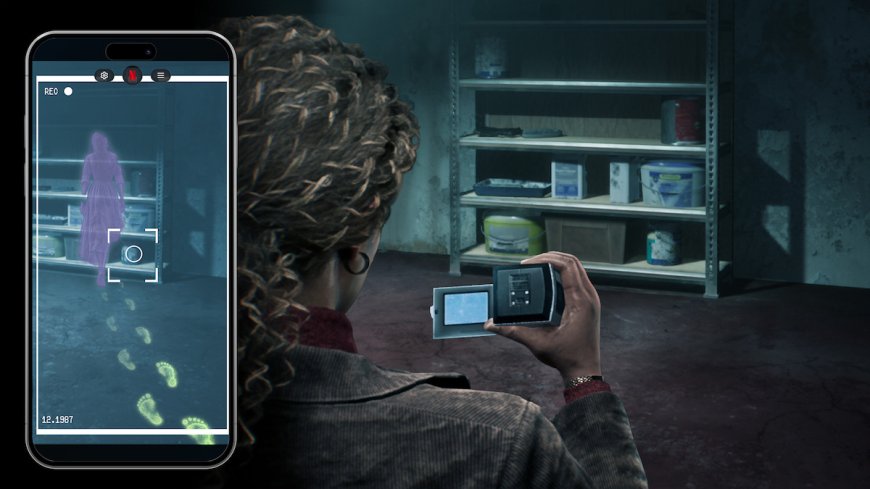
The most distinctive design choice is how The Conjuring: Unspoken uses a smartphone. The television displays the environment, while the phone becomes the player’s paranormal investigation interface. Netflix says tools include an electromagnetic field reader, infrared camera and spirit box.
The infrared camera is a good example of why the setup could be more interesting than simply placing virtual buttons on a touchscreen. Players can use the phone to view a thermal representation of the environment and search for cold spots associated with paranormal activity. That gives the second screen a role within the fiction rather than treating it purely as an inexpensive substitute for a gamepad.
Netflix already supports phones and tablets as controllers for games played through compatible televisions and web browsers. Android devices connect through the Netflix app, while iPhone and iPad users need compatible software and supported operating-system versions. Pairing is handled through a QR code displayed on the larger screen.
For a horror game, that setup has obvious potential. Looking down at a personal device to check an EMF reading or infrared view could create a different kind of tension from navigating everything through the TV. Whether the mechanic remains compelling throughout the game will depend on how creatively Supermassive uses it, but the basic concept is more purposeful than a standard touchscreen controller layout.
Supermassive is a logical developer for the project
Supermassive Games is best known for interactive narrative titles including Until Dawn, The Quarry and The Dark Pictures Anthology. The studio describes its focus as developing story-driven interactive experiences, making it a natural match for a franchise whose appeal depends heavily on atmosphere, characters, and carefully timed scares.
The Conjuring: Unspoken also appears to lean into the studio’s familiar emphasis on player decisions. Netflix says different dialogue choices shape the story, though it has not detailed the full extent of branching outcomes or how substantial those decisions will be. That distinction matters. Meaningful choices can give a relatively compact horror experience replay value, while superficial decisions would make the structure feel much more linear.
There is no reason yet to assume this will have the scope of one of Supermassive’s major console releases. Its importance may instead come from adapting the studio’s cinematic approach to Netflix’s lower-friction gaming model, where someone can move from watching television to playing without buying separate hardware or launching a console.
No separate console is part of the appeal
Netflix’s current TV-game system is designed around accessibility. Its TV and computer gaming support documentation says games are included with a Netflix membership without separate game fees, advertisements or in-app purchases. Compatible television hardware, a stable internet connection and a phone or tablet used as the controller are still required.
That removes one of the biggest barriers normally associated with a licensed console game. Someone interested in The Conjuring does not necessarily need to own a PlayStation, Xbox or dedicated controller. For Netflix, that accessibility is central to the proposition: the same television used for streaming becomes the gaming screen, while a device already in the player’s pocket handles input.
The limitation is availability. Netflix says The Conjuring: Unspoken will initially launch for members in Australia, Austria, Belgium, Canada, Finland, France, Germany, Italy, Mexico, the Netherlands, Poland, South Africa, Spain, Sweden, Switzerland, the United Kingdom and the United States. Netflix’s broader TV-gaming feature also depends on compatible devices and supported regions, so a Netflix subscription alone does not guarantee access.
Familiarity with the movies is optional
Netflix says players do not need to have watched The Conjuring movies before starting Unspoken. The story is designed to function independently, although existing fans can expect familiar characters and franchise connections that add context.
That is an important choice for a game being distributed through Netflix. Requiring several films of background knowledge would significantly narrow the potential audience. A standalone paranormal mystery gives newcomers an easier entry point while still leaving room for references that reward established fans.
What remains unproven
The announced mechanics are promising, but several important questions remain unanswered until broader hands-on testing. The quality of the touchscreen controls, responsiveness of the phone-to-TV connection, effectiveness of the scares, depth of the branching narrative and overall length will all have a major impact on the finished experience.
The second-screen concept also creates a potential usability tradeoff. Using a phone as an in-world investigation tool can increase immersion, but repeatedly shifting attention between a handheld screen and a television could become tiring if the game depends on it too heavily. Much will depend on pacing and how naturally the two displays work together.
For that reason, The Conjuring: Unspoken is better judged at this stage by the strength of its concept than by claims about execution. Netflix and Supermassive have outlined a clear idea, but performance, control quality and replayability should not be assumed until the game is available.
Pros and Cons
Pros:
- The smartphone functions as themed paranormal investigation equipment rather than a generic controller.
- Supermassive Games has extensive experience with cinematic and choice-driven horror.
- Included within Netflix’s gaming ecosystem without a separate game purchase.
- Designed to be approachable even for players unfamiliar with The Conjuring films.
- No dedicated console or traditional gamepad is required on supported setups.
Cons:
- Launch availability is limited to selected countries.
- Compatible Netflix TV-gaming hardware and a phone or tablet are required.
- The effectiveness of the touchscreen controls and second-screen mechanics remains unproven before release.
- Netflix has not yet provided enough information to judge the depth of its branching narrative or overall replay value.
Final Verdict
The Conjuring: Unspoken has a stronger concept than a typical franchise tie-in. Using a smartphone as an EMF reader, infrared camera, and spirit box gives Netflix’s phone-controller system a purpose that fits naturally into the horror setting. At the same time,e Supermassive’s background in interactive storytelling makes it a sensible choice for the project.
The game is most interesting for Conjuring fans, narrative-horror players and Netflix subscribers curious about playing on their televisions without investing in additional gaming hardware. Players looking for conventional controller-based gameplay or a large-scale console horror experience may find the format less appealing. Too much remains unknown to make a definitive judgment before release. But as a demonstration of what Netflix’s television gaming strategy could become, The Conjuring: Unspoken is worth watching. If the phone-based tools feel as natural in practice as they do in concept, this could be one of the clearest examples yet of why Netflix wants the smartphone to become the controller for its living-room games.
What's Your Reaction?
 Like
0
Like
0
 Dislike
0
Dislike
0
 Love
0
Love
0
 Funny
0
Funny
0
 Angry
0
Angry
0
 Sad
0
Sad
0
 Wow
0
Wow
0