































SteelSeries Rival Pro and Sensei Pro Review: UWB Wireless and Swappable Batteries
SteelSeries Rival Pro and Sensei Pro review covering UWB wireless, 8K polling, swappable batteries, lightweight designs, sensors, software, and gaming features.
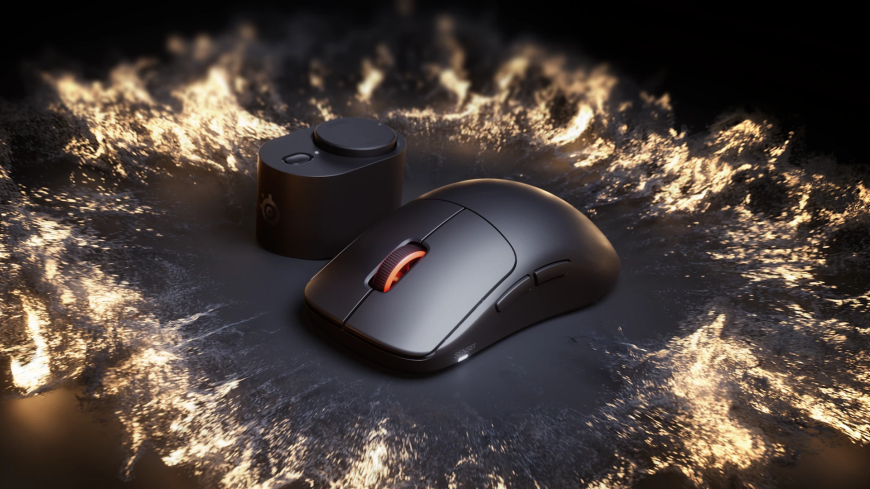
SteelSeries is taking a different approach to wireless gaming mice with its new Rival Pro and Sensei Pro series. Instead of treating wireless connectivity and battery life as separate compromises, the company has built the mice around Ultra-Wideband wireless, true 8K polling, and a hot-swappable battery system.
The Rival Pro and Sensei Pro are positioned as premium gaming mice for players who want low weight, high-speed tracking, and more control over wireless performance. The full-size models weigh about 53 grams in black, while the smaller models drop to roughly 49 grams, giving players different options for size and grip.
Design and Shape
The biggest physical difference between the two families is their shape. The Sensei Pro uses a symmetrical design based on the long-running Sensei form, while the Rival Pro uses an ergonomic shape designed around a more contoured hand position.
Both models are available in full-size and Mini versions. SteelSeries lists the full-size models at 53 grams and the Mini versions at 49 grams, with the smaller design intended for players who prefer fingertip or more aggressive claw grips. SteelSeries’ product specifications provide dimensions and grip guidance for each version.
That variety matters because mouse shape can influence comfort as much as the sensor or wireless system. Rather than offering one universal design, SteelSeries is using two established form factors to target different hand positions and playing styles.
UWB Wireless Is the Main Technology
The most unusual feature of the Rival Pro and Sensei Pro is their Ultra-Wideband wireless system. SteelSeries says the mice operate across the 6.4GHz to 9.056GHz spectrum and offer roughly 20 times the bandwidth of conventional 2.4GHz wireless connections.
The goal isn’t simply to increase a specification number. At an 8,000Hz polling rate, the mouse has to send position information to the computer extremely frequently. SteelSeries argues that UWB gives the connection more room to maintain that high reporting rate in crowded 2.4GHz environments.
The company also says the system is designed to provide a more consistent wireless connection with lower latency and fewer interruptions. These are manufacturer claims rather than independent measurements, but the underlying approach makes the wireless system one of the most distinctive parts of the Pro series. SteelSeries explains its UWB implementation in more detail.
True 8K Polling and Tracking
Both mouse families support an 8,000Hz polling rate. In simple terms, the mouse can report its position up to 8,000 times per second instead of the 1,000Hz rate commonly associated with standard gaming mice.
SteelSeries pairs the high polling rate with its TrueMove 42K Pro optical sensor and claims 0.35 milliseconds of click latency. The company also includes a Max Performance Mode that keeps the sensor operating at 8K while capturing movement at up to 20,000 frames per second, with specifications of up to 800 IPS and 70G acceleration.
The practical value of 8K polling depends on the rest of the gaming system, including the display, game, CPU workload, and the player’s sensitivity settings. It’s better understood as a high-end performance feature than a guarantee of dramatic improvement for every player.
The Swappable Battery System
Battery management is where SteelSeries takes a more unusual approach. The Rival Pro and Sensei Pro use two removable batteries, letting one power the mouse while the other charges in the included base station.
SteelSeries calls this the Infinite Power System. The company rates the system for up to 120 hours at 1K polling or up to 32 hours at 8K, with each battery providing up to 60 hours at 1K or 16 hours at 8K.
This approach addresses one of the biggest limitations of high-polling wireless mice. Running at 8K uses more power, but users don’t necessarily need to connect a charging cable during a gaming session if a charged spare battery is available.
Software Goes Beyond Basic Customisation
SteelSeries GG supports the hardware and provides controls for sensitivity, polling, tracking, and other mouse settings. The company has also added tools designed specifically around competitive gaming.
Features include adjustable lift-off distance, Rotation Control, Scroll Jump Protection, Smart DPI, and a Sensitivity Converter that can help transfer aim settings between games. SteelSeries also provides a browser-based GG interface, reducing the need to install software for some configuration tasks. The official product page outlines the available customisation tools.
SuperSync and Competitive Gaming
One of the more interesting software features is SuperSync. It lets players adjust the sensor report rate and click reporting behaviour separately, so they can change sensor polling while maintaining 8K click reporting.
That is a more specialised feature than most players will need, but it demonstrates where SteelSeries is targeting the Pro series. The company is trying to meet the technical needs of competitive players who want to fine-tune individual aspects of mouse responsiveness rather than rely on a single performance setting.
Price and Availability
The Rival Pro and Sensei Pro are priced at $179.99 in the United States, while the Mini versions carry the same MSRP. SteelSeries began taking preorders on September 29, with retail availability scheduled for October 13, 2026.
That places the mice firmly in the premium gaming-peripheral category. The price isn’t just for a lightweight shell; it also covers the UWB wireless system, dual-battery setup, high-polling hardware, and accompanying software platform. SteelSeries’ launch announcement provides the regional pricing and availability details.
Pros and Cons
Pros:
- UWB wireless is designed specifically for consistent high-speed wireless performance
- True 8K polling and a TrueMove 42K Pro optical sensor
- Hot-swappable dual-battery system reduces charging interruptions
- Very lightweight full-size and Mini designs
- Rival and Sensei shapes provide different ergonomic approaches
- Extensive sensitivity and tracking customisation through SteelSeries GG
Cons:
- The $179.99 price puts the mice firmly in the premium category
- The benefits of 8K polling may be limited for some users and setups
- UWB requires the accompanying wireless hardware for its full wireless experience
- The extensive customisation features may be unnecessary for casual gamers
Final Verdict
The SteelSeries Rival Pro and Sensei Pro are built around a clear idea: wireless gaming mice should not have to sacrifice polling performance or convenience. UWB underpins the company’s 8K wireless strategy, while the dual-battery system addresses the higher power demands of high polling rates.
The two shapes also make the lineup more flexible. The Sensei Pro targets players who prefer a symmetrical design, while the Rival Pro offers an ergonomic alternative, with Mini versions for smaller hands or different grip preferences.
At $179.99, these are specialised premium gaming mice rather than straightforward upgrades for every player. Their strongest appeal is likely to be among competitive PC gamers who care about low weight, high polling rates, wireless consistency, and the ability to fine-tune tracking and sensitivity settings. For everyone else, the Pro series demonstrates how far gaming mouse technology is moving toward highly specialised wireless performance.
What's Your Reaction?
 Like
0
Like
0
 Dislike
0
Dislike
0
 Love
0
Love
0
 Funny
0
Funny
0
 Angry
0
Angry
0
 Sad
0
Sad
0
 Wow
0
Wow
0