






























Sony QSSR Review: AI Upscaling Comes to the Standard PS5
Sony QSSR review covering AI upscaling on PS5, image quality improvements, performance, PSSR differences, supported games, and what the technology means for console gaming.
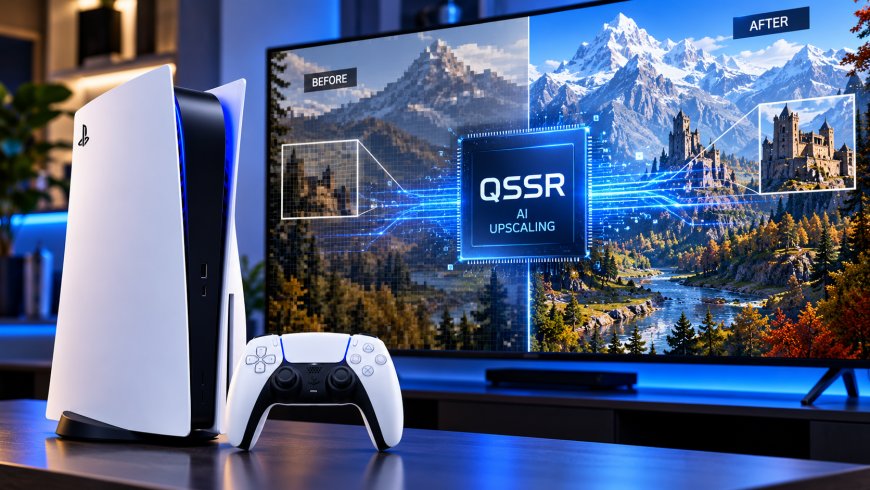
Sony is bringing AI-powered image upscaling to the standard PlayStation 5 with Quick Spectral Super Resolution, or QSSR. The technology is designed to improve image detail and stability without requiring the more demanding processing approach used by PlayStation Spectral Super Resolution on the PS5 Pro.
QSSR is the result of Sony’s Project Amethyst collaboration with AMD and represents a new performance tier for AI-guided upscaling. The first games to support it are Marvel’s Wolverine and Ghost of Yōtei, which are receiving patches that add QSSR as an additional graphics option on PS5.
What Is QSSR?
Quick Spectral Super Resolution is an AI-based image reconstruction technology designed specifically for the standard PS5. Sony says its earlier PSSR technology analyses game images pixel by pixel and uses AI to reconstruct them with greater detail and stability than conventional upscaling methods.
The problem was computational cost. PSSR was designed for the more powerful PS5 Pro, while bringing the same approach to the standard PS5 required a more efficient solution. QSSR addresses that limitation through a streamlined neural network architecture and a hand-tuned implementation designed to maximise performance on PS5 hardware.
How QSSR Differs From PSSR
QSSR is related to PSSR, but Sony does not present the two technologies as equivalent. The company continues to position PSSR as its higher-end upscaling technology on PS5 Pro, while QSSR is designed around the performance limitations of the standard PS5.
The main objective is therefore efficiency. QSSR is intended to deliver noticeable improvements in image detail and temporal stability without requiring the processing resources of the full PSSR implementation. Sony’s technical explanation of QSSR describes the streamlined neural network and optimised implementation behind the technology.
Image Quality and Stability
QSSR’s biggest potential benefit is improved image reconstruction. Upscaling technologies must make decisions about information not directly available at the target resolution, which can lead to softness, shimmering, flickering, or unstable fine details.
Sony says QSSR is designed to improve both detail and stability on PS5. Insomniac Games says the technology adds more pixel-level clarity and stability to environments in Marvel’s Wolverine. In contrast, Sucker Punch says it improves fine details and temporal stability in Ghost of Yōtei.
These developer observations are important context, but they should not be treated as independent benchmark results. Actual visual differences will depend on the game, graphics mode, display, and implementation each developer chooses.
Marvel’s Wolverine Is One of the First Tests
Marvel’s Wolverine is one of the first games to receive QSSR support. The PS5 version was built specifically for the console generation and already uses detailed environments, dense action sequences, and large visual spaces that can benefit from more stable image reconstruction.
According to PlayStation’s official game information, Marvel’s Wolverine is a single-player action-adventure developed by Insomniac Games and designed exclusively for PS5 consoles. The QSSR update adds another graphics option for players using the standard PS5.
Ghost of Yōtei Also Gets QSSR
Ghost of Yōtei is the other launch title for QSSR. The game already supports PSSR on PS5 Pro, making it a useful example of how Sony is bringing related image-reconstruction technology to its standard console.
The game’s official PlayStation page highlights detailed landscapes, dynamic combat, and PS5-specific visual features. Sucker Punch says QSSR is intended to improve fine details and temporal stability across characters and environments on the standard PS5.
QSSR Could Matter Beyond Two Games
The importance of QSSR extends beyond its first two supported games. Sony says the technology will be broadly available to PlayStation developers, making it possible for more PS5 games to adopt AI-guided upscaling in future updates and releases.
That could make QSSR more significant over time. Rather than a feature limited to two showcase titles, it could become another tool developers use to balance resolution, image quality, and performance on the standard PS5.
What It Means for PS5 Owners
For standard PS5 owners, QSSR is notable because it brings a form of AI-assisted image reconstruction previously associated with the PS5 Pro experience to the less powerful console. It does not turn the standard PS5 into a PS5 Pro, and Sony still positions PSSR as the higher-end solution on the Pro model.
Instead, QSSR gives developers another way to improve visual quality within the standard console’s hardware constraints. Its practical impact will depend on how games implement the technology and how clearly the improvements show on different displays.
Pros and Cons
Pros:
- Brings AI-guided upscaling to the standard PS5
- Designed to improve image detail and temporal stability
- Uses a streamlined neural network optimised for PS5 performance
- First support arrives in Marvel’s Wolverine and Ghost of Yōtei
- Sony plans to make QSSR available broadly to PlayStation developers
Cons:
- QSSR is not the same technology tier as PSSR on PS5 Pro
- Visual improvements will depend on individual game implementations
- There is not yet a large library of QSSR-supported games
- The benefits may be more noticeable on some displays and graphics modes than others
Final Verdict
QSSR is an important step in Sony’s effort to bring AI-assisted graphics techniques to a wider portion of the PS5 user base. Rather than simply moving PSSR from PS5 Pro to the standard console, Sony has created a more efficient version designed around the hardware’s available performance.
The first implementations in Marvel’s Wolverine and Ghost
What's Your Reaction?
 Like
0
Like
0
 Dislike
0
Dislike
0
 Love
0
Love
0
 Funny
0
Funny
0
 Angry
0
Angry
0
 Sad
0
Sad
0
 Wow
0
Wow
0