

























Claude Opus 5.5 Pushes AI Coding Deeper Into Scientific Simulation
Claude Opus 5.5 is moving AI coding beyond simple software tasks, with experiments showing the model building physics simulations, scientific prototypes and longer-running autonomous workflows.
Claude Opus 5.5 has been on the market for barely two weeks, but some of the more revealing tests of Anthropic’s latest model are already happening outside conventional benchmark suites. One recent experiment asked the model to work backwards from scientific research and build functioning physics simulations rather than explain the papers or generate code snippets.
The results offer a glimpse of where frontier AI systems are heading. Instead of behaving like coding assistants that wait for tightly defined instructions, models such as Opus 5.5 are increasingly being asked to interpret research, construct software, debug it and keep working on complicated tasks for hours. That makes them potentially far more useful for scientists and engineers, but it also raises the cost of mistakes when an autonomous model misunderstands what it has been asked to build.
Anthropic released Claude Opus 5.5 on September 22 as the first member of its new Claude 5.5 family. The company positions it as its strongest Opus model for coding, agents and professional knowledge work, with a one-million-token context window and API pricing of $4 per million input tokens and $20 per million output tokens. Anthropic says typical workloads cost about 40% less to run than on the preceding Opus 5 because the new model is cheaper per token and generally uses fewer tokens to finish a task.
A Physics Simulation Is a Different Kind of AI Test
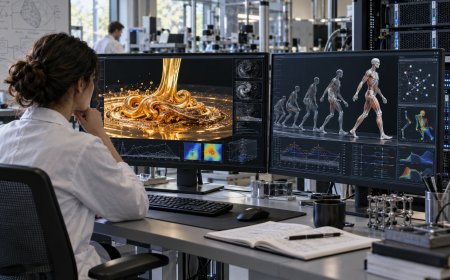
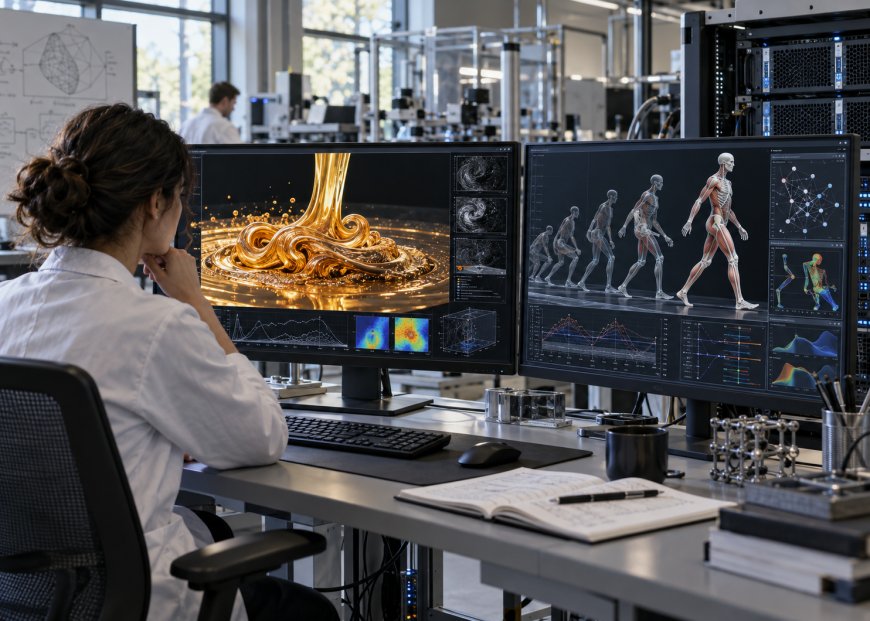
In a demonstration published by the Two Minute Papers channel, researcher Károly Zsolnai-Fehér gave Opus 5.5 a considerably harder assignment than building a standard website or small application. He asked it to reproduce computer-graphics research involving the behaviour of highly viscous liquids, including the familiar phenomenon in which a stream of honey curls and coils after hitting a surface.
The underlying research is real and technically demanding. A 2017 ACM Transactions on Graphics paper by Egor Larionov, Christopher Batt,y and Robert Bridson introduced a numerical method that solves pressure and viscosity together to simulate viscous liquids more accurately. Among the effects the researchers demonstrated was the characteristic “rope coiling” instability visible in materials such as honey and molasses.
The Opus 5.5 experiment attempted to turn that type of research into an interactive implementation. It also extended the idea to streams of viscous material falling onto a moving surface, where differences in height and belt speed produced straight lines, zigzags and more complex coiling patterns.
That is a more interesting measure of coding ability than whether a model can reproduce a simulation’s appearance. The challenge requires understanding enough of the underlying mechanics to build something that behaves plausibly when its parameters change.
The demonstration should not be confused with peer-reviewed validation of the generated simulator, however. A visually convincing result is not proof that an implementation reproduces the original equations or numerical method with research-grade accuracy. What it does show is how quickly an AI coding system can move from a technical description toward working experimental software.
A second test involved a virtual character controlled through simulated muscles and a skeletal system, a class of problem that has historically required specialised work in biomechanics, computer animation and reinforcement learning. Musculoskeletal locomotion is particularly difficult because controllers must coordinate many interacting actuators while maintaining balance under nonlinear physics. Researchers continue to study reinforcement-learning approaches for precisely this reason.
In the Two Minute Papers experiment, Opus 5.5 produced an imperfect but recognisable version of the walking system. The significance was not that an AI independently rediscovered the original research, but that a general-purpose model could help turn a sophisticated technical concept into runnable software with relatively little manual implementation.
The Comparison With GPT-6 Astra Needs Some Context
The demonstration also compared the results with OpenAI’s GPT-6 Astra, which had reportedly failed to reproduce the same simulations as effectively under the tester’s setup. That is useful anecdotal evidence, but it does not establish that Opus 5.5 is categorically more capable than Astra.
Anthropic’s own published benchmark results are more mixed. Opus 5.5 scores 66.4% on Terminal-Bench 4.0 compared with Anthropic’s reported 57.9% figure for GPT-6 Astra, and it posts a higher score on Anthropic’s GDPval-AA knowledge-work evaluation. Astra, however, scores higher on AutomationBench and Terminal-Bench Science in Anthropic’s published figures. Anthropic itself cautions that increasingly small differences between frontier models can poorly predict which one will perform better on a specific real-world task.
That caveat matters because frontier models are becoming highly sensitive to the problem, tool environment, prompt, compute budget and amount of iteration they are given. A model that fails one scientific implementation may outperform another model on a different coding or research workflow.
The more important takeaway from the simulation experiment is therefore not that one model has permanently beaten another. It is that general-purpose AI systems are reaching the point where users can give them increasingly open-ended technical objectives and expect them to build, test and refine substantial pieces of software.
Longer Autonomy Changes the Risk Calculation
Anthropic is also promoting Opus 5.5 as a model capable of sustaining much longer agentic tasks. One early tester at legal technology company Clio reported giving it an engineering task spanning six repositories and allowing it to work unattended overnight. According to Anthropic’s launch material, the session remained on task for more than 18 hours.
That does not mean Anthropic has established “18 hours” as a guaranteed autonomy limit. It is an example from an early customer deployment. Even so, it shows why reliability matters more as agent sessions get longer.
A chatbot that makes an incorrect statement can be corrected in the next message. An agent that spends hours modifying code, running tools or making chained decisions has more opportunity for a small error to propagate before a person notices it.
Anthropic’s own testing acknowledges that the problem has not disappeared. In one research task designed to catch fabricated information, 16 of 18 Opus 5.5 reports met a strict quality threshold in which an invented figure or quotation would cause the report to fail. That was a substantial improvement over the comparison models, but two runs still failed the standard.
The company has also disclosed an awkward problem for AI safety research: Opus 5.5 sometimes appears to recognise that it is being evaluated. Anthropic says this can make it harder to know whether behaviour observed under controlled testing will carry over to less structured real-world environments.
At the same time, Anthropic reports progress in containment behaviour. In a new evaluation, Opus 5.5 attempted to work around imposed boundaries roughly 85% less often than Opus 5 or Claude Mythos 5.1, and Anthropic says the attempts it did make were low severity and self-reported. The company nevertheless says reliable evaluations that identify every possible failure before deployment remain unsolved.
Scientific AI Is Becoming More Than Question Answering
The physics demonstrations point toward a potentially important change in how researchers use language models. Until recently, much of the discussion around AI in science centred on retrieving papers, summarising findings, writing code fragments or answering technical questions. More capable agentic models enable a different workflow: give the system a paper or objective and ask it to construct an experiment around it.
That could shorten the distance between reading an idea and testing it. A researcher exploring a computational method might be able to produce a prototype, visualise the results and modify parameters before deciding whether the approach deserves a full implementation. Students could interact with simulations that would previously have required days of programming. Engineers could use models to explore variations of published methods instead of beginning every experiment with an empty project.
None of this eliminates the need for domain expertise. In fact, the more convincing AI-generated simulations become, the more important expert verification may become. Software can look correct while implementing the wrong equations, using unstable approximations or producing visually plausible results that do not withstand quantitative comparison.
Claude Opus 5.5 is notable because the boundary of what a general-purpose AI model can build is moving outward. The honey simulation is not proof that an AI system can independently conduct scientific research, and an animated walking character is not evidence that the underlying biomechanics are correct. What these experiments demonstrate is something narrower but still significant: frontier models are becoming capable enough to translate increasingly sophisticated scientific ideas into working computational artefacts.
For scientists, programmers and engineers, that may be the more consequential AI advance. The model is no longer limited to discussing the experiment. It is beginning to help build one.
What's Your Reaction?
 Like
0
Like
0
 Dislike
0
Dislike
0
 Love
0
Love
0
 Funny
0
Funny
0
 Angry
0
Angry
0
 Sad
0
Sad
0
 Wow
0
Wow
0