

































The Oregon Trail: How a 1971 Classroom Game Became a Generational Tech Icon
The Oregon Trail began as a 1971 classroom project and became one of gaming’s most influential educational titles, shaping generations of young computer users.
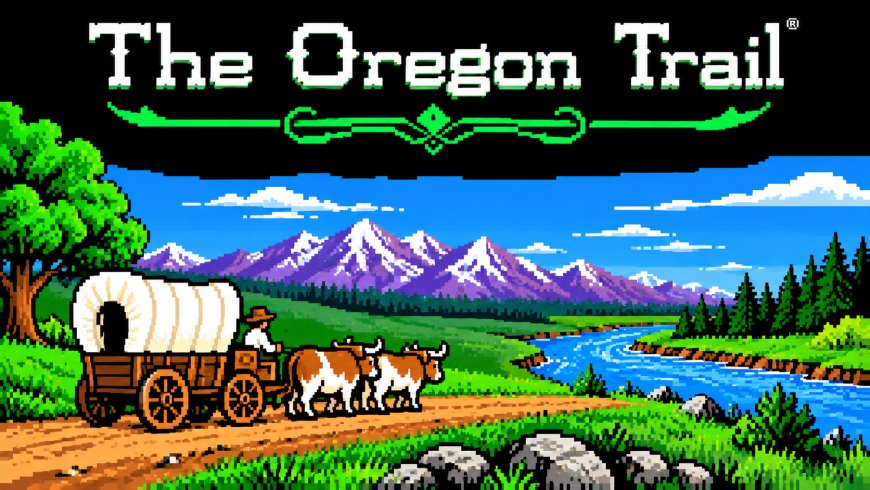
The Oregon Trail became famous for dysentery, broken wagon wheels, and disastrous river crossings. Still, its importance goes far beyond a collection of memorable ways to lose a computer game. What began as a small classroom experiment in Minnesota in 1971 ultimately became one of the most influential educational games ever created, introducing generations of students not only to American history but, in many cases, to computers themselves.
Its longevity is unusual even by video game standards. The Oregon Trail existed before the modern home-computer market, survived the rise of the Apple II and IBM-compatible PC, became a fixture of school computer labs, and continues today through newer interpretations built for consoles, PCs and mobile devices. The technology changed repeatedly, but the central idea remained remarkably durable: give players limited resources, put them on a dangerous journey west and make their decisions matter.
It Started as a Classroom Project in 1971
Don Rawitsch, Bill Heinemann, and Paul Dillenberger created the original Oregon Trail as three student teachers in Minnesota. Rawitsch was preparing to teach a history class and wanted students to experience westward migration in a more interactive way than a textbook lesson.
Instead of asking students to memorise dates and locations, the game put them in charge of a wagon party travelling toward Oregon. Players had to manage food, supplies, travel speed and other decisions while dealing with illnesses and unexpected events.
The Strong National Museum of Play’s history of The Oregon Trail notes that the first version ran through a teletype terminal connected to a computer. There was no modern graphical interface. The experience was largely text-based, yet its decision-making structure made it immediately engaging for students.
The original classroom experiment was also remarkably short-lived. After the teaching period ended, the program was removed from the school computer system. The creators preserved the code on paper, however, allowing the project to return several years later.
MECC Turned a Classroom Experiment Into Educational Software
The decisive change came after Rawitsch joined the Minnesota Educational Computing Consortium, better known as MECC, in 1974. MECC was created to expand access to computing across Minnesota schools at a time when computer access remained unusual for most American students.
Rawitsch brought the game back and revised its historical data using accounts from people who had travelled west. MECC made a new version available through its computer network, allowing students far beyond the original classroom to experience the simulation.
The Strong Museum’s history of MECC describes the organisation as an important force in bringing computers into education. Its software was not intended merely to occupy students during computer time. MECC developed supporting documentation, educational objectives and historical material that teachers could incorporate into lessons.
That combination mattered. The Oregon Trail was educational, but it was also a game with choices, uncertainty and consequences. Students learned partly because they wanted to find out whether their wagon party would survive.
The Apple II Helped Turn Oregon Trail Into a Phenomenon
The growth of affordable personal computers transformed the project. MECC recognised the potential of machines such as the Apple II relatively early and began bringing them into schools.
An Apple II version of the game appeared in the late 1970s, helping move The Oregon Trail away from centralised mainframe access and toward the personal computers increasingly appearing in classrooms.
The version many players now associate with the classic game arrived in 1985. MECC rebuilt the experience for the Apple II as a standalone product, adding a much richer collection of systems, graphics and events.
Lead designer R. Philip Bouchard has documented how the 1985 Apple II version was effectively redesigned from the ground up. Features that became synonymous with the game included naming members of the travelling party, stopping at landmarks, crossing rivers, dealing with diseases, carrying spare wagon parts, and leaving tombstones when travellers died.
The familiar image of an ox pulling a covered wagon across the landscape also emerged from this era. Hunting became more interactive, travel conditions became easier to visualise, and the game increasingly resembled the version students remembered from school computer labs during the 1980s and 1990s.
Why the Game Worked So Well in Schools
The clever part of The Oregon Trail was that it embedded learning in decisions rather than separating it from them. Players had to understand geography because distance mattered. They had to think about resources because buying too much of one item could leave too little money for something else. Weather, disease and river conditions affected the journey in ways that forced players to reassess their plans.
A student might start the game focused on reaching Oregon as quickly as possible, then discover that maintaining food supplies, protecting the group’s health, and preparing for difficult terrain mattered more than speed.
That structure also made failure memorable. Losing a traveller to illness or watching supplies disappear during a failed river crossing created a stronger emotional response than simply answering a history question incorrectly.
Smithsonian’s history of The Oregon Trail and MECC describes how the game became intertwined with the spread of computers through American schools. For many students, playing educational software was one of their first regular interactions with a computer.
Dysentery Became Part of Gaming Culture
The educational design explains why schools adopted the game, but it does not fully explain why people still talk about it decades later. Part of its cultural longevity comes from the strange combination of serious subject matter and unpredictable failure.
Illnesses, injuries, starvation, damaged equipment and accidents could destroy an apparently successful journey. Dysentery in particular became inseparable from the game’s identity, eventually turning into a cultural reference understood even by people who had not played the original versions.
The phrase about dying of dysentery survived because it captures something unusual about the game. The Oregon Trail could be educational and bleak while still being funny in retrospect. Players named friends and family members after their travelling companions, then watched those characters suffer increasingly unfortunate outcomes.
That personal element helped transform classroom software into a shared generational memory.
The History Behind the Game Has Also Been Reconsidered
The game’s historical influence does not mean every version presented westward expansion completely or neutrally. Earlier editions focused primarily on the experience of settlers moving west. They gave far less attention to the Indigenous peoples whose land, communities and lives were profoundly affected by American expansion.
Even the original creators later discussed limitations in the way Native Americans were portrayed. Research used during development improved some depictions, but the broader perspective remained centred on settlers.
Modern versions have attempted to address that weakness. The current Oregon Trail game was developed with input from Native American scholars and includes playable Indigenous characters and stories. Its developers explicitly acknowledge that westward expansion represented invasion and displacement from the perspective of Indigenous peoples.
That change is significant because educational games do more than convey facts. They also decide whose experience becomes the player’s point of view. Updating the historical perspective allows the series to remain useful without pretending that an influential educational product from earlier decades captured the entire story.
From School Software to the World Video Game Hall of Fame
By the time MECC’s software had spread across American classrooms, The Oregon Trail had become much more than one successful educational title. It helped demonstrate that computer games could teach through simulation instead of simply presenting quizzes on a screen.
Players learned through systems: budgeting money, allocating supplies, responding to uncertainty, and understanding how geography influenced a journey. Those concepts are now common in strategy and simulation games, but they were remarkably effective educational tools when personal computing was still new.
The Strong National Museum of Play inducted The Oregon Trail into the World Video Game Hall of Fame in 2016, recognising its longevity and influence on educational gaming.
Its importance also reaches beyond software design. The game arrived during a period when schools were helping normalise computer use for children. A student who sat down at an Apple II to guide a wagon toward Oregon was simultaneously learning how to interact with digital technology.
Why The Oregon Trail Still Matters
Many educational games disappear when the supporting technology becomes obsolete, or classroom priorities change. The Oregon Trail survived because its core design doesn’t depend on a single computer platform.
At heart, it is a game about uncertain decisions. Players prepare with incomplete knowledge, choose between competing priorities and deal with consequences they cannot always control. Better graphics can modernise the journey, but the tension comes from deciding whether to push forward, stop for supplies, risk a river crossing,g or change course before conditions worsen.
That structure made the game useful in 1971, compelling on school computers in the 1980s and 1990s, and adaptable to modern hardware decades later.
Its legacy is therefore larger than nostalgia for green-tinted monitors, floppy disks or unfortunate wagon parties. The Oregon Trail showed early on that a computer could make a lesson interactive, that education and entertainment did not have to be opposites, and that a simple simulation built for one classroom could eventually become part of the cultural memory of multiple generations.
What's Your Reaction?
 Like
0
Like
0
 Dislike
0
Dislike
0
 Love
0
Love
0
 Funny
0
Funny
0
 Angry
0
Angry
0
 Sad
0
Sad
0
 Wow
0
Wow
0