

































Why AI Data Centers Are Making Your Devices More Expensive
AI data centers are reshaping memory supply as demand for HBM pushes chipmakers to shift capacity, raising costs for storage, laptops, phones and consoles.
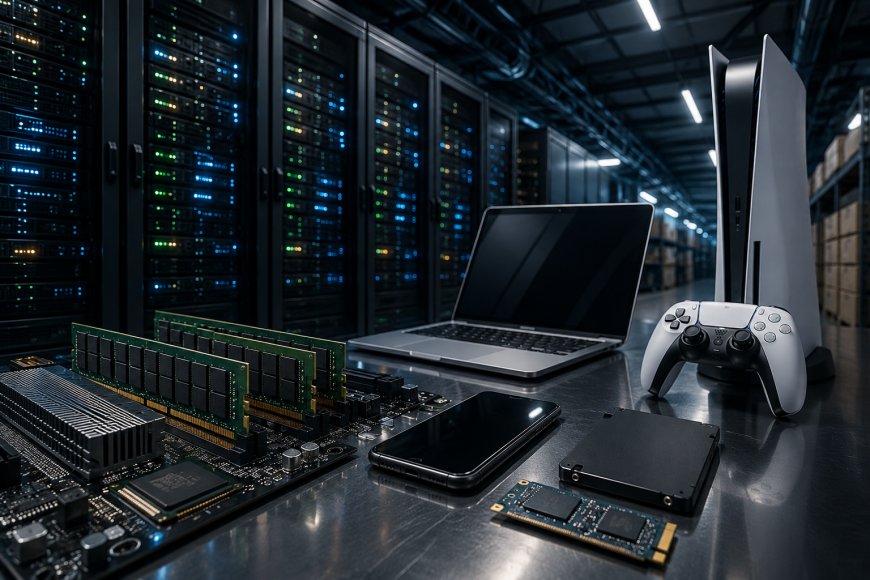
In 2025, a MacBook Pro cost around $1,600. Less than a year later, the same laptop cost $400 more. Apple said it was due to rising costs of memory and storage components. Xbox raised the price of its six-year-old Series S console by $150, citing the same reason. Lenovo, Dell, and HP followed. A photographer in Atlanta watched the price of a storage drive he bought for $285 climb past $1,100. A camera store in New York saw its memory card sales drop by 30 per cent in volume because customers simply could not afford to replace what they had.
The explanation offered every time was the same: AI data centers are consuming massive amounts of chips, causing shortages that drive up prices for everyone else.
There is just one problem with that explanation. AI data centers do not use the same chips as your laptop.
So what is actually going on?
Three Types of Chips, One Very Complicated Problem
To understand the shortage, you need to realise that “memory chip” isn’t a single thing. Three types matter here, and they work differently, cost differently, and go into very different products.
The first is NAND. This is long-term storage, the kind that holds onto information after you power a device off. The photos on your phone, the files on your laptop, the game saves on your console: all NAND. It is the reason a 1TB phone costs more than a 256GB one.
The second is DRAM, which stands for dynamic random access memory. This is short-term memory, fast but temporary. It clears the moment you switch off the power. DRAM is what your laptop uses to run multiple applications at once, and it is what determines whether your computer feels responsive or sluggish.
The third is HBM, or high-bandwidth memory. Think of HBM as DRAM that has been completely rebuilt for a different purpose. Instead of lying flat on a circuit board, HBM chips are stacked vertically in a three-dimensional configuration, then packaged together to create a memory module that can move data five to ten times faster than standard DRAM. That stacked design makes HBM dramatically more complex to manufacture and dramatically more expensive to produce. It is also the specific type of memory that AI data centers actually need. HBM is what sits inside the Nvidia chips that power ChatGPT, Gemini, Claude, and every other major AI system.
NAND and DRAM go into your devices. HBM goes into AI infrastructure. They are made differently, priced differently, and sold to completely different customers.
So why is there a shortage of NAND and DRAM?
Three Companies Control Almost Everything
The entire global supply of NAND and DRAM is produced by essentially three companies: Micron, Samsung, and SK Hynix. Together they produce more than 60 percent of the world’s NAND and nearly 90 percent of its DRAM. No other meaningful competitors exist. Building a chip fabrication facility costs between $15 billion and $20 billion, takes three to five years to construct, and requires specialised clean rooms where even microscopic dust particles can destroy entire production runs. The machines inside a single facility can cost up to $400 million each, and a facility needs rows of them. The barriers to entering this industry are not high. They are nearly vertical.
All three companies have shifted significant portions of their manufacturing capacity toward HBM production. The reason is straightforward: AI companies are currently the most lucrative customers in the history of the semiconductor industry, and HBM carries far higher margins than ordinary DRAM. Google, Microsoft, Amazon, and Meta have collectively spent more than a trillion dollars expanding AI infrastructure since 2023. As of mid-2026, there are more than 2,200 data centers in planning or construction stages across the United States alone. Microsoft expects to spend roughly $175 billion on AI in 2026 on its own.
When the most profitable customers in the world are demanding a specific type of chip in unlimited quantities, a rational company shifts its factories to producing that chip, which means less capacity to make everything else.
The result is that the same three companies who produce nearly all of the world’s consumer memory chips have been steadily reducing output of the types used in phones, laptops, and gaming consoles, while ramping up production of the type used in AI servers. Less supply, same or growing demand, prices rise. That is how a $285 storage drive becomes a $1,100 storage drive in 14 months without any improvement in what the drive actually does.
The Lawsuit Nobody Is Talking About
Here is where the story gets more complicated, and more interesting.
On June 25, 2026, a federal class action lawsuit was filed in the Northern District of California against all three companies: Samsung, SK Hynix, and Micron. The 17 plaintiffs, a mix of individual consumers and small businesses, allege that the three companies did not simply make independent business decisions to shift toward HBM. They allege they coordinated those decisions to restrict conventional DRAM supply and deliberately drive prices up.
The lawsuit cites a price increase of roughly 700 percent for conventional DRAM over four years. It argues that the companies used the transition to HBM as cover to wind down production of older formats, including DDR3 and DDR4, and that this reduction occurred in a pattern too synchronised to be coincidental.
The companies deny it. Micron stated that it competes “vigorously, fairly and in compliance with all applicable laws.” Samsung and SK Hynix have not publicly responded to the specific allegations. The case remains unproven.
But the lawsuit’s historical backdrop is nothing. In the early 2000s, Samsung and SK Hynix both pleaded guilty to criminal DRAM price-fixing charges brought by the US Department of Justice, paying a combined $485 million in fines. Multiple executives served prison time. Micron participated in that same conspiracy but cooperated with federal investigators and escaped prosecution entirely under the Department of Justice’s corporate leniency program. The current lawsuit cites this history as evidence of a pattern.
A similar class action was filed in 2018 alleging collusion during a previous DRAM price spike and was dismissed in 2022. Whether the current case survives will depend on plaintiffs’ ability to prove coordination rather than parallel, independent decisions, which is a genuinely difficult legal bar to clear. But the fact that three companies control 90 percent of a market, have been convicted of fixing prices in that market before, and are now simultaneously reducing supply of one product while pivoting to a more profitable one is the kind of fact pattern that makes antitrust lawyers pay attention.
Who Is Actually Getting Hurt
The price increases are not abstractions. They are landing on real people in specific ways.
Xbox’s Series S, which cost $300 when it launched in 2020, now costs $500 for the base configuration. The 1TB version went from $450 to $600. Microsoft, Xbox’s parent company, warned that console memory and storage costs are expected to double again by late 2027. The company simultaneously spent billions building AI data centers that consume the very chips its gaming division cannot afford to buy in sufficient quantity. Microsoft is both the cause and the victim, which is a situation that does not have a clean resolution.
For professionals who depend on storage, the impact is more severe. A commercial photographer who typically spends $15,000 to $20,000 a year on storage drives watched a 4TB Samsung drive he bought for $285 in April 2025 climb to over $1,100 by July 2026. A camera store in New York reported that memory card and solid-state drive prices doubled since the beginning of 2026, and that one customer who previously bought cinema cards for $500 each was now paying $1,300 for the same card. The store’s sales volume dropped 30 percent, not because demand fell but because customers stopped buying things they could no longer afford.
Even Apple, one of the world’s largest purchasers of consumer memory components, has lost some of its leverage in the supply chain. Without the AI data center footprint that gives Microsoft and Amazon priority access to chip manufacturers, Apple is competing for a shrinking allocation of consumer-grade components alongside everyone else.
Is There Any Relief Coming?
Three possible paths exist, none of them fast.
The first is new chip factories. The supply problem could be solved by building more fabs. But a single fab costs up to $20 billion, takes three to five years to build, and requires specialised expertise that is not readily available anywhere in large quantities. SK Hynix has announced plans to accelerate construction of a major semiconductor cluster, originally scheduled for completion in 2045, now targeting much earlier completion dates. But “earlier” in fab construction is still measured in years, not months.
The second is a slowdown in AI data center expansion. If the demand for HBM decreases, chip makers have less incentive to shift their capacity away from consumer products. That pressure is actually growing. On July 18, 2026, more than 140 protests opposing data center construction took place across 42 states. Dozens of local governments have moved to pause or restrict data center projects. New York became the first state to enact a formal moratorium, a one-year pause while the state develops a regulatory framework. If data center construction slows significantly, demand for HBM could ease, which would reduce the financial incentive for memory makers to starve the consumer market.
The third path is time. People who have tracked the memory chip industry for decades point to something the current crisis often ignores: this market has always been cyclical. There have always been boom periods where demand outstrips supply and prices spike, followed by oversupply corrections where prices crash. The current boom is unusually large and unusually fast, but the underlying dynamic is not new. Fabs currently being built will eventually come online. Demand that currently seems limitless will eventually plateau. The possibility that chip production catches up and overshoots, sending prices back down sharply, is not a hope. Historically, the normal resolution to situations like this one.
The question is when. Investment bank Jefferies has forecast further price increases of 40 to 50 percent in the near term, with no meaningful relief before 2028. That is a long time if you need a storage drive now, or if you are a gamer watching a console you cannot yet afford get more expensive every six months.
The AI boom built the most capable technology the industry has ever produced. It is also quietly and without much fanfare making ordinary electronics more expensive for everyone who cannot afford a data centre.
What's Your Reaction?
 Like
0
Like
0
 Dislike
0
Dislike
0
 Love
0
Love
0
 Funny
0
Funny
0
 Angry
0
Angry
0
 Sad
0
Sad
0
 Wow
0
Wow
0