
































Pluto Security Emerges From Stealth With $42M to Secure Enterprise AI Tools
Pluto Security emerges from stealth with $42 million in funding to protect enterprises from risky AI agents, employee-built apps and connected AI tools.
Pluto Security has emerged from stealth with $42 million in funding to help enterprises identify and control security risks created by AI agents, employee-built applications and connected AI tools. The startup says it has already exceeded $2 million in annual recurring revenue after beginning sales in April 2026.
The funding includes an $8.5 million seed round led by TLV Partners and a $34 million Series A led by Jump Capital. Other investors include Skinos, Ansa Capital and the founders of cybersecurity company Armis.
Co-founder and CEO Shahar Bahat said the company has secured more than 30 enterprise customers, including Oscar Health, Workato, Sixt and AlphaSense.
Employee-Built AI Apps Create New Security Risks
According to Bahat, about 60% of the risks Pluto Security detects across its customers involve AI-generated applications employees build outside traditional development teams. Finance departments account for the largest share, followed by marketing, legal and software development teams.
In one case, Pluto identified an application a finance employee at a Fortune 500 company built to manage customer information and churn. The application was exposed to the public internet, potentially putting sensitive business data at risk.
Bahat said newly released AI tools can appear inside corporate environments within two hours of launch, making conventional approval and monitoring processes difficult to maintain.
How Pluto Security Monitors AI Agents
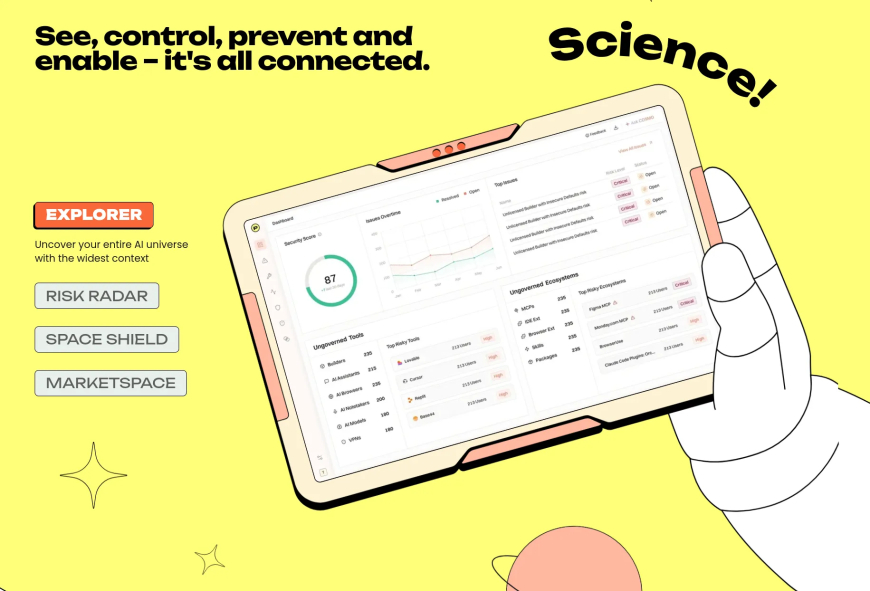
Pluto’s platform monitors AI applications, agent activity, extensions, skills and Model Context Protocol (MCP) servers. It connects with existing endpoint security and device management systems to examine activity, permissions, commands and other information needed to assess potential threats.
The software can also intervene while an AI agent is operating. If an agent attempts to obtain permissions beyond a user’s instructions, Pluto says its system can block the action or prompt the agent to request additional authorisation.
Other cybersecurity companies are addressing related challenges. Zenity provides enterprise AI agent security and governance, while LayerX focuses on monitoring and controlling risks involving AI development tools, plugins and agent activity.
Plutonium Provides Free AI Security Checks
Pluto also operates Plutonium, a free platform that helps security professionals assess publicly available AI skills, connectors and extensions. It includes an MCP scanner and a catalogue of reviewed components.
Bahat said thousands of security professionals use Plutonium, helping the company attract potential customers and gather product feedback. Approximately 70% of Pluto’s sales pipeline now comes from inbound inquiries, although the company has not disclosed how much originates directly from the free platform.
Pluto plans to use its funding to expand product development, strengthen security research and grow its U.S. operations. The company currently employs 40 people across the United States and Israel.
What's Your Reaction?
 Like
0
Like
0
 Dislike
0
Dislike
0
 Love
0
Love
0
 Funny
0
Funny
0
 Angry
0
Angry
0
 Sad
0
Sad
0
 Wow
0
Wow
0