



































Epic Games Unveils AI-Assisted Launcher With Faster Performance and Linux Support
Epic Games previews a faster, AI-assisted launcher for Windows, macOS and Linux, with redesigned libraries, quicker startup and improved download controls.
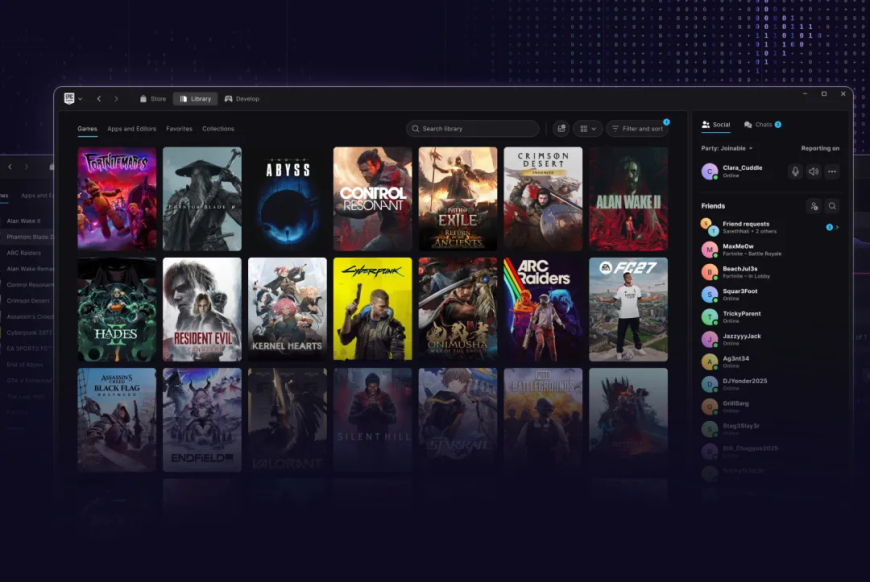
Epic Games has released a redesigned Epic Games Launcher built with extensive assistance from AI coding tools. Available in preview for Windows, macOS, and Linux, the application promises faster startup, smoother navigation, and reduced background resource use. It also represents one of the company’s most visible examples of integrating generative AI into software development.
Epic describes the new launcher as “vibe coded,” though the development process involved more human oversight than the phrase suggests. AI agents helped write and review code, reproduce existing functionality, and speed up testing, whileEpic’ss engineers supervised the work. The result is an ambitious attempt to modernise a launcher that has frequently faced criticism for sluggish performance.
AI Agents Helped Rebuild the Epic Games Launcher
Martin Keely, Epic’s vice president and general manager of the Epic Games Store and Epic Online Services, confirmed that AI played a substantial role in creating the new application. The team used coding agents to reproduce features from the existing launcher and speed up development without abandoning human oversight.
Epic has been working on the project for much of 2026. Although AI agents helped write and review code, Keely emphasised that developers remained responsible for managing the process. This approach differs from a fully automated workflow in which AI systems produce software independently, without engineering oversight.
The distinction matters because AI-generated code still requires testing, security reviews and maintenance. A games launcher handles user accounts, purchases, downloads, and software installations, so reliability is especially important. Epic’s official October 14 announcement introduces the rebuilt application as a faster, more responsive alternative to its existing software. The company is releasing it as a public preview rather than replacing the current launcher immediately.
Faster Startup and a Redesigned Interface
Performance is the central selling point. Epic says the new launcher starts faster from a closed state, responds more quickly when switching between the store and game library, and consumes fewer system resources while running in the background.
The redesigned interface also improves game discovery, download management and library organisation. Players can customise parts of the launcher, browse their collections and access integrated social features, including voice chat and connections with friends across Epic services.
However, the initial preview does not include every feature available in the existing launcher. Epic is continuing development and recommends that competitive players and developers managing active projects remain on the current version for now.
The performance improvements are encouraging, but the company’s claims require broader independent testing across different PC configurations. Faster navigation in a demo does not necessarily show how reliably the application will perform with large game libraries, ongoing downloads, or extended background operation.
Linux Support Is a Major Addition
The most consequential platform change is native Linux support. For the first time, Epic is offering an official version of its games launcher for Linux users, removing the need to rely exclusively on unofficial launchers or compatibility workarounds to access the Epic Games Store.
That doesn’t mean every game in Epic’s catalogue will run natively on Linux. Windows-only games may still require compatibility software, while titles using unsupported anti-cheat systems can remain inaccessible.
Epic is separately rebuilding Easy Anti-Cheat to address those restrictions. Its new EAC Linux v2 system will use existing operating-system security technologies, including Secure Boot, signed kernels and hardware-based integrity checks.
Fortnite will serve as the initial testing platform before the technology becomes available to other developers. Epic has confirmed plans to bring Fortnite to Linux through its launcher, but it has not announced a release date.
The move could eventually improve Linux gaming compatibility, although the new security requirements may exclude certain hardware configurations. Steam Deck support also remains unresolved because the current device does not meet every requirement of Epic’s proposed anti-cheat system.
Epic’s Wider Shift Toward AI Development
The launcher arrives as Epic accelerates its adoption of generative AI across the company. CEO Tim Sweeney has described a broader effort to reorganise development resources around AI-assisted workflows, aiming to improve productivity and help teams produce more content.
The new launcher provides a concrete example of that strategy. Rather than introducing an AI feature for players, Epic is using the technology behind the scenes to change how it develops its software.
Whether that approach delivers sustainable benefits remains uncertain. AI coding agents can help automate repetitive programming tasks, but their output still requires technical review. Development speed matters only if the resulting software remains secure, stable, and maintainable.
What Comes Next for the Epic Games Launcher?
Epic plans to update the preview with additional features, optimisations, and fixes based on user feedback. The company has not announced when the redesigned launcher will completely replace its predecessor.
For PC gamers, the most immediate benefits are a lighter interface and potentially faster access to their libraries. For Linux users, an officially supported launcher is a bigger change, even though individual game compatibility remains a separate challenge.
The AI-assisted development process is notable, but the launcher’s long-term success will depend on its reliability, not how it was built. Epic has made an important start by addressing performance complaints and expanding platform support. The next challenge is delivering a complete application that consistently performs better than the one it replaces.
What's Your Reaction?
 Like
0
Like
0
 Dislike
0
Dislike
0
 Love
0
Love
0
 Funny
0
Funny
0
 Angry
0
Angry
0
 Sad
0
Sad
0
 Wow
0
Wow
0